Maharashtra State Board 11th Maths Solutions Chapter 9 Probability Miscellaneous Exercise 9
(I) Select the correct answer from the given four alternatives.
Solution & Step-by-Step Answer:
(D) Hint: There are 5 girls and 2 boys. They can be arranged among themselves in = 7! ways. ∴ Girls can be arranged among themselves in = 5! ways. No two boys should sit together. Let girls be denoted by the letter G. – G – G – G – G – G – There are 6 places, marked by ‘-’ where boys can sit. ∴ Boys can be arranged in = = 30 ways. ∴ Required probability =
Solution & Step-by-Step Answer:
(A)
Solution & Step-by-Step Answer:
(A) Hint: Two dice are thrown. ∴ n(S) = 36 Getting two numbers whose product is even, i.e., one of the two numbers must be even. Let event A: Getting even number on first dice, event B: Getting even number on second dice. n(A) = 18, n(B) = 18, n(A ∩ B) = 9 Required probability = P(A ∩ B) = = =
Solution & Step-by-Step Answer:
(D) Hint: 17 white + 13 black = 30 shirts 4 white and 5 black are ‘PARTY WEAR’ A: Choosing a black shirt ∴ P(A) = B: Choosing a ‘PARTY WEAR’ shirt. ∴ P(B) = There are 5 black ‘PARTY WEAR’ shirts. ∴ P(A ∩ B) = ∴ Required probability P(A ∪ B) = P(A) + P(B) – P(A ∩ B) = + – =
Solution & Step-by-Step Answer:
(B) Hint: Let event S1: First shelve is selected, event S2: Second shelve is selected, event P: Drawing a physics book. ∴ P(S1) = and P(S2) = First shelve has 5 physics and 3 biology books, i.e., total 8 books. ∴ P(P/S1) = Similarly, P(P/S2) = ∴ P(P) = P(S1). P(P/S1) + P(S2). P(P/S2) = =
Solution & Step-by-Step Answer:
(C)
Solution & Step-by-Step Answer:
The probability of the guessed answer being correct is . Given that the student has answered the question correctly, the probability that the student knows the correct answer is (A) (B) (C) (D) Answer: (D) Hint: Let event A: Student knows the correct answer, event A’: Student guesses the answer, event B: Answer is correct. ∴ P(A) = , P(A’) = , P(B/A’) = Clearly, P(B/A) = 1 Required probability = P(A/B) = = =
Solution & Step-by-Step Answer:
(D)
Solution & Step-by-Step Answer:
(C) 1 : 2 Hint: A fair dice is tossed twice. ∴ n(S) = 36 A: Getting 4, 5, or 6 on the first toss and Getting 1, 2, 3, or 4 on the second toss. ∴ A = {(4, 1), (4, 2), (4, 3), (4, 4), (5, 1), (5, 2), (5, 3), (5, 4), (6, 1), (6, 2), (6, 3), (6, 4)} ∴ P(A) = ∴ Required answer = P(A) : P(A’) = 1 : 2
Solution & Step-by-Step Answer:
(B)
(II) Solve the following.
Solution & Step-by-Step Answer:
The letters of the word EQUATION can be arranged in 8! ways. ∴ n(S) = 8! There are 5 vowels and 3 consonants. (i) A: all vowels are together we need to arrange (E, U, A, I, O), Q, T, N Let us consider all vowels as one unit. So, there are 4 units, which can be arranged in 4! ways. Also, 5 vowels can be arranged among themselves in 5! ways. ∴ n(A) = 4! × 5! Required probability = P(A) = = =
(ii) B: arrangement start with a vowel and ends with a consonant.
First and last places can be filled in 5 and 3 ways respectively.
Remaining 6 letters are arranged in 6! Ways.
∴ n(B) = 5 × 3 × 6!
Required probability = P(B)
=
=
=
Solution & Step-by-Step Answer:
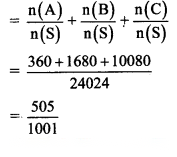
Let event A: Four positive numbers are chosen, event B: Four negative numbers are chosen, event C: Two positive and two negative numbers are chosen. Since four numbers are chosen without replacement, n(A) = 6 × 5 × 4 × 3 = 360 n(B) = 8 × 7 × 6 × 5 = 1680 In event C, four numbers are to be chosen without replacement such that two numbers are positive and two numbers ate negative. This can be done in following ways: + + – – OR + – + – OR + – – + OR – + – + OR – – + + OR – + + – ∴ n(C) = 6 × 5 × 8 × 7 + 6 × 8 × 5 × 7 + 6 × 8 × 7 × 5 + 8 × 6 × 7 × 5 + 6 × 5 × 8 × 7 + 8 × 6 × 5 × 7 = 6 × (8 × 7 × 6 × 5) =10080 Here, total number of numbers = 14 ∴ n(S) = 14 × 13 × 12 × 11 = 24024 Since A, B, C are mutually exclusive events, Required probability = P(A) + P(B) + P(C)
Solution & Step-by-Step Answer:
S = {1, 2,…., 10} ∴ n(S) = 10 A: Number is more than 3. A = {4, 5, 6, 7, 8, 9, 10} ∴ n(A) = 7 ∴ P(A) = B: Number is even. B = {2, 4, 6, 8, 10} ∴ A ∩ B = {4, 6, 8, 10} ∴ n(A ∩ B) = 4 ∴ P(A ∩ B) = Required probability = P(B/A) = = =
Solution & Step-by-Step Answer:
Since A and B are independent events, P(A ∩ B) = P(A). P(B) ∴ P(A). P(B) = ……(i) B and C are independent events. ∴ P(B ∩ C) = P(B). P(C) ∴ P(B). P(C) = ……(ii) A and C are independent events. ∴ P(A ∩ C) = P(A). P(C) ∴ P(A). P(C) = ……(iii) Dividing (i) by (ii), we get P(A) = P(C) ……(iv) Substituting equation (iv) in (iii), we get P(C). P(C) = [P(C)]2 = ∴ P(C) = Substituting P(C) = in equation (ii), we get P(B) = 1 Substituting P(B) = 1 in equation (i), we get P(A) =
Solution & Step-by-Step Answer:
There are 11 letters in the word ‘REGULATIONS’ which can be arranged among themselves in 11! ways. ∴ n(S) = 11! Let event A: There will be exactly 4 letters between R and E. R, E can occur at (1, 6), (2, 7), ….,(6, 11) positions. So, there are 6 possibilities. Also, R and E can interchange their positions. So, R, E can be arranged in 2 × 6 = 12 ways. Remaining 9 letters can be arranged in 9! ways. ∴ n(A) = 12 × 9! ∴ P(A) =
Solution & Step-by-Step Answer:
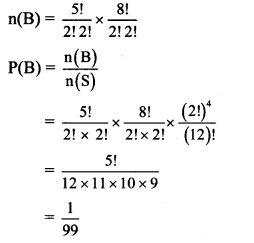
The word ‘ARRANGEMENTS’ has 12 letters in which 2A, 2E, 2N, 2R, G, M, T, S are there. n(S) = Total number of arrangements = (i) A: Arrangement chosen at random begins with the letters EE. If the first and second places are filled with EE, there are 10 letters left in which 2A, 2N, 2R, G, M, T, S are there. ∴ n(A) =
(ii) B: Consonants (G, M, T, S, 2N, 2R) are together.
2A, 2E, and the group containing consonants form total 5 units. Which can be arranged in ways.
Also, 8 consonants can be arranged among themselves in ways.
Solution & Step-by-Step Answer:
Word ASSISTANT has 2A, I, N, 3S, 2T, and word STATISTICS has A, C, 2I, 3S, 3T. C and N are uncommon letters. In the words ASSISTANT, there are 9 letters out of which 2 letters are ‘A’, and in the word STATISTICS, there are 10 letters, out of which 1 letter is A. ∴ Probability of choosing A from both the letters = Similarly, Probability of choosing I from both the letters = Probability of choosing S from both the letters = Probability of choosing T from both the letters = Required probability = =
Solution & Step-by-Step Answer:
According to the given condition, the probability of the face with 1, 2, 3, 4, 5, 6 dots turning up is proportional to 1, 2, 3, 4, 5, 6. Let k be the common ration of proportionality. ∴ The probabilities of the faces with 1, 2, 3, 4, 5, 6 dots turning up are 1k, 2k, 3k, 4k, 5k, 6k respectively. Since sum of the probabilities = 1, k(1 + 2+ ….. + 6) = 1 k() = 1 k = Required probability = P(1) + P(3) + P(5) = = =
Solution & Step-by-Step Answer:
A: Event of drawing a red ball and placing a green ball in the urn B: Event of drawing a green ball and placing a red ball C: Event of drawing a red ball in the second draw P(A) = P(B) = P(C/A) = P(C/B) = Required probability P(C) = P(A) P(C/A) + P(B) P(C/B) = =
Solution & Step-by-Step Answer:
The odds against A solving the problems are 4 : 3. Let P(A’) = P(A does not solve the problem) = So, the probability that A solves the problem = P(A) = 1 – P(A’) = 1 – = Similarly, let P(B) = P(B solves the problem) Since odds in favour of B solving the problem are 7 : 5. ∴ P(B) = Required probability P(A ∪ B) = P(A) + P(B) – P(A ∩ B) Since A and B are independent events. ∴ P(A ∩ B) = P(A). P(B) ∴ Required probability = P(A) + P(B) – P(A). P(B) = =
Solution & Step-by-Step Answer:
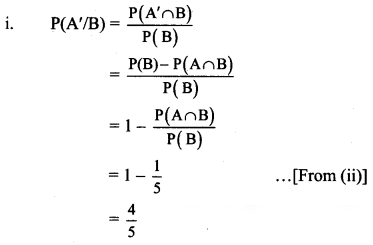
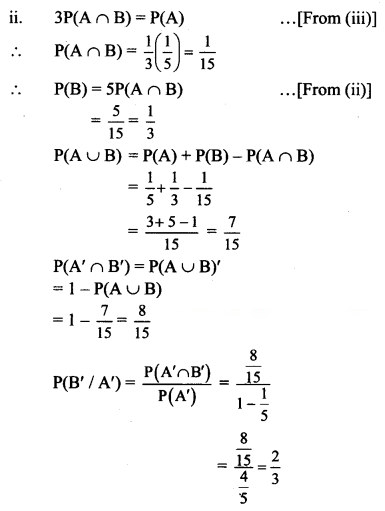
Since P(A) = P(A/B) = P(A) = and ∴ P(A) = ……(i) P(B) = 5 P(A ∩ B) ……..(ii) Since P(B/A) = ∴ P(A) = 3 P(A ∩ B) ………(iii)
Solution & Step-by-Step Answer:
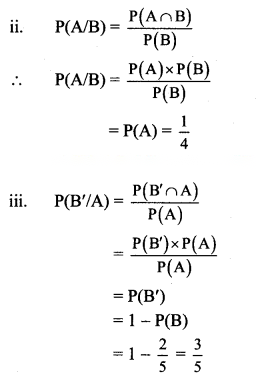
A and B are independent events.. ∴ P(A ∩ B) = P(A) × P(B) (i) P(A ∪ B) = P(A) + P(B) – P(A ∩ B) ∴ P(A ∪ B) = P(A) + P(B) – P(A) × P(B) ∴ 2P(B) – P(A) = P(A) + P(B) – P(A) × P(B) ……[∵ P(A ∪ B) = 2P(B) – P(A)] ∴ 2P(B) – = + P(B) – × P(B) ∴ 2P(B) – P(B) + P(B) = +
Solution & Step-by-Step Answer:
A leap year comes after 3 years. ∴ The probability of a year being a leap year = ∴ Probability of a year being a non-leap year = 1 – = In a non-leap year, there are 52 weeks and one extra day, whereas a leap year has 52 weeks and 2 extra days. ∴ 53rd Wednesday’s chance in a non-leap year = Two extra days of a leap year can be (Mon, Tue), (Tue, Wed), (Wed, Thu), (Thu, Fri), (Fri, Sat), (Sat, Sun), (Sun, Mon) ∴ There are 2 possibilities of 53rd Wednesday in a leap year. ∴ 53rd Wednesday’s chance in a leap year = Required probability = P(a non-leap year and Wednesday) + P(a leap year and Wednesday) = =
Solution & Step-by-Step Answer:
Let event P: P become principal, event Q: Q become principal, event R: R become principal, event E: Subject IT is introduced. Given, P(P) = P(Q) = P(R) = P(E/P) = P(E/Q) = P(E/R) = (a) Required probability P(E) = P(P) P(E/P) + P(Q) P(E/Q) + P(R) P(E/R) = = = =
(b) Required probability = P(Q/E)
By Bayes’ theorem,
P(Q/E) =
=
=
Solution & Step-by-Step Answer:
Number of fuses = 5 + 2 = 7 Testing two fuses one-by-one at random, without replacement from 7 can be done in ways. ∴ n(S) = = 7 × 6 = 42 Let event A: Getting defective fuses in the first two tests without replacement. There are two defective fuses. ∴ n(A) = = 2 × 1 = 2 ∴ P(A) =
Solution & Step-by-Step Answer:
Let P(A) = x, P(B) = y, P(C) = z Since A, B are disjoint, A ∩ B = Φ and A ∩ B ∩ C = Φ ∴ P(A ∩ B) = 0, P(A ∩ B ∩ C) = 0 ……(i) Since A and C are independent, P(A ∩ C) = P(A) P(C) = xz Since B and C are independent, P(B ∩ C) = P(B) P(C) = yz P(A ∪ C) = P(A) + P(C) – P(A ∩ C) ∴ = x + z – xz ……..(ii) P(B ∪ C) = P(B) + P(C) – P(B ∩ C) ∴ = y + z – yz ………(iii) P(A ∪ B ∪ C) = P(A) + P(B) + P(C) – P(A ∩ B) – P(B ∩ C) – P(C ∩ A) + P(A ∩ B ∩ C) = x + y + z – 0 – yz – zx + 0 …… [From(i)] = (x + z – xz) + (y + z – yz) – z = – z ……. [From (ii) and (iii)]

Solution & Step-by-Step Answer:
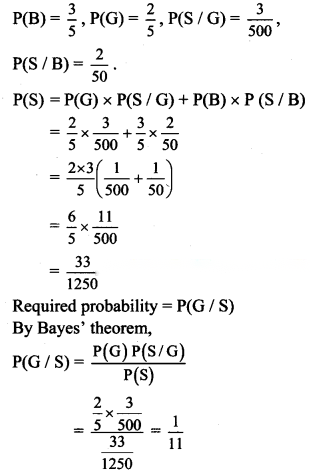
Let event S: The student is a good singer, event B: The student is a boy, event G: The student is a girl. Since the ratio of boys to girls is 3 : 2 and 3 girls out of 500 and 2 boys out of 50 are good singers.
Solution & Step-by-Step Answer:
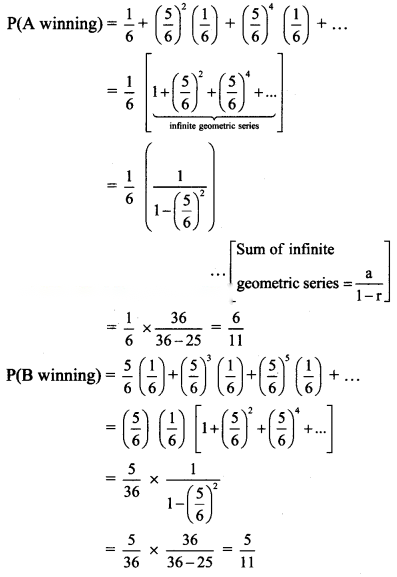
Since P(getting 3) = , P(not getting 3) = 1 – = In 1st throw if A gets 3, A wins ∴ P(A win) = In 2nd throw by B (i.e., A does not get 3), ∴ P(B wins) = In 3rd throw by A, P(A wins) = (3rd throw by A shows that B has lost in 2nd throw) and so on.
Solution & Step-by-Step Answer:
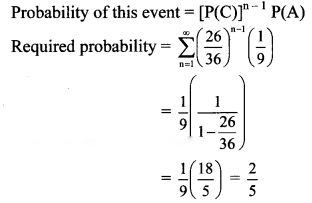
When two dice are thrown, the sample space is S = {(1, 1), (1, 2), (1, 3), (1, 4), (1, 5), (1, 6), (2, 1), (2, 2), (2, 3), (2, 4), (2, 5), (2, 6), (3, 1), (3, 2), (3, 3), (3, 4), (3, 5), (3, 6), (4, 1), (4, 2), (4, 3), (4, 4), (4, 5), (4, 6), (5, 1), (5, 2), (5, 3), (5, 4), (5, 5), (5, 6), (6, 1), (6, 2), (6, 3), (6, 4), (6, 5), (6, 6)} ∴ n(S) = 36 Let event A: The sum is 5 in a trial. A = {(2, 3), (3, 2), (1, 4), (4, 1)} ∴ P(A) = Let event B: The sum is 7 in a trial. B = {(2, 5), (5, 2), (3, 4), (4, 3), (1, 6), (6, 1)} ∴ P(B) = Let event C: Neither sum is 5 nor 7. P(C) = 1 – P(A) – P(B) = 1 – – = Let the sum of 5 appear in the nth trial for the first time and the sum of 7 has not occurred in the first (n – 1) trials.
Solution & Step-by-Step Answer:
Let event G: The event that machine produces a good part, event S: The event that machine produces a slightly defective part, event D: The event that machine produces an obviously defective part.

Solution & Step-by-Step Answer:
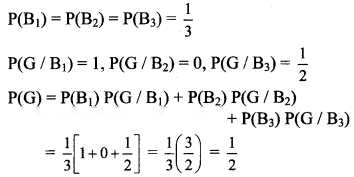
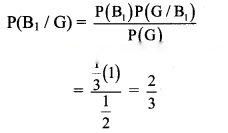
Let event B1: Select box I having two gold coins. event B2: Selecting box II having two silver coins, event B3: Selecting box III having one silver and one gold coin, event G: Coin is gold. To find the probability that the other can in the box is also gold. Which is possible only when it is drawn from the box I. ∴ Required probability = P(B1/G) By Bayes’ theorem,
Solution & Step-by-Step Answer:
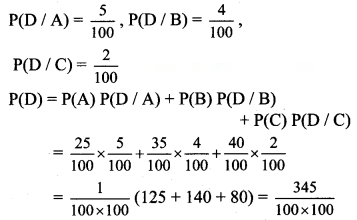
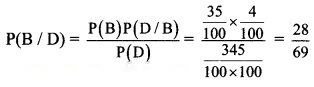
Let event A: Bulb manufactured by machine A event B: Bulb manufactured by machine B event C: Bulb manufactured by machine C event D: Bulb defective ∴ P(A) = P(B) = P(C) = Machines A, B and C manufacture respectively 25%, 35% and 40% of the bulbs. Of their outputs, 5, 4, and 2 percent are respectively defective bulbs. Required probability = P(B/D) By Bayes’ theorem,
Solution & Step-by-Step Answer:
A family has two children. ∴ Sample space S = {BB, BG, GB, GG} (i) A: First child is a girl. ∴ A = {GB, GG} ∴ P(A) = B: Second child is a girl. ∴ B = {BG, GG} ∴ A ∩ B = {GG} ∴ P(A ∩ B) = Required probability P(B/A) =
(ii) A: At least one of the children is a girl.
∴ A = {GG, GB, BG}
∴ P(A) =
B: both children are girls.
B = {GG}
∴ P(B) =
Also, A ∩ B = B
