Maharashtra State Board 11th Maths Solutions Chapter 8 Continuity Miscellaneous Exercise 8
(I) Select the correct answer from the given alternatives.
Solution & Step-by-Step Answer:
(A) f is continuous at x = Hint:
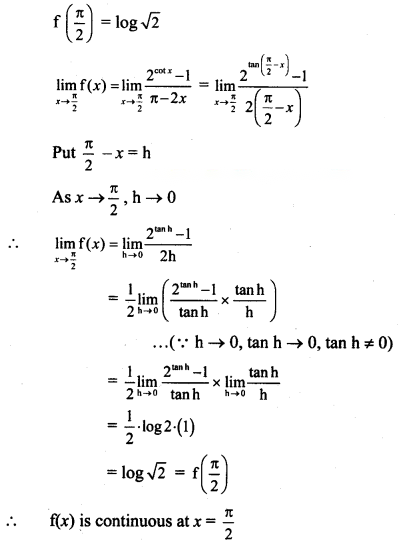
Solution & Step-by-Step Answer:
(D) Hint:

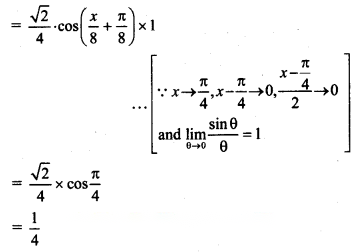
Solution & Step-by-Step Answer:
(D) Hint:

Solution & Step-by-Step Answer:
(B) f is discontinuous at x = -4 Hint: f(x) = , for x ∈ [-6, -3] = Here f(x) is a rational function and is continuous everywhere except at the points Where denominator becomes zero. Here, denominator becomes zero when x = -4 or x = 2 But x = 2 does not lie in the given interval. ∴ x = -4 is the point of discontinuity.
Solution & Step-by-Step Answer:
(A) a = , b = 3 Hint: f(x) = ax2 + bx + 1, |x – 1| ≥ 3 = 4x + 5; -2 < x < 4 The first interval is |x – 1| ≥ 3 ∴ x – 1 ≥ 3 or x – 1 ≤ -3 ∴ x ≥ 4 or x ≤ -2 ∴ f(x) is same for x ≤ -2 as well as x ≥ 4. ∴ f(x) is defined as: f(x) = ax2 + bx + 1; x ≤ -2 = 4x + 5; -2 < x < 4 = ax2 + bx + 1; x ≥ 4 f(x) is continuous everywhere. ∴ f(x) is continuous at x = -2 and x = 4. As f(x) is continuous at x = -2, ∴ ∴ a(-2)2 + b(-2) + 1 = 4(-2) + 5 ∴ 4a – 2b + 1 = -3 ∴ 4a – 2b = -4 ∴ 2a – b = -2 …..(i) ∵ f(x) is continuous at x = 4, ∴ 4(4) + 5 = a(4)2 + b(4) + 1 16a + 4b + 1 = 21 16a + 4b = 20 4a + b = 5 …..(ii) Adding (i) and (ii), we get 6a = 3 ∴ a = Substituting a = in (ii), we get 4() + b = 5 ∴ 2 + b = 5 ∴ b = 3 ∴ a = , b = 3
Solution & Step-by-Step Answer:
(B) Hint:
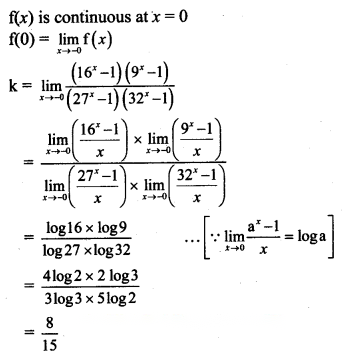
Solution & Step-by-Step Answer:
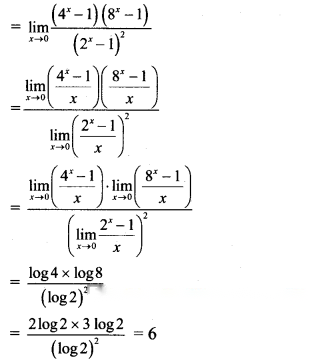
(A) 6 Hint:
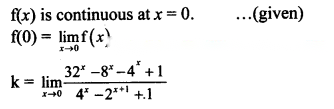
Solution & Step-by-Step Answer:
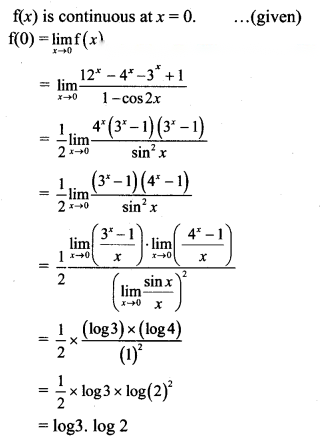
(B) log 2. log 3 Hint:
Solution & Step-by-Step Answer:
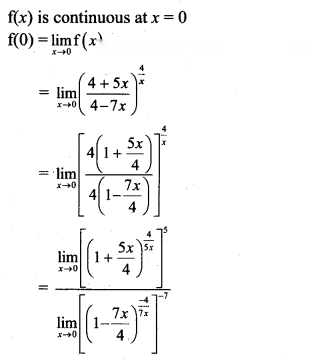
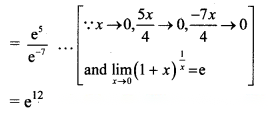
(C) e12 Hint:
Solution & Step-by-Step Answer:
(C) x = 0, 1 Hint: f(x) = , x ∈ (-1, 2) This function is discontinuous at all integer values of x between -1 and 2. ∴ f(x) is discontinuous at x = 0 and x = 1.
II. Discuss the continuity of the following functions at the point(s) or on the interval indicated against them.
Solution & Step-by-Step Answer:
Solution & Step-by-Step Answer:
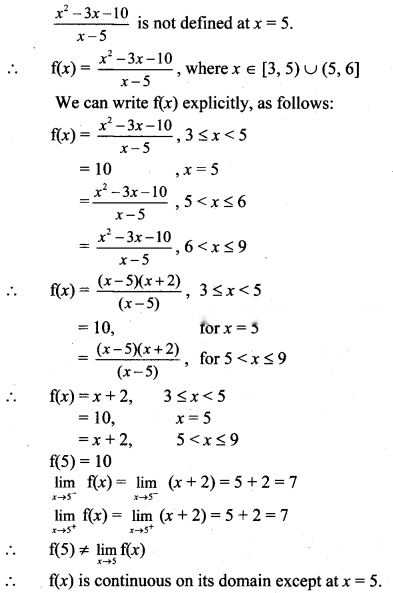
The domain of f(x) is [0, 7]. (i) For 0 ≤ x ≤ 2 f(x) = 2x2 – 2x + 5 It is a polynomial function and is Continuous at all point in [0, 2).
(ii) For 2 < x < 4
f(x) =
It is a rational function and is continuous everwhere except at points where its denominator becomes zero.
Denominator becomes zero at x = 1
But x = 1 does not lie in the interval.
f(x) is continuous at all points in (2, 4).
(iii) For 4 ≤ x ≤ 7, x ≤ 5
f(x) =
It is a rational function and is continuous everywhere except at points where its denominator becomes zero.
Denominator becomes zero at x = 5
But x = 5 does not lie in the interval.
∴ f(x) is continuous at all points in (4, 7] – {5}.
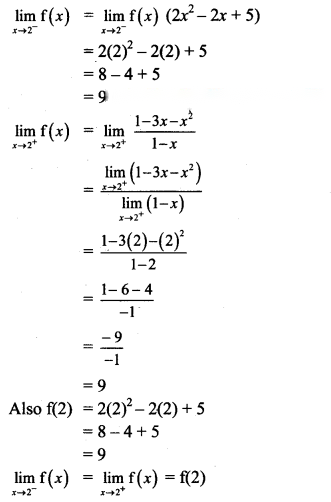
(iv) For continuity at x = 2:
∴ f(x) is continuous at x = 2.
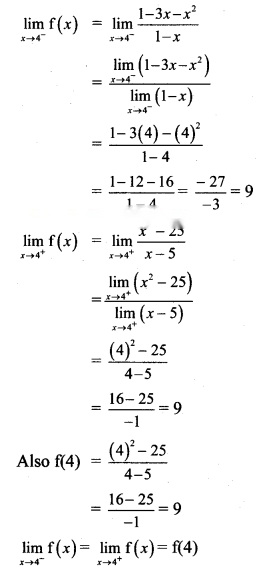
(v) For continuity at x = 4:
∴ f(x) is continuous at x = 4.
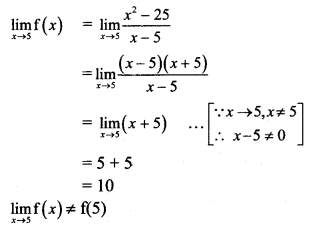
(vi) For continuity at x = 5.
f(5) = 7
∴ f(x) is discontinuous at x = 5.
Thus, f(x) is continuous at all points on its domain except at x = 5.
Solution & Step-by-Step Answer:
The domain of f(x) is [, ] (i) For [, ] – {0}: f(x) = It is a rational function and is continuous everywhere except at points where its denominator becomes zero. Denominator becomes zero when cos x = 1, i.e., x = 0 But x = 0 does not lie in the interval. ∴ f(x) is continuous at all points in [, ] – {0}
(ii) For continuity at x = 0:
∴
∴ f(x) is discontinuous at x = 0.
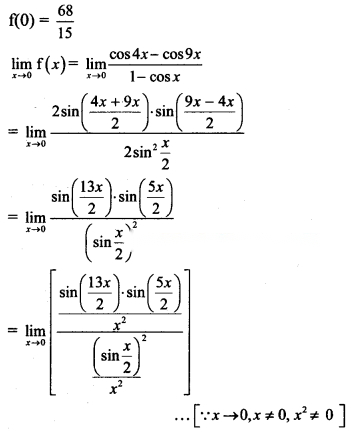
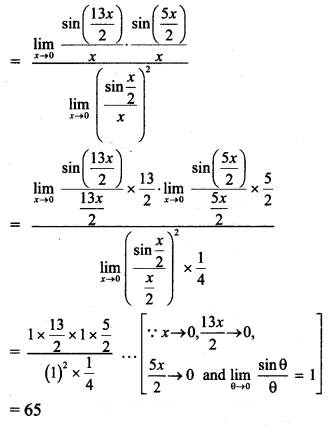
Solution & Step-by-Step Answer:
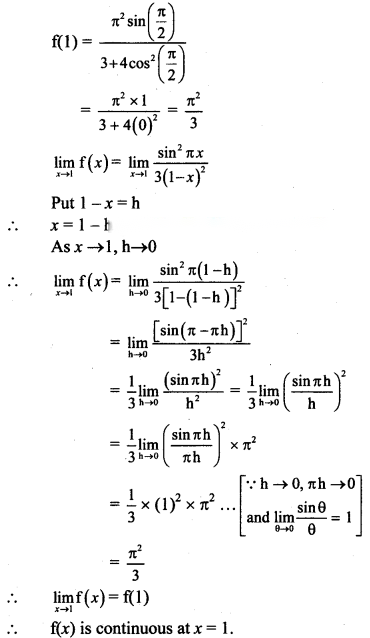
Solution & Step-by-Step Answer:
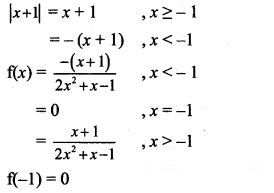
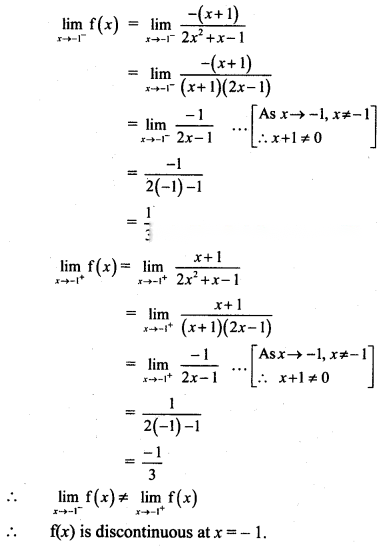
Solution & Step-by-Step Answer:
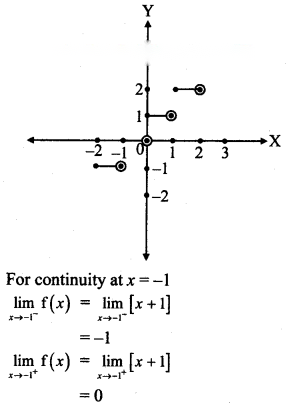
f(x) = [x + 1], x ∈ [-2, 2) ∴ f(x) = -1, x ∈ [-2, -1) = 0, x ∈ [-1, 0) = 1, x ∈ [0, 1) = 2, x ∈ [1, 2) ∴ ∴ f(x) is discontinuous at x = -1. Similarly, f(x) is discontinuous at the points x = 0 and x = 1.
Solution & Step-by-Step Answer:
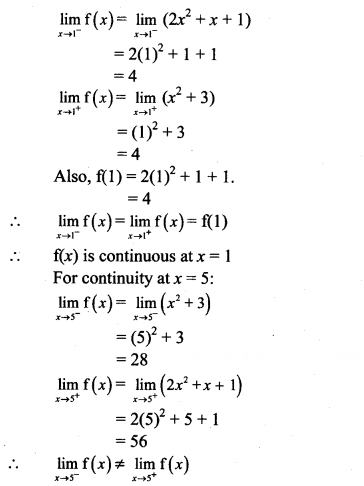
|x – 3| ≥ 2 ∴ x – 3 ≥ 2 or x – 3 ≤ -2 ∴ x ≥ 5 or x ≤ 1 ∴ f(x) = 2x2 + x + 1, x ≤ 1 = x2 + 3, 1 < x < 5 = 2x2 + x + 1, x ≥ 5 Consider the intervals x < 1, i.e., (-∞, 1) 1 < x < 5, i.e., (1, 5) x > 5, i.e., (5, ∞) In all these intervals, f(x) is a polynomial function and hence is continuous at all points. For continuity at x = 1: ∴ f(x) is discontinuous at x = 5. ∴ f(x) is continuous for all x ∈ R, except at x = 5.
III. Identify discontinuities if any for the following functions as either a jump or a removable discontinuity on their respective domains.
Solution & Step-by-Step Answer:
f(-2) has not been defined. = (-2)2 + (-2) – 3 = 4 – 2 – 3 = -1 = (-2)2 – 5 = 4 – 5 = -1 ∴ ∴ But f(-2) has not been defined. ∴ f(x) has a removable discontinuity at x = -2.
Solution & Step-by-Step Answer:
= (3)2 + 5(3) + 1 = 9 + 15 + 1 = 25 = (3)3 + 3 + 5 = 27 + 3 + 5 = 35 ∴ ∴ does not exist. ∴ f(x) is discontinuous at x = 3. ∴ f(x) has a jump discontinuity at x = 3.
Solution & Step-by-Step Answer:
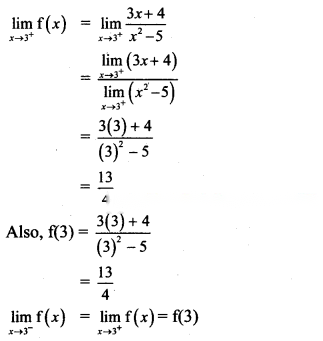
∴ f(x) is continuous at x = 3.

IV. Discuss the continuity of the following functions at the point or on the interval indicated against them. If the function is discontinuous, identify the type of discontinuity and state whether the discontinuity is removable. If it has a removable discontinuity, redefine the function so that it becomes continuous.
Solution & Step-by-Step Answer:
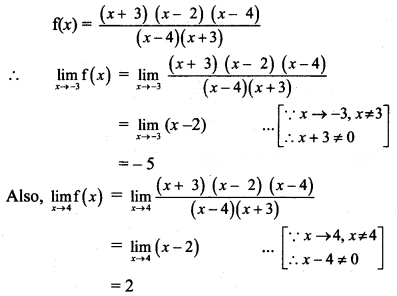
f(x) = = ∴ f(x) is not defined at x = 4 and x = -3. ∴ The domain of function f = R – {-3, 4}. For x ≠ -3 and 4, f(x) is discontinuous at x = 4 and x = -3. This discontinuity is removable. ∴ f(x) can be redefined as f(x) = , for x ≠ 4, x ≠ -3 = -5, for x ∈ R – {-3, 4}, x = -3 = 2, for x ∈ R – {-3, 4}, x = 4
Solution & Step-by-Step Answer:
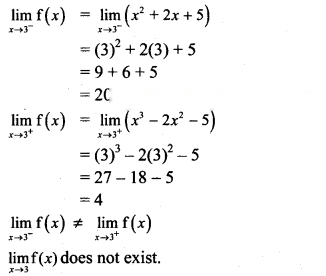
∴ f(x) is discontinuous at x = 3. This discontinuity is irremovable.
V. Find k if the following functions are continuous at the points indicated against them.
Solution & Step-by-Step Answer:
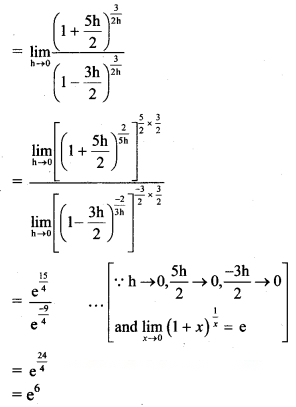
f(x) is continuous at x = 2. …..(given)

Solution & Step-by-Step Answer:
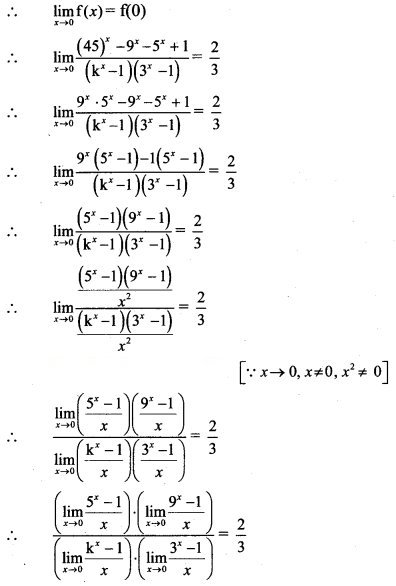
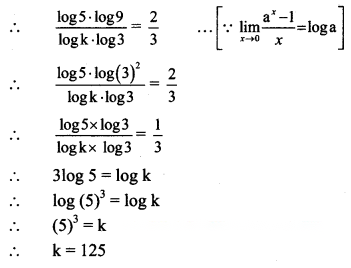
f(x) is continuous at x = 0 …..(given)
VI. Find a and b if the following functions are continuous at the points or on the interval indicated against them.
Solution & Step-by-Step Answer:
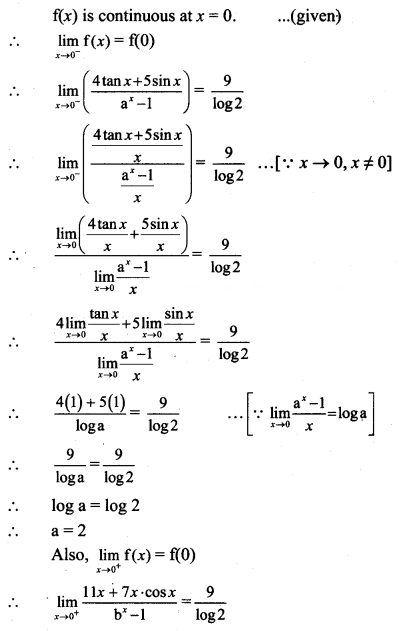
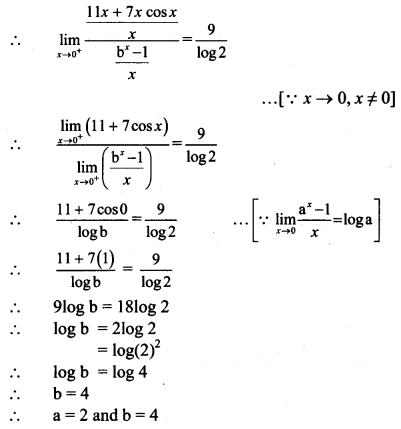
Solution & Step-by-Step Answer:
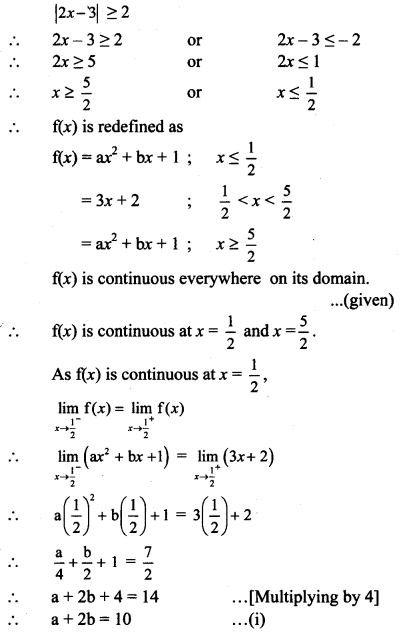
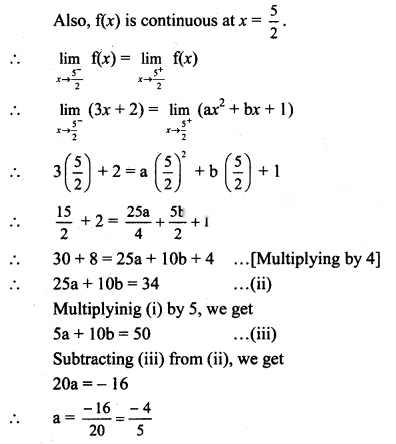
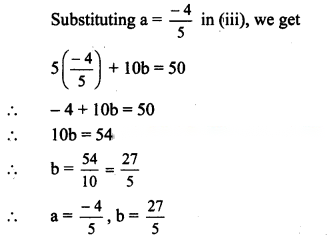
VII. Find f(a), if f is continuous at x = a where,
Solution & Step-by-Step Answer:
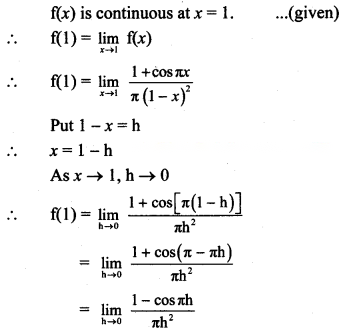
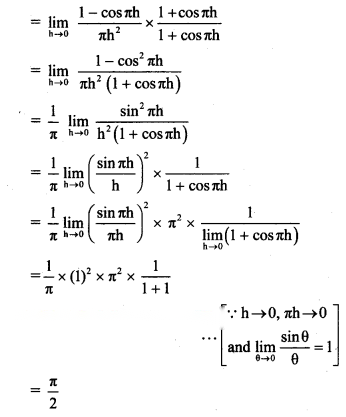
Solution & Step-by-Step Answer:
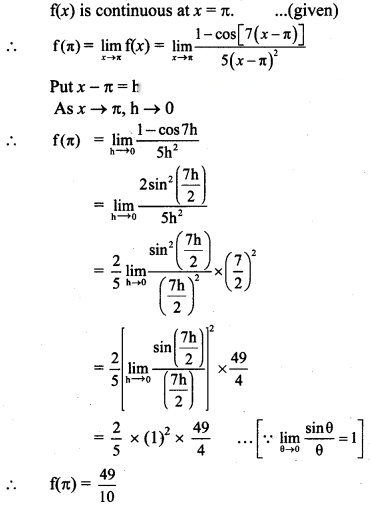
VIII. Solve using intermediate value theorem.
Solution & Step-by-Step Answer:
Let f(x) = 5x – 6x 5x and 6x are continuous functions for all x ∈ R. ∴ 5x – 6x is also continuous for all x ∈ R. i.e., f(x) is continuous for all x ∈ R. A root of f(x) exists, if f(x) = 0 for at least one value of x. f(1) = 51 – 6(1) = -1 < 0 f(2) = (5)2 – 6(2) = 13 > 0 ∴ f(1) < 0 and f(2) > 0 ∴ By intermediate value theorem, there has to be a point ‘c’ between 1 and 2 such that f(c) = 0. ∴ There is a root of the given equation in [1, 2].
Solution & Step-by-Step Answer:
Let f(x) = x3 – 5x2 + 3x + 6 f(x) is a polynomial function and hence it is continuous for all x ∈ R. A root of f(x) exists, if f(x) = 0 for at least one value of x. Here, we have been asked to show that f(x) has at least two roots between x = 1 and x = 5. f(1) = (1)3 – 5(1)2 + 3(1) + 6 = 5 > 0 f(2) = (2)3 – 5(2)2 + 3(2) + 6 = 8 – 20 + 6 + 6 = 0 ∴ x = 2 is a root of f(x). Also, f(3) = (3)3 – 5(3)2 + 3(3) + 6 = 27 – 45 + 9 + 6 = -3 < 0 f(4) = (4)3 – 5(4)2 + 3(4) + 6 = 64 – 80 + 12 + 6 = 2 > 0 ∴ f(3) < 0 and f(4) > 0 ∴ By intermediate value theorem, there has to be a point ‘c’ between 3 and 4 such that f(c) = 0. ∴ There are two roots, x = 2 and a root between x = 3 and x = 4. Thus, there are at least two roots of the given equation between x = 1 and x = 5.