Maharashtra State Board 11th Maths Solutions Chapter 7 Conic Sections Miscellaneous Exercise 7
(I) Select the correct option from the given alternatives.
Solution & Step-by-Step Answer:
(A) 1 Hint: y2 = 4x Compare with y2 = 4ax ∴ a = 1 Equation of tangent is y = mx + 1 Compare with y = mx + = 1 ∴ a = m = 1
Solution & Step-by-Step Answer:
(C) 8 Hint: Given equation of parabola is x2 – 4x – 8y + 12 = 0 ⇒ x2 – 4x = 8y – 12 ⇒ x2 – 4x + 4 = 8y – 12 + 4 ⇒ (x – 2)2 = 8(y – 1) Comparing this equation with (x – h)2 = 4b(y – k), we get 4b = 8 ∴ Length of latus rectum = 4b = 8
Solution & Step-by-Step Answer:
(A) x2 = -12y Hint: SP2 = PM2 ⇒ (x – 0)2 + (y + 3)2 = ⇒ x2 + y2 + 6y + 9 = y2 – 6y + 9 ⇒ x2 = -12y

Solution & Step-by-Step Answer:
(C) (2, ±4)
Solution & Step-by-Step Answer:
(A) (6, ±12)
Solution & Step-by-Step Answer:
(B) y2 = 32x Hint: Since directrix is parallel to Y-axis, The X-axis is the axis of the parabola. Let the equation of parabola be y2 = 4ax. Equation of directrix is x + 8 = 0 ∴ a = 8 ∴ required equation of parabola is y2 = 32x
Solution & Step-by-Step Answer:
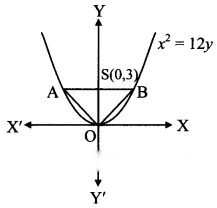
(C) 18 sq. units Hint: x2 = 12y 4b = 12 b = 3 Area of triangle = × AB × OS = × 4a × a = × 12 × 3 = 18 sq. units
Solution & Step-by-Step Answer:
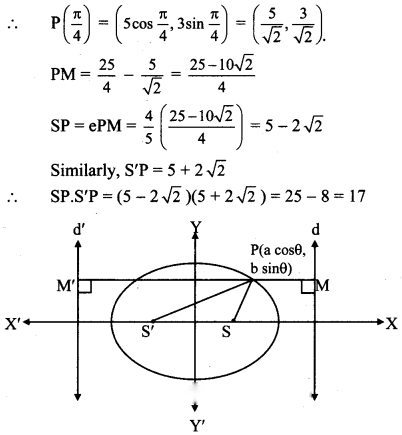
(C) 17 Hint: 9x2 + 25y2 = 225 Here, a = 5, b = 3 Eccentricity (e) = ∴ Coordinates of foci are S(4, 0) and S'(-4, 0) P(θ) = (a cos θ, b sin θ)
Solution & Step-by-Step Answer:
(B) y2 = 8x Hint: The given points lie in the 1st and 4th quadrants. ∴ Equation of the parabola is y2 = 4ax End points of latus rectum are (a, 2a) and (a, -2a) ∴ a = 2 ∴ required equation of parabola is y = 8x
Solution & Step-by-Step Answer:
(B) Hint: Length of latus rectum = 4a The given parabola passes through (3, 2) ∴ (2)2 = 4a(3) ∴ 4a =
Solution & Step-by-Step Answer:
(C)
Solution & Step-by-Step Answer:
(C) 128x2 + 144y2 = 18432
Solution & Step-by-Step Answer:
(B) x2 + 4y2 = 100
Solution & Step-by-Step Answer:
(B) ±3√21
Solution & Step-by-Step Answer:
(B) y = ±4
Solution & Step-by-Step Answer:
(C) 3y = 4x + 6√5
Solution & Step-by-Step Answer:
(B) Hint: 16x2 – 3y2 – 32x – 12y – 44 = 0 ⇒ 16(x – 1)2 – 3(y + 2)2 = 48 ⇒ Here, a2 = 3 and b2 = 16
Solution & Step-by-Step Answer:
(A) (2, 5) Hint: 9x2 + 5y2 – 36x – 50y – 164 = 0 ⇒ 9(x – 2)2 + 5(y – 5)2 = 325 ⇒ ⇒ centre of the ellipse = (2, 5)
Solution & Step-by-Step Answer:
(C) (3, 2)
Solution & Step-by-Step Answer:
(A) (±√13, 0)
II. Answer the following.
Solution & Step-by-Step Answer:
(i) Given equation of the parabola is 2y2 = 17x y2 = x Comparing this equation with y2 = 4ax, we get 4a = a = Co-ordinates of focus are S(a, 0), i.e., S(, 0) Equation of the directrix is x + a = 0 x + = 0 8x + 17 = 0 Length of latus rectum = 4a = 4() = Co-ordinates of end points of latus rectum are (a, 2a) and (a, -2a) i.e., and
(ii) Given equation of the parabola is 5x2= 24y
x2=
Comparing this equation with x2= 4by, we get
4b =
b =
Co-ordinates of focus are S(0, b), i.e., S(0, )
Equation of the directrix is y + b = 0
y + = 0
5y + 6 = 0
Length of latus rectum = 4b = 4() =
Co-ordinates of end points of latus rectum are (2b, b) and (-2b, b), i.e., and
Solution & Step-by-Step Answer:
Given equation of the parabola is y2 = 12x Comparing this equation with y2 = 4ax, we get 4a = 12 ∴ a = 3 If t is the parameter of the point P on the parabola, then P(t) = (at2, 2at) i.e., x = at2 and y = 2at …..(i) (i) Given, t = 2 Substituting a = 3 and t = 2 in (i), we get x = 3(2)2 and y = 2(3)(2) x = 12 and y = 12 ∴ The cartesian co-ordinates of the point on the parabola are (12, 12).
(ii) Given, t = -3
Substitùting a = 3 and t = -3 in (i), we get
x = 3(-3)2and y = 2(3)(-3)
∴ x = 27 and y = -18
∴ The cartesian co-ordinates of the point on the parabola are (27, -18).
Solution & Step-by-Step Answer:
Given equation of the parabola is y2 = 8x Comparing this equation with y2 = 4ax, we get 4a = 8 ∴ a = 2 Focal distance of a point = x + a Given, focal distance = 10 x + 2 = 10 ∴ x = 8 Substituting x = 8 in y2 = 8x, we get y2 = 8(8) ∴ y = ±8 ∴ The co-ordinates of the points on the parabola are (8, 8) and (8, -8).
Solution & Step-by-Step Answer:
Given equation of the parabola is y2 = 9x Comparing this equation with y2 = 4ax, we get 4a = 9 ∴ a = Equation of the tangent y2 = 4ax at (x1, y1) is yy1 = 2a(x + x1) The equation of the tangent at (4, -6) is y(-6) = 2()(x + 4) ⇒ -6y = (x + 4) ⇒ -12y = 9x + 36 ⇒ 9x + 12y + 36 = 0 ⇒ 3x + 4y + 12 = 0
Solution & Step-by-Step Answer:
Given equation of the parabola is y2 = 8x Comparing this equation with y2 = 4ax, we get 4a = 8 a = 2 t = 1 Equation of tangent with parameter t is yt = x + at2 ∴ The equation of tangent with t = 1 is y(1) = x + 2(1)2 y = x + 2 ∴ x – y + 2 = 0
Solution & Step-by-Step Answer:
Given equation of the parabola is y2 = 9x Comparing this equation with y2 = 4ax, we get 4a = 9 ∴ a = Equation of tangent to the parabola y2 = 4ax having slope m is y = mx + y = mx + But, (4, 10) lies on the tangent. 10 = 4m + ⇒ 40m = 16m2+ 9 ⇒ 16m2 – 40m + 9 = 0 ⇒ 16m2 – 36m – 4m + 9 = 0 ⇒ 4m(4m – 9) – 1(4m – 9) = 0 ⇒ (4m – 9) (4m – 1) = 0 ⇒ 4m – 9 = 0 or 4m – 1 = 0 ⇒ m = or m = These are the slopes of the required tangents. By slope point form, y – y1 = m(x – x1), the equations of the tangents are y – 10 = (x – 4) or y – 10 = (x – 4) ⇒ 4y – 40 = 9x – 36 or 4y – 40 = x – 4 ⇒ 9x – 4y + 4 = 0 or x – 4y + 36 = 0
Solution & Step-by-Step Answer:
Given the equation of the parabola is y2 = 24x. Comparing this equation with y2 = 4ax, we get 4a = 24 ⇒ a = 6 Equation of tangent to the parabola y2 = 4ax having slope m is y = mx + ⇒ y = mx + But, (-6, 9) lies on the tangent 9 = -6m + ⇒ 9m = -6m2 + 6 ⇒ 6m2 + 9m – 6 = 0 The roots m1 and m2 of this quadratic equation are the slopes of the tangents. m1m2 = -1 Tangents drawn to the parabola y2 = 24x from the point (-6, 9) are at a right angle.
Alternate method:
Comparing the given equation with y2= 4ax, we get
4a = 24
⇒ a = 6
Equation of the directrix is x = -6.
The given point lies on the directrix.
Since tangents are drawn from a point on the directrix are perpendicular,
Tangents drawn to the parabola y2= 24x from the point (-6, 9) are at the right angle.
Solution & Step-by-Step Answer:
Given the equation of the parabola is y2 = 8x. Comparing this equation with y2 = 4ax, we get 4a = 8 a = 2 Slope of the line 2x + 2y + 5 = 0 is -1 Since the tangent is parallel to the given line, slope of the tangent line is m = -1 Equation of tangent to the parabola y2 = 4ax having slope m is y = mx + Equation of the tangent is y = -x + x + y + 2 = 0 Point of contact = = = (2, -4)
Solution & Step-by-Step Answer:
Given equation of the parabola is y2 = 8x Comparing this equation with y2 = 4ax, we get 4a = 8 a = 2 Equation of tangent to given parabola with slope m is y = mx + m2x – my + 2 = 0 ….(i) Equation of the circle is x2 + y2 = 2 Its centre = (0, 0) and Radius = √2 Line (i) touches the circle. Length of perpendicular from the centre to the line (i) = radius ⇒ = √2 ⇒ = 2 ⇒ m4 + m2 – 2 – 0 ⇒ (m2 + 2)(m2 – 1) = 0 Since m2 ≠ -2, m2 – 1 = 0 ⇒ m = ±1 When m = 1, equation of the tangent is y = (1)x + y = (x + 2) …..(i) When m = -1, equation of the tangent is y = (-1)x + y = -x – 2 y = -(x + 2) …..(ii) From (i) and (ii), equation of the common tangents to the given parabola is y = ±(x + 2)
Solution & Step-by-Step Answer:
Given parabola is y2 = 8x Comparing with y2 = 4ax, we get, 4a = 8 ⇒ a = 2 Let M(t1) and N(t2) be any two points on the parabola. The equations of tangents at M and N are yt1 = x + …..(1) yt2 = x + …(2) ….[∵ a = 2] Let tangent at M meet the tangent at the vertex in P. But tangent at the vertex is Y-axis whose equation is x = 0. ⇒ to find P, put x = 0 in (1) ⇒ yt1 = ⇒ y = 2t1 …..(t1 ≠ 0 otherwise tangent at M will be x = 0) ⇒ P = (0, 2t1) Similarly, Q = (0, 2t2) It is given that PQ = 4 ∴ |2t1 – 2t2| = 4 ∴ |t1 – t2| = 2 …..(3) Let R = (x1, y1) be any point on the required locus. Then R is the point of intersection of tangents at M and N. To find R, we solve (1) and (2). Subtracting (2) from (1), we get y(t1 – t2) = y(t1 – t2) = 2(t1 – t2)(t1 + t2) ∴ y = 2(t1 + t2) …..[∵ M, N are distinct ∴ t1 ≠ t2] i.e., y1 = 2(t1 + t2) …..(4) ∴ from (1), we get 2t1(t1 + t2) = x + ∴ 2t1t2 = x i.e. x1 = 2t1t2 …..(5) To find the equation of locus of R(x1, y1), we eliminate t1 and t2 from the equations (3), (4) and (5). We know that, (t1 + t2)2 = (t1 + t2)2 + 4t1t2 ⇒ …[By (3), (4) and (5)] ⇒ = 16 + 8x1 = 8(x1 + 2) Replacing x1 by x and y1 by y, the equation of required locus is y2 = 8(x + 2).
Solution & Step-by-Step Answer:
Let P(x1, y1) be any point on the parabola y2 = 4ax. Equation of tangent to the parabola y2 = 4ax having slope m is y = mx + This tangent passes through P(x1, y1). y1 = mx1 + my1 = m2x1 + a m2x1 – my1 + a = 0 This is a quadratic equation in ‘m’. The roots m1 and m2 of this quadratic equation are the slopes of the tangents drawn from P. ∴ m1 + m2 = , m1m2 = Since (x1, y1) and a are constants, m1 – m2 is a constant. ∴ m1 – m2 = k, where k is constant.
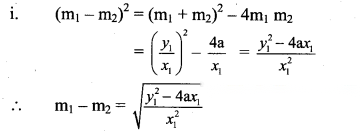
(ii) Since (x1, y1) and a are constants, m1m2is a constant.
= k, where k is a constant.
Solution & Step-by-Step Answer:
Let P(, 2at1) be a point on the parabola and S(a, 0) be the focus of parabola y2 = 4ax Since the tangent passing through point P meet Y-axis at point Q, equation of tangent at P(, 2at1) is yt1 = x + …..(i) ∴ Point Q lie on tangent ∴ put x = 0 in equation (i) yt1 = y = at1 ∴ Co-ordinate of point Q(0, at1) S = (a, 0), P(, 2at1), Q(0, at1) ∴ SP subtends a right angle at Q.


Solution & Step-by-Step Answer:
(a) Given equation of the ellipse is Comparing this equation with , we get a2 = 25 and b2 = 9 ∴ a = 5 and b = 3 Since a > b, X-axis is the major axis and Y-axis is the minor axis. (i) Length of major axis = 2a = 2(5) = 10 Length of minor axis = 2b = 2(3) = 6 ∴ Lengths of the principal axes are 10 and 6.
(ii) We know that e =
∴ e = =
Co-ordinates of the foci are S(ae, 0) and S'(-ae, 0)
i.e., S(5(), 0) and S'(-5(), 0),
i.e., S(4, 0) and S'(-4, 0)
(iii) Equations of the directrices are x = ±
i.e., x = ±
i.e., x = ±
(iv) Length of latus rectum =
(v) Distance between foci = 2ae = 2 (5) () = 8
(vi) Distance between directrices = = =
(b) Given equation of the ellipse is 16x2+ 25y2= 400
Comparing this equation with , we get
a2= 25 and b2= 16
∴ a = 5 and b = 4
Since a > b,
X-axis is the major axis and Y-axis is the minor axis
(i) Length of major axis = 2a = 2(5) = 10
Length of minor axis = 2b = 2(4) = 8
Lengths of the principal axes are 10 and 8.
(ii) b2= a2(1 – e2)
16 = 25(1 – e2)
= 1 – e2
e2= 1 –
e2=
e = ……[∵ 0 < e < 1]
Co-ordinates of the foci are S(ae, 0) and S'(-ae, 0),
i.e., S(5(), 0) and S'(-5(), 0),
i.e., S(3, 0) and S'(-3, 0)
(iii) Equations of the directrices are x = ±
i.e., x = ±
i.e., x = ±
(iv) Length of latus rectum =
(v) Distance between foci = 2ae = 2(5)() = 6
(vi) Distance between directrices =
(c) Given equation of the hyperbola
Comparing this equation with
a2= 144 and b2= 25
∵ a = 12 and b = 5
(i) Length of transverse axis = 2a = 2(12) = 24
Length of conjugate axis = 2b = 2(5) = 10
lengths of the principal axes are 24 and 10.
(ii) b2= a2(e2– 1)
25 = 144 (e2– 1)
= e2– 1
e2= 1 +
e2=
e = …….[∵ e > 1]
Co-ordinates of foci are S(ae, 0) and S'(-ae, 0)
i.e., S(12(), 0) and S'(-12(), 0)
i.e., S(13, 0) and S'(-13, 0)
(iii) Equations of the directrices are x =
i.e., x =
i.e., x =
(iv) Length of latus rectum = =
(v) Distance between foci = 2ae = 2(12)() = 26
(vi) Distance between directrices = =
(d) Given equation of the hyperbola is x2– y2= 16
∴
Comparing this equation with , we get
a2= 16 and b2= 16
∴ a = 4 and b = 4
(i) Length of transverse axis = 2a = 2(4) = 8
Length of conjugate axis = 2b = 2(4) = 8
(ii) We know that
Co-ordinates of foci are S(ae, 0) and S'(-ae, 0),
i.e., S(4√2, 0) and S'(-4√2, 0)

(iii) Equations of the directrices are x = ±
∴x = ±
∴ x = ±2√2
(iv) Length of latus rectum = = = 8
(v) Distance between foci = 2ae = 2(4)(√2) = 8√2
(vi) Distance between directrices = = = 4√2.
Solution & Step-by-Step Answer:
(i) Let the required equation of ellipse be , where a > b. Given, eccentricity (e) = Distance between foci = 2ae Given, distance between foci = 6 ∴ 2ae = 6 ∴ 2a() = 6 ∴ = 6 ∴ a = 8 ∴ a2 = 64 Now, b2 = a2 (1 – e2) = = = 64() = 55 ∴ The required equation of the ellipse is
(ii) Let the equation of the ellipse be
……(1)
Then length of major axis = 2a = 10
∴ a = 5
Also, distance between foci= 2ae = 8
∴ 2 × 5 × e = 8
∴ e =
∴ b2= a2(1 – e2)
= 25(1 – )
= 9
∴ from (1), the equation of the required ellipse is
(iii) Let the required equation of ellipse be , where a > b.
The ellipse passes through the points (-3, 1) and (2, -2).
∴ Substituting x = -3 and y = 1 in equation of ellipse, we get
∴ …..(i)
Substituting x = 2 and y = -2 in equation of ellipse, we get
∴ ……(ii)
Let = A and = B
∴ Equations (i) and (ii) become
9A + B = 1..…(iii)
4A + 4B = 1 …..(iv)
Multiplying (iii) by 4, we get
36A + 4B = 4 …..(v)
Subtracting (iv) from (v), we get
32A = 3
∴ A =
Substituting A = in (iv), we get
4() + 4B = 1
∴ + 4B = 1
∴ 4B = 1 –
∴ 4B =
∴ B =
Since = A and = B
and
∴ a2= and b2=
∴ The required equation of ellipse is
i.e., 3x2+ 5y2= 32.
Solution & Step-by-Step Answer:
Let the equation of the ellipse be It is given that, distance between directrices is three times the distance between the foci. ∴ = 3(2ae) ∴ 1 = 3e2 ∴ e2 = ∴ e = …..[∵ 0 < e < 1]
Solution & Step-by-Step Answer:
Given equation of the hyperbola is Comparing this equation with , we get a2 = 100 and b2 = 25 ∴ a = 10 and b = 5 ∴ Co-ordinates of vertex is A(a, 0), i.e., A(10, 0) Eccentricity, e = = = = = Co-ordinates of the foci are S(ae, 0) and S'(-ae, 0) i.e., S(10(), 0) and S'(-10(), 0) i.e., S(5√5, 0) and S'(-5√5, 0) Since S, A and S’ lie on the X-axis, SA = |5√5 – 10| and S’A = |-5√5 – 10| = |-(5√5 + 10)| = |5√5 + 10| ∴ SA. S’A = |5√5 – 10| |5√5 + 10| = |(5√5)2 – (10)2| = |125 – 100| = |25| SA. S’A = 25
Solution & Step-by-Step Answer:
Given equation of the ellipse is Comparing this equation with , we get a2 = 5 and b2 = 4 Equations of tangents to the ellipse having slope m are y = mx ± Since (2, -2) lies on both the tangents, -2 = 2m ± ∴ -2 – 2m = ± Squaring both the sides, we get 4m2 + 8m + 4 = 5m2 + 4 ∴ m2 – 8m = 0 ∴ m(m – 8) = 0 ∴ m = 0 or m = 8 These are the slopes of the required tangents. ∴ By slope point form y – y1 = m(x – x1), the equations of the tangents are y + 2 = 0(x – 2) and y + 2 = 8(x – 2) ∴ y + 2 = 0 and y + 2 = 8x – 16 ∴ y + 2 = 0 and 8x – y – 18 = 0.
Solution & Step-by-Step Answer:
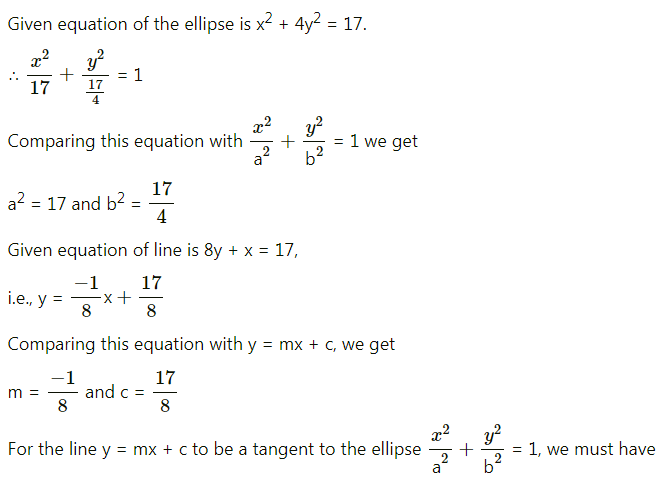
Given equation of ellipse is x2 + 4y2 = 100 ∴ Comparing this equation with , we get a2 = 100 and b2 = 25 Equation of tangent to the ellipse at (x1, y1) is Equation of tangent at (8, 3) is 2x + 3y = 25
Solution & Step-by-Step Answer:
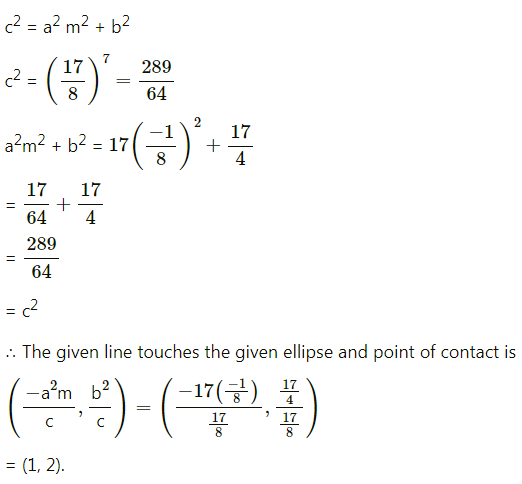
Solution & Step-by-Step Answer:
Given equation of the ellipse is 4x2 + 5y2 = 20. ∴ Comparing this equation with , we get a2 = 5 and b2 = 4 Since inclinations of tangents are θ1 and θ2, m1 = tan θ1 and m2 = tan θ2 Equation of tangents to the ellipse having slope m are y = mx ± ∴ y = mx ± ∴ y – mx = ± Squaring both the sides, we get y2 – 2mxy + m2x2 = 5m2 + 4 ∴ (x2 – 5)m2 – 2xym + (y2 – 4) = 0 The roots m1 and m2 of this quadratic equation are the slopes of the tangents. ∴ m1 + m2 = Given, tan θ1 + tan θ2 = 2 ∴ m1 + m2 = 2 ∴ ∴ xy = x2 – 5 ∴ x2 – xy – 5 = 0, which is the required equation of the locus of P.
Solution & Step-by-Step Answer:
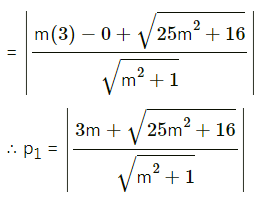
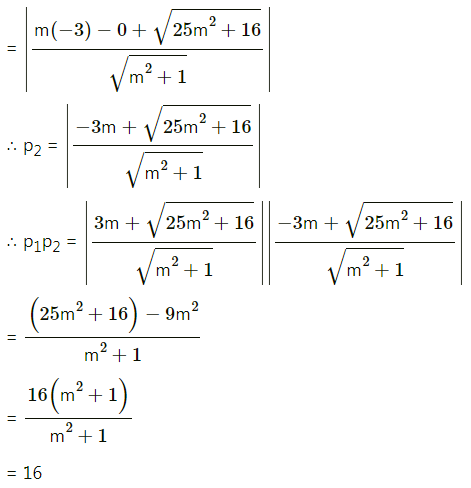
Given equation of the ellipse is Comparing this equation with , we get ∴ a2 = 25, b2 = 16 ∴ a = 5, b = 4 We know that e = ∴ e = = ae = 5() = 3 Co-ordinates of foci are S(ae, 0) and S'(-ae, 0), i.e., S(3, 0) and S'(-3, 0) Equations of tangents to the ellipse having slope m are y = mx ± Equation of one of the tangents to the ellipse is y = mx + ∴ mx – y + = 0 …..(i) p1 = length of perpendicular segment from S(3, 0) to the tangent (i) p2 = length of perpendicular segment from S'(-3, 0) to the tangent (i)
Solution & Step-by-Step Answer:
(i) Let the required equation of hyperbola be Length of conjugate axis = 2b Given, length of conjugate axis = 5 2b = 5 b = b2 = Distance between foci = 2ae Given, distance between foci = 13 2ae = 13 ae = a2e2 = Now, b2 = a2(e2 – 1) b2 = a2e2 – a2 = – a2 a2 = = 36 ∴ The required equation of hyperbola is i.e.,
(ii) Let the required equation of hyperbola be
Given, eccentricity (e) =
Distance between foci = 2ae
Given, distance between foci = 12
∴ 2ae = 12
∴ 2a() = 12
∴ 3a = 12
∴ a = 4
∴ a2= 16
Now, b2= a2(e2– 1)
∴ b2=
∴ b2= 16( – 1)
∴ b2= 16()
∴ b2= 20
∴ The required equation of hyperbola is
(iii) Let the required equation of hyperbola be
Length of conjugate axis = 2b
Given, length of conjugate axis = 3
∴ 2b = 3
∴ b =
∴ b2=
Distance between foci = 2ae
Given, distance between foci = 5
∴ 2ae = 5
∴ ae =
∴ a2e2=
Now, b2= a2(e2– 1)
∴ b2= a2e2– a2
∴ = – a2
∴ a2=
∴ a2= 4
∴ The required equation of hyperbola is
i.e.,
Solution & Step-by-Step Answer:
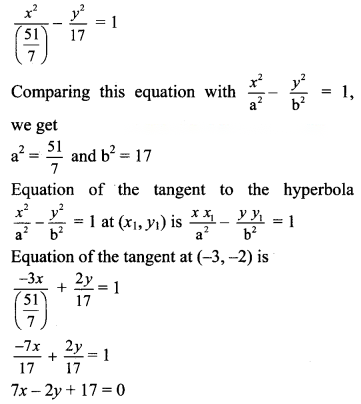
(i) Given equation of the hyperbola is 7x2 – 3y2 = 51
(ii) Given, equation of the hyperbola is
x = 3 sec θ, y = 5 tan θ
Since sec2θ – tan2θ = 1,
Comparing this equation with , we get
a2= 9 and b2= 25
a = 3 and b = 5
Equation of tangent at P(θ) is
∴ Equation of tangent at P(π/3) is
10x – 3√3 y = 15
(iii) Given equation of hyperbola is
Comparing this equation with , we get
a2= 25 and b2= 16
a = 5 and b = 4
Equation of tangent at P(θ) is
The equation of tangent at P(30°) is
8x – 5y = 20√3
Solution & Step-by-Step Answer:
Given equation of die hyperbola is 4x2 – 3y2 = 24. ∴ Comparing this equation with , we get a2 = 6 and b2 = 8 Given equation of line is 2x – y = 4 ∴ y = 2x – 4 Comparing this equation with y = mx + c, we get m = 2 and c = -4 For the line y = mx + c to be a tangent to the hyperbola , we must have c2 = a2m2 – b2 c2 = (-4)2 = 16 a2m2 – b2 = 6(2)2 – 8 = 24 – 8 = 16 ∴ The given line is a tangent to the given hyperbola and point of contact = = = (3, 2)
Solution & Step-by-Step Answer:
Given the equation of the hyperbola is 3x2 – y2 = 48. ∴ Comparing this equation with , we get a2 = 16 and b2 = 48 Slope of the line x + 2y – 7 = 0 is Since the given line is perpendicular to the tangents, slope of the required tangent (m) = 2 Equations of tangents to the ellipse having slope m are y = mx ± y = 2x ± y = 2x ± √16 ∴ y = 2x ± 4
Solution & Step-by-Step Answer:
Given equation of the hyperbola is Let θ1 and θ2 be the inclinations. m1 = tan θ1, m2 = tan θ2 Let P(x1, y1) be a point on the hyperbola Equation of a tangent with slope ‘m’ to the hyperbola is y = mx ± This tangent passes through P(x1, y1). y1 = mx1 ± (y1 – mx1)2 = a2m2 – b2 ……(i) This is a quadratic equation in ‘m’. It has two roots say m1 and m2, which are the slopes of two tangents drawn from P. ∴ m1 + m2 = Since tan θ1 + tan θ2 = k, ∴ P(x1, y1) moves on the curve whose equation is k(x2 – a2) = 2xy.