Maharashtra State Board 11th Maths Solutions Chapter 5 Straight Line Miscellaneous Exercise 5
(I) Select the correct option from the given alternatives.
Solution & Step-by-Step Answer:
(b) (, 0) Hint: Let B(x, 0) be the point on X-axis. We have A = (5, -3) slope of AB = -2 ⇒ = -2 ⇒ 3 = -2(x – 5) ⇒ 3 = -2x + 10 ⇒ x = Co-ordinates of point B = (, 0)
Solution & Step-by-Step Answer:
(c) 1 Hint: Line passes through (a, 0), (0, b). x-intercept = a, y-intercept = b ∴ Equation of line is …….(i) Since line (i) passes through (1, 1), (1, 1) satisfies (i) ∴
Solution & Step-by-Step Answer:
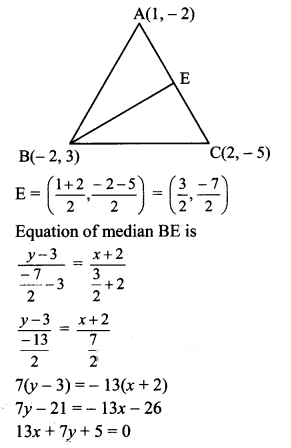
(b) 13x + 7y + 5 = 0 Hint:
Solution & Step-by-Step Answer:
(d) x + y = 3 Hint: Let the equation of required line be ……..(i) Since the line makes equal intercepts on the axes, a = b ∴ x + y = a ……(ii) But, equation (ii) passes through (1, 2). 1 + 2 = a ∴ a = 3 Substituting a = 3 in equation (ii), we get x + y = 3
Solution & Step-by-Step Answer:
(b) 2 Hint: Given two lines are 2x + 3y = 4 ……(i) 3x + 4y = 5 …….(ii) Multiplying (i) by 3 and (ii) by 2 and then subtracting, we get y = 2 Substituting y = 2 in (i), we get x = -1 ∴ Point of intersection of lines (i) and (ii) is (-1, 2). Given that the line kx + 4y = 6 passes through (-1, 2). k(-1) + 4(2) = 6 ∴ k = 2
Solution & Step-by-Step Answer:
(b) √3x + y ± 6 = 0 Hint: Here, α = 30° and p = 3 units Equation of line with inclination a and distance from origin as p is x cos α + y sin α = p ∴ x cos 30° + y sin 30° = ±3 ∴ ∴ √3x + y ± 6 = 0

Solution & Step-by-Step Answer:
(d) Hint: Slope of line 3x + y = 3 is -3 ∴ Slope of line perpendicular to given line = Equation of required line passing through (2, 2) and having slope is y – 2 = (x – 2) 3y – 6 = x – 2 ∴ x – 3y + 4 = 0 ∴ y-intercept =
Solution & Step-by-Step Answer:
(b) 30° Hint:

Solution & Step-by-Step Answer:
(a) -3 Hint: Lines kx + 2y – 1 = 0 and 6x – 4y + 2 = 0 are identical. ∴ ∴ k = -3
Solution & Step-by-Step Answer:
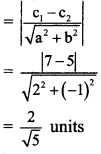
(d) Hint: Here, c1 = 7, c2 = 5, a = 2 and b = -1 Distance between parallel lines
II. Answer the following questions.
Solution & Step-by-Step Answer:
(a) Given, P(3, 4), Q(5, k) and Slope of PQ = 9 = 9 = 9 k – 4 = 18 k = 22
(b) Given, points A(1, 3), B(4, 1) and C(3, k) are collinear.
Slope of AB = Slope of BC
2 = 3k – 3
k =
(c) Given, point P(1, k) lies on the line joining A(2, 2) and B(3, 3).
Slope of AB = Slope of BP
1 =
2 = 3 – k
k = 1
Solution & Step-by-Step Answer:
Given equation is 6x + 3y + 8 = 0, which can be written as 3y = – 6x – 8 y = y = -2x – This is of the form y = mx + c with m = -2 y = -2x – is in slope-intercept form with slope = -2
Solution & Step-by-Step Answer:
Given equation of line is x = -2 This equation represents a line parallel to Y-axis and at a distance of 2 units to the left of Y-axis. ∴ Distance of the origin from the line is 2 units.
Solution & Step-by-Step Answer:
Given equation is 3x + 2y – 6 = 0. Substituting x = 2 and y = 3 in L.H.S. of given equation, we get L.H.S. = 3x + 2y – 6 = 3(2) + 2(3) – 6 = 6 ≠ R.H.S. ∴ Point A does not lie on the given line.
Solution & Step-by-Step Answer:
(d) 2x – y = 0 Hint: Any line passing through origin is of the form y = mx or ax + by = 0. Here in the given option, 2x – y = 0 is in the form ax + by = 0. ∴ Option (d) is the correct answer.
Solution & Step-by-Step Answer:
(a) Equation of a line parallel to X-axis is y = k. Since the line is at a distance of 3 units below X-axis, k = -3 ∴ The equation of the required line is y = -3.
(b) Equation of a line parallel to Y-axis is x = h.
Since the line is at a distance of 2 units to the left of Y-axis, h = -2
∴ The equation of the required line is x = -2.
(c) Equation of a line parallel to X-axis with y-intercept ‘k’ is y = k.
Here, y-intercept = 5
∴ The equation of the required line is y = 5.
(d) Equation of a line parallel to Y-axis with x-intercept ‘h’ is x = h.
Here, x-intercept = 3
∴ The equation of the required line is x = 3.
Solution & Step-by-Step Answer:
(i) Equation of a line parallel to X-axis is of the form y = k. Since the line passes through (2, 3), k = 3 ∴ The equation of the required line is y = 3.
(ii) Equation of a line perpendicular to Y-axis
i.e., parallel to X-axis, is of the form y = k.
Since the line passes through (2, 4), k = 4
∴ The equation of the required line is y = 4.
Solution & Step-by-Step Answer:
(a) Given, slope(m) = 5 and the line passes through A(-1, 2). Equation of the line in slope point form is y – y1 = m(x – x1) The equation of the required line is y – 2 = 5(x + 1) y – 2 = 5x + 5 ∴ 5x – y + 7 = 0
(b) Given, Inclination of line = θ = 90°
the required line is parallel to Y-axis.
Equation of a line parallel to Y-axis is of the form x = h.
Since the line passes through (7, 3), h = 7
∴ The equation of the required line is x = 7.
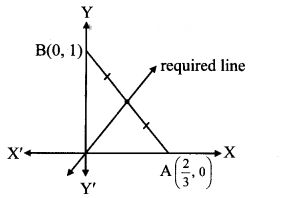
(c) Given equation of the line is 3x + 2y = 2.
This equation is of the form , with a = , b= 1.
The line 3x + 2y = 2 intersects the X-axis at A(, 0) and Y-axis at B(0, 1).
Required line is passing through the midpoint of AB.
Midpoint of AB =
∴ Required line passes through (0, 0) and .
Equation of the line in two point form is
∴ The equation of the required line is
2y = 3x
∴ 3x – 2y = 0
Solution & Step-by-Step Answer:
The required line passes through the points S(2, 1) and T(2, 3). Since both the given points have same x co-ordinates i.e. 2 the given points lie on a line parallel to Y-axis. ∴ The equation of the required line is x = 2.
Solution & Step-by-Step Answer:
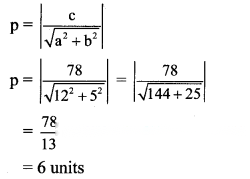
Let p be the perpendicular distance of origin from the line 12x + 5y + 78 = 0. Here, a = 12, b = 5, c = 78
Solution & Step-by-Step Answer:
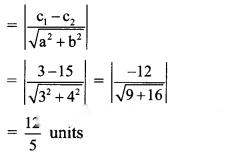
Equations of the given parallel lines are 3x + 4y + 3 = 0 and 3x + 4y + 15 = 0 Here, a = 3, b = 4, c1 = 3 and c2 = 15 ∴ Distance between the parallel lines
Solution & Step-by-Step Answer:
Case I: Line not passing through origin. Let the equation of the line be …….(i) This line passes through A(3, 5). ∴ ……..(ii) Since the required line makes equal intercepts on the co-ordinates axes, a = b …….(iii) Substituting the value of b in (ii), we get ∴ a = 8 ∴ b = 8 …… [From (iii)] Substituting the values of a and b in equation (i), the equation of the required line is ∴ x + y = 8
Case II: Line passing through origin.
Slope of line passing through origin and A(3, 5) is
m =
∴ Equation of the line having slope m and passing through origin (0, 0) is y = mx.
∴ The equation of the required line is
y = x
∴ 5x – 3y = 0
Solution & Step-by-Step Answer:
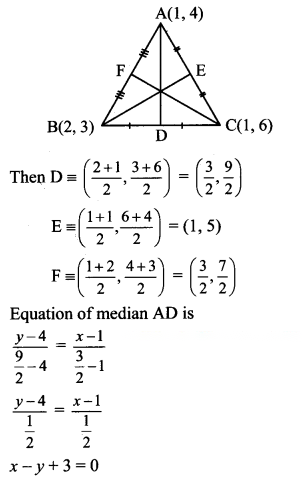
Vertices of ∆ABC are A(1, 4), B(2, 3) and C(1, 6) (a) Equation of the line in two point form is = Equation of side AB is y – 4 = -1(x – 1) y – 4 = -x + 1 x + y = 5 Equation of side BC is -1(y – 3) = 3(x – 2) -y + 3 = 3x – 6 ∴ 3x + y = 9 Since both the points A and C have same x co-ordinates i.e. 1 the points A and C lie on a line parallel to Y-axis. ∴ The equation of side AC is x = 1.
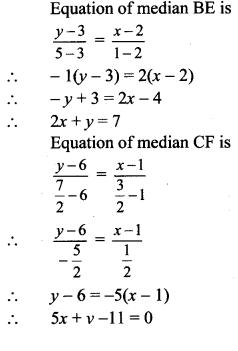
(b) Let D, E and F be the midpoints of sides AC and AB respectively of ∆ABC.
(c) Slope of side BC = = -3
Slope of perpendicular bisector of BC is and the line passes through .
Equation of the perpendicular bisector of side BC is
3(2y – 9) = (2x – 3)
6y – 27 = 2x – 3
2x – 6y + 24 = 0
∴ x – 3y + 12 = 0
Since both the points A and C have same x co-ordinates i.e. 1
the points A and C lie on the line x = 1.
AC is parallel to Y-axis and therefore, perpendicular bisector of side AC is parallel to X-axis.
Since, the perpendicular bisector of side AC passes through E(1, 5).
The equation of perpendicular bisector of side AC is y = 5.
Slope of side AB = = -1
Slope of perpendicular bisector of AB is 1 and the line passes through .
Equation of the perpendicular bisector of side AB is
2y – 7 = 2x – 3
2x – 2y + 4 = 0
∴ x – y + 2 = 0
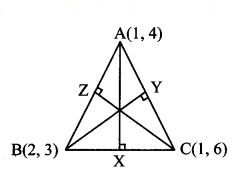
(d) Let AX, BY, and CZ be the altitudes through the vertices A, B and C respectively of ∆ABC.
Slope of BC = -3
Slope of AX = ……[∵ AX ⊥ BC]
Since altitude AX passes through (1, 4) and has slope ,
equation of altitude AX is
y – 4 = (x – 1)
3y – 12 = x – 1
∴ x – 3y + 11 = 0
Since both the points A and C have same x co-ordinates i.e. 1
the points A and C lie on the line x = 1.
AC is parallel to Y-axis and therefore, altitude BY is parallel to X-axis.
Since the altitude BY passes through B(2, 3), the equation of altitude BY is y = 3.
Also, slope of AB = -1
Slope of CZ = 1
Since altitude CZ passes through (1, 6) and has slope 1,
equation of altitude CZ is
y – 6 = 1(x – 1)
∴ x – y + 5 = 0
Solution & Step-by-Step Answer:
Let u ≡ x + y – 3 = 0 and v ≡ 2x – y + 1 = 0 Equation of the line passing through the point of intersection of lines u = 0 and v = 0 is given by u + kv = 0. (x + y – 3) + k(2x – y + 1) = 0 …..(i) x + y – 3 + 2kx – ky + k = 0 x + 2kx + y – ky – 3 + k = 0 (1 + 2k)x + (1 – k)y – 3 + k = 0 But, this line is parallel to X-axis Its slope = 0 ⇒ ⇒ 1 + 2k = 0 ⇒ k = Substituting the value of k in (i), we get (x + y – 3) + (2x – y + 1) = 0 ⇒ 2(x + y – 3) – (2x – y + 1 ) = 0 ⇒ 2x + 2y – 6 – 2x + y – 1 = 0 ⇒ 3y – 7 = 0, which is the equation of the required line.
Solution & Step-by-Step Answer:
Let u ≡ x + y + 9 = 0 and v ≡ 2x + 3y + 1 = 0 Equation of the line passing through the point of intersection of lines u = 0 and v = 0 is given by u + kv = 0. (x + y + 9) + k(2x + 3y + 1) = 0 ……(i) ⇒ x + y + 9 + 2kx + 3ky + k = 0 ⇒ (1 + 2k)x + (1 + 3k)y + 9 + k = 0 But, x-intercept of this line is 1. ⇒ ⇒ -9 – k = 1 + 2k ⇒ k = Substituting the value of k in (i), we get (x + y + 9) + () (2x + 3y + 1) = 0 ⇒ 3(x + y + 9) – 10(2x + 3y + 1) = 0 ⇒ 3x + 3y + 27 – 20x – 30y – 10 = 0 ⇒ -17x – 27y+ 17 = 0 ⇒ 17x + 27y – 17 = 0, which is the equation of the required line.
Solution & Step-by-Step Answer:
Slope of ST = = 3 Since the required line is perpendicular to ST, slope of required line = and line passes through A(-2, 3) Equation of the line in slope point form is y – y1 = m(x – x1) The equation of the required line is y – 3 = (x + 2) ⇒ 3(y – 3) = -(x + 2) ⇒ 3y – 9 = -x – 2 ⇒ x + 3y = 7
Solution & Step-by-Step Answer:
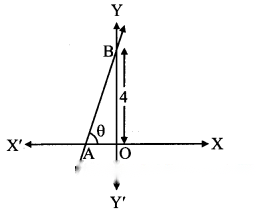
Equation of a line having slope ‘m’ and y-intercept ‘c’ is y = mx + c Given, m = 3, c = 4 The equation of the line is y = 3x + 4 3x – y = -4 This equation is of the form , where x-intercept = a x-intercept =
Alternate Method:
Let θ be the inclination of the line.
Then tan θ = 3 …..[∵ slope = 3 (given)]
OA =
x-intercept = – as point A is to the left side of Y-axis.
Solution & Step-by-Step Answer:
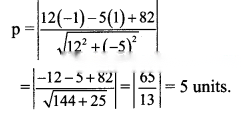
Given equation of the line is 12(x + 6) = 5(y – 2) 12x + 72 = 5y – 10 12x – 5y + 82 = 0 Let p be the perpendicular distance of the point (-1, 1) from the line 12x – 5y + 82 = 0.
Solution & Step-by-Step Answer:
Given, A(h, 3) and B(4, 1) Slope of AB (m1) = m1 = Slope of line 7x – 9y – 19 = 0 is m2 = Since line AB and line 7x – 9y – 19 = 0 are perpendicular to each other, m1 × m2 = -1 14 = 9(4 – h) 14 = 36 – 9h 9h = 22 h =
Solution & Step-by-Step Answer:
Let m be the slope of the required line which make an angle of 45° with the other line. Slope of one of the lines is 2. tan 45° = 1 = = 1 or = -1 m – 2 = 1 + 2m or m – 2 = -1 – 2m m = -3 or 3m = 1 m = -3 or m = Required line passes through M(2, 3) When m = -3, equation of the line is y – 3 = -3(x – 2) y – 3 = -3x + 6 ∴ 3x + y = 9 When m = , equation of the line is y – 3 = (x – 2) 3y – 9 = x – 2 ∴ x – 3y + 7 = 0
Solution & Step-by-Step Answer:
Given, slope = 4, x-intercept = 5 Since the x-intercept of the line is 5, it passes through (5, 0). Equation of the line in slope point form is y – y1 = m(x – x1) Equation of the required line is y – 0 = 4(x – 5) y = 4x – 20 4x – y = 20 This equation is of the form , where x-intercept = b, y-intercept = -20
Solution & Step-by-Step Answer:
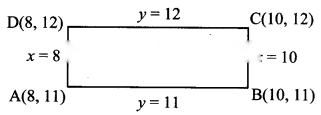
Given, equations of sides of rectangle are x = 8, x = 10, y = 11 and y = 12 From the above diagram, Vertices of rectangle are A(8, 11), B(10, 11), C(10, 12) and D(8, 12). Equation of diagonal AC is 2y – 22 = x – 8 x – 2y + 14 = 0 Equation of diagonal BD is -2y + 22 = x – 10 x + 2y = 32
Solution & Step-by-Step Answer:
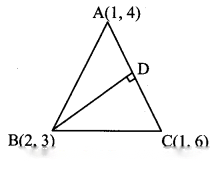
Vertices of triangle are A(1, 4), B(2, 3) and C(1, 6). Let BD be the altitude through the vertex B. Since both the points A and C have same x co-ordinates i.e. 1 the given points lie on a line parallel to Y-axis. The equation of the line AC is x = 1 …..(i) AC is parallel to Y-axis and therefore, altitude BD is parallel to X-axis. Since the altitude BD passes through B(2, 3), the equation of altitude BD is y = 3 ……(ii) From (i) and (ii), Point of intersection of AC and altitude BD is (1, 3).
Solution & Step-by-Step Answer:
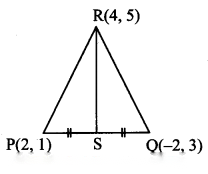
Let S be the midpoint of side PQ. Then RS is the median through R. S = = (0, 2) The median RS passes through the points R(4, 5) and S(0, 2). ∴ Equation of median RS is ⇒ ⇒ 4(y – 5) = 3(x – 4) ⇒ 4y – 20 = 3x – 12 ∴ 3x – 4y + 8 = 0
Solution & Step-by-Step Answer:
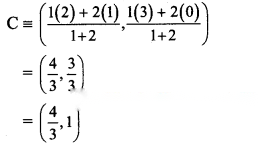
Given, A(1, 0), B(2, 3) Slope of AB = = 3 Required line is perpendicular to AB. Slope of required line = Let point C divide AB in the ratio 1 : 2. Required line passes through and has slope = Equation of the line in slope point form is y – y1 = m(x – x1) The equation of the required line is y – 1 = ⇒ 3(y – 1) = ⇒ 3y – 3 = -x + ⇒ 9y – 9 = -3x + 4 ⇒ 3x + 9y = 13
Solution & Step-by-Step Answer:
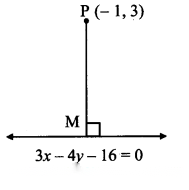
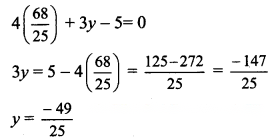
Let M be the foot of perpendicular drawn from P(-1, 3) to the line 3x – 4y – 16 = 0 Slope of the line 3x – 4y – 16 = 0 is Since PM ⊥ to line (i), slope of PM = Equation of PM is y – 3 = (x + 1) ⇒ 3(y – 3) = -4(x + 1) ⇒ 3y – 9 = -4x – 4 ∴ 4x + 3y – 5 = 0 ……(ii) The foot of perpendicular i.e., point M, is the point of intersection of equation (i) and (ii). By (i) × 3 + (ii) × 4, we get 25x = 68 x = Substituting x = in (ii), we get The co-ordinates of the foot of perpendicular M are
Solution & Step-by-Step Answer:
The equation of line is i.e. 4x + 3y – 12 = 0 …..(i) Let (h, 0) be a point on the X-axis. The distance of this point from line (i) is 4. ⇒ ⇒ ⇒ |4h – 12| = 20 ⇒ 4h – 12 = 20 or 4h – 12 = -20 ⇒ 4h = 32 or 4h = -8 ⇒ h = 8 or h = -2 ∴ The required points are (8, 0) and (-2, 0).
Solution & Step-by-Step Answer:
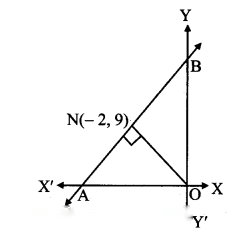
Slope of ON = Since line AB ⊥ ON, slope of the line AB perpendicular to ON is and it passes through point N(-2, 9). Equation of the line in slope point form is y – y1 = m(x – x1) Equation of line AB is y – 9 = (x + 2) ⇒ 9(y – 9) = 2(x + 2) ⇒ 9y – 81 = 2x + 4 ⇒ 2x – 9y + 85 = 0
Solution & Step-by-Step Answer:
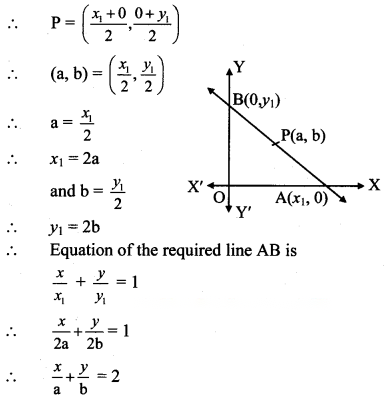
Let the intercepts of a line AB be x1 and y1 on the X and Y-axes respectively. A ≡ (x1, 0), B = (0, y1) P(a, b) is the midpoint of a line segment AB intercepted between the axes.
Solution & Step-by-Step Answer:
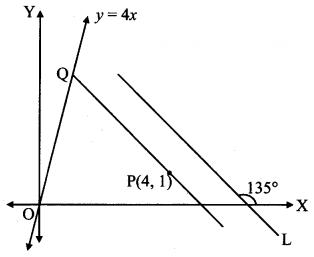
Let a line L make angle 135° with positive X-axis. Required distance = PQ, where PQ || line L Slope of PQ = tan 135° = tan (180° – 45°) = -tan 45° = -1 Equation of PQ is y – 1 = (-1)(x – 4) y – 1 = -x + 4 x + y = 5 …..(i) To get point Q we solve the equation 4x – y = 0 with (i) Substituting y = 4x in (i), we get 5x = 5 x = 1 Substituting x = 1 in (i), we get 1 + y = 5 y = 4 ∴ Q = (1, 4) PQ = = = 3√2
Solution & Step-by-Step Answer:
Case I: Line not passing through origin. Let the equation of the line be ……(1) This line passes through (3, 4) …..(ii) Since the sum of the intercepts of the line is zero, a + b = 0 a = -b ……(iii) Substituting the value of a in (ii), we get = 1 b = 1 a = -1 ……[From (iii)] Substituting the values of a and b in (i), the equation of the required line is x – y = -1 ∴ x – y + 1 = 0
Case II: Line passing through origin.
Slope of line passing through origin and A(3, 4) is
m =
Equation of the line having slope m and passing through origin (0, 0) is y = mx.
The equation of the required line is
y = x
∴ 4x – 3y = 0
∴ There are two lines which pass through A(3, 4) and the sum of whose intercepts is zero.
Solution & Step-by-Step Answer:
When line is passing through origin, the sum of intercepts made by the line is zero. Slope of line passing through origin and B(5, 5) is m = = 1 Equation of the line having slope m and passing through origin (0, 0) is y = mx. The equation of the required line is y = x ∴ x – y = 0 ∴ There is only one line which passes through B(5, 5) and the sum of whose intercepts is zero.