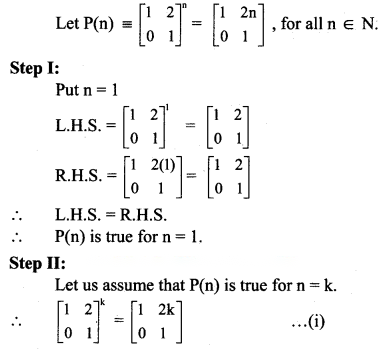
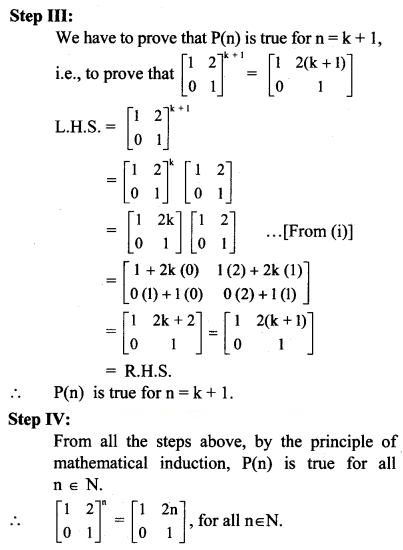
Maharashtra State Board 11th Maths Solutions Chapter 4 Methods of Induction and Binomial Theorem Ex 4.1
Prove by the method of induction, for all n ∈ N.
Step II:
Let us assume that P(n) is true for n = k.
∴ 2 + 4 + 6 + ….. + 2k = k(k + 1) ……(i)
Step III:
We have to prove that P(n) is true for n = k + 1,
i.e., to prove that
2 + 4 + 6 + …… + 2(k + 1) = (k + 1) (k + 2)
L.H.S. = 2 + 4 + 6 + …+ 2(k + 1)
= 2 + 4 + 6+ ….. + 2k + 2(k + 1)
= k(k + 1) + 2(k + 1) …..[From (i)]
= (k + 1).(k + 2)
= R.H.S.
∴ P(n) is true for n = k + 1.
Step IV:
From all the steps above, by the principle of mathematical induction, P(n) is true for all n ∈ N.
∴ 2 + 4 + 6 + …… + 2n = n(n + 1) for all n ∈ N.
Step I:
Put n = 1
L.H.S. = 3
R.H.S. = 1[2(1)+ 1] = 3
∴ L.H.S. = R.H.S.
∴ P(n) is true for n = 1.
Step II:
Let us assume that P(n) is true for n = k.
∴ 3 + 7 + 11 + ….. + (4k – 1) = k(2k + 1) …..(i)
Sept III:
We have to prove that P(n) is true for n = k + 1,
i.e., to prove that
3 + 7 + 11 + …+ [4(k + 1) – 1] = (k + 1)(2k + 3)
L.H.S. = 3 + 7 + 11 + …… + [4(k + 1) – 1]
= 3 + 7 + 11 + ….. + (4k – 1) + [4(k+ 1) – 1]
= k(2k + 1) + (4k + 4 – 1) …..[From (i)]
= 2k2+ k + 4k + 3
= 2k2+ 2k + 3k + 3
= 2k(k + 1) + 3(k + 1)
= (k + 1) (2k + 3)
= R.H.S.
∴ P(n) is true for n = k + 1.
Step IV:
From all the steps above, by the principle of mathematical induction, P(n) is true for all n ∈ N.
∴ 3 + 7 + 11 + ….. to n terms = n(2n + 1) for all n ∈ N.
Step II:
Let us assume that P(n) is true for n = k.
∴ 12+ 22+ 32+…+ k2= …..(i)
Step III:
We have to prove that P(n) is true for n = k + 1,
i.e., to prove that
∴ P(n) is true for n = k + 1.
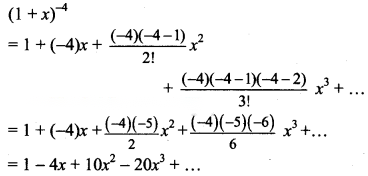
Step IV:
From all the steps above, by the principle of mathematical induction, P(n) is true for all n ∈ N.
∴ 12+ 22+ 32+ …+ n2= for all n ∈ N.
Step II:
Let us assume that P(n) is true for n = k.
∴ 12+ 32+ 52+….+(2k – 1)2= (2k – 1)(2k + 1) …….(i)
Step III:
We have to prove that P(n) is true for n = k + 1,
i.e., to prove that
∴ P(n) is true for n = k + 1.
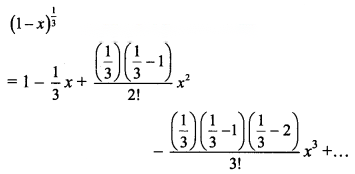
Step IV:
From all the steps above, by the principle of mathematical induction, P(n) is true for all n ∈ N.
∴ 12+ 32+ 52+ …+ (2n – 1)2= (2n – 1)(2n + 1) for all n ∈ N.
Step I:
Put n = 1
L.H.S. = 13= 1
R.H.S. = 12[2(1)2– 1] = 1
∴ L.H.S. = R.H.S.
∴ P(n) is true for n = 1.
Step II:
Let us assume that P(n) is true for n = k.
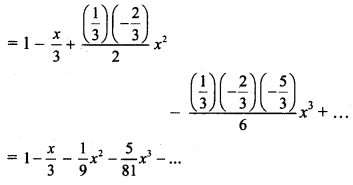
∴ 13+ 33+ 53+…+ (2k – 1)3= k2(2k2– 1) …..(i)
Step III:
We have to prove that P(n) is true for n = k + 1,
i.e., to prove that
∴ P(n) is true for n = k + 1.
Step IV:
From all the steps above, by the principle of mathematical induction, P(n) is true for all n ∈ N.
∴ 13+ 33+ 53+ … to n terms = n2(2n2– 1) for all n ∈ N.
Step I:
Put n = 1
L.H.S. = 1.2 = 2
R.H.S. = (1 + 1)(1 + 2) = 2
∴ L.H.S. = R.H.S.
∴ P(n) is true for n = 1.
Step II:
Let us assume that P(n) is true for n = k.
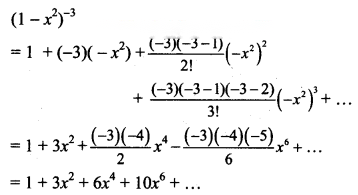
∴ 1.2 + 2.3 + 3.4 + ….. + k(k + 1) = (k + 1)(k + 2) ……(i)
Step III:
We have to prove that P(n) is true for n = k + 1,
i.e., to prove that
∴ P(n) is true for n = k + 1.
Step IV:
From all the steps above, by the principle of mathematical induction, P(n) is true for all n ∈ N.
∴ 1.2 + 2.3 + 3.4 + … + n(n + 1) = (n + 1)(n + 2), for all n ∈ N.
Step I:
Put n = 1
L.H.S. = 1.3 = 3
R.H.S. = [4(1)2+ 6(1) – 1] = 3
∴ L.H.S. = R.H.S.
∴ P(n) is trae for n = 1.
Step II:
Let us assume that P(n) is true for n = k.
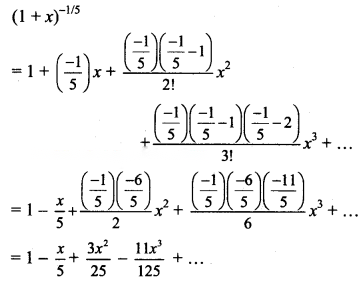
∴ 1.3 + 3.5 + 5.7 +….+ (2k – 1)(2k + 1) = (4k2+ 6k – 1) ……(i)
Step III:
We have to prove that P(n) is true for n = k + 1,
i.e., to prove that
∴ P(n) is true for n = k + 1.
Step IV:
From all the steps above, by the principle of mathematical induction, P(n) is true for all n ∈ N.
∴ 1.3 + 3.5 + 5.7 +… to n terms = (4n2+ 6n – 1) for all n ∈ N.
Step I:
Put n = 1
L.H.S. =
R.H.S. =
∴ L.H.S. = R.H.S.
∴ P(n) is true for n = 1.
Step II:
Let us assume that P(n) is true for n = k.
∴ …..(i)
Step III:
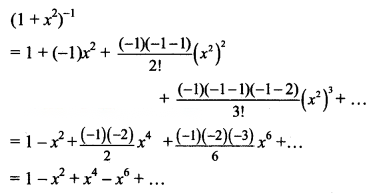
We have to prove that P(n) is true for n = k + 1,
i.e., to prove that
∴ P(n) is true for n = k + 1.
Step IV:
From all the steps above, by the principle of mathematical induction, P(n) is true for all n ∈ N.
∴ , for all n ∈ N.
Step I:
Put n = 1
L.H.S. =
R.H.S. =
∴ L.H.S. = R.H.S.
∴ P(n) is true for n = 1.
Step II:
Let us assume that P(n) is true for n = k.
∴ = ….(i)
Step III:
We have to prove that P(n) is true for n = k + 1,
i.e., to prove that
∴ P(n) is true for n = k + 1.
Step IV:
From all the steps above, by the principle of mathematical induction, P(n) is true for all n ∈ N.
∴ , for all n ∈ N.
Step I:
Put n = 1
∴ 23n– 1 = 23(1)– 1 = 23– 1 = 8 – 1 = 7
∴ (23n– 1) is a multiple of 7.
∴ P(n) is true for n = 1.
Step II:
Let us assume that P(n) is true for n = k.
i.e., 23k– 1 is a multiple of 7.
∴ 23k– 1 = 7a, where a ∈ N
∴ 23k= 7a + 1 ……(i)
Step III:
We have to prove that P(n) is true for n = k + 1,
i.e., to prove that
23(k+1)– 1 = 7b, where b ∈ N.
∴ P(k + 1) = 23(k+1)– 1
= 23k+3– 1
= 23k. (23) – 1
= (7a + 1)8 – 1 …..[From (i)]
= 56a + 8 – 1
= 56a + 7
= 7(8a + 1)
7b, where b = (8a + 1) ∈ N
∴ P(n) is true for n = k + 1.
Step IV:
From all the steps above, by the principle of mathematical induction, P(n) is true for all n ∈ N.
∴ (24n– 1) is divisible by 7, for all n ∈ N.
Step I:
Put n = 1
∴ 24(1)– 1 = 16 – 1 = 15
∴ (24n– 1) is a multiple of 15.
∴ P(n) is true for n = 1.
Step II:
Let us assume that P(n) is true for n = k.
∴ 24k– 1 = 15a, where a ∈ N
∴ 24k= 15a + 1 …..(i)
Step III:
We have to prove that P(n) is true for n = k + 1,
i.e., to prove that
∴ 24(k+1)– 1 = 15b, where b ∈ N
∴ P(k + 1) = 24(k+1)– 1 = 24k+4– 1
= 24k. 24– 1
= 16. (24k) – 1
= 16(15a + 1) – 1 …..[From (i)]
= 240a + 16 – 1
= 240a + 15
= 15(16a + 1)
= 15b, where b = (16a + 1) ∈ N
∴ P(n) is true for n = k + 1.
Step IV:
From all the steps above, by the principle of mathematical induction, P(n) is true for all n ∈ N.
∴ (24n– 1) is divisible by 15, for all n ∈ N.
Step I:
Put n = 1
∴ (3n– 2n – 1) = 3(1)– 2(1) – 1 = 0 = 4(0)
∴ (3n– 2n – 1) is a multiple of 4.
∴ P(n) is tme for n = 1.
Step II:
Let us assume that P(n) is true for n = k.
∴ 3k– 2k – 1 = 4a, where a ∈ N
∴ 3k= 4a + 2k + 1 ….(i)
Step III:
We have to prove that P(n) is tme for n = k + 1,
i.e., to prove that
3(k+1)– 2(k + 1) – 1 = 4b, where b ∈ N
P(k + 1) = 3k+1– 2(k + 1) – 1
= 3k. 3 – 2k – 2 – 1
= (4a + 2k + 1). 3 – 2k – 3 …….[From (i)]
= 12a + 6k + 3 – 2k – 3
= 12a + 4k
= 4(3a + k)
= 4b, where b = (3a + k) ∈ N
∴ P(n) is tme for n = k + 1.
Step IV:
From all the steps above, by the principle of mathematical induction, P(n) is tme for all n ∈ N.
∴ 3n– 2n – 1 is divisible by 4, for all n ∈ N.
Step I:
Put n = 1
L.H.S. = 5
R.H.S. = (51– 1) = 5
∴ L.H.S. = R.H.S.
∴ P(n) is true for n = 1.
Step II:
Let us assume that P(n) is true for n = k.
∴ 5 + 52+ 53+ ….. + 5k= (5k– 1) …….(i)
Step III:
We have to prove that P(n) is true for n = k + 1,
i.e., to prove that
∴ P(n) is true for n = k + 1.
Step IV:
From all the steps above, by the principle of mathematical induction, P(n) is true for all n ∈ N.
∴ 5 + 52+ 53+ … + 5n= (5n– 1), for all n ∈ N.
Step II:
Let us assume that P(n) is true for n = k.
∴ (cos θ + i sin θ)k= cos kθ + i sin kθ …….(i)
Step III:
We have to prove that P(n) is true for n = k + 1,
i.e., to prove that
(cos θ + i sin θ)k+1= cos (k + 1)θ + i sin (k + 1)θ
L.H.S. = (cos θ + i sin θ)k+1
= (cos θ + i sin θ)k. (cos θ + i sin θ)
= (cos kθ + i sin kθ). (cos θ + i sin θ) ……[From (i)]
= cos kθ cos θ + i sin θ cos kθ + i sin kθ cosθ – sin kθ sin θ ……[∵ i2= -1]
= (cos kθ cos θ – sin k θ sin θ) + i(sin kθ cos θ + cos kθ sin θ)
= cos(kθ + θ) + i sin(kθ + θ)
= cos(k + 1) θ + i sin (k + 1) θ
= R.H.S.
∴ P(n) is true for n = k + 1.
Step IV:
From all the steps above, by the principle of mathematical induction, P(n) is true for all n ∈ N.
∴ (cos θ + i sin θ)n= cos (nθ) + i sin (nθ), for all n ∈ N.
Step II:
Let us assume that P(n) is true for n = k.
∴ tk+1= 5 tk+4and tk= 5k– 1
Step III:
We have to prove that P(n) is true for n = k + 1,
i.e., to prove that tk+1= 5k+1– 1
Since tk+1= 5 tk+4and tk= 5k– 1 …..[From Step II]
tk+1= 5 (5k– 1) + 4 = 5k+1– 1
∴ P(n) is true for n = k + 1.
Step IV:
From all the steps above, by the principle of mathematical induction, P(n) is true for all n ∈ N.
∴ tn= 5n– 1, for all n ∈ N.