Maharashtra State Board 11th Maths Solutions Chapter 2 Trigonometry – I Ex 2.2
Solution & Step-by-Step Answer:
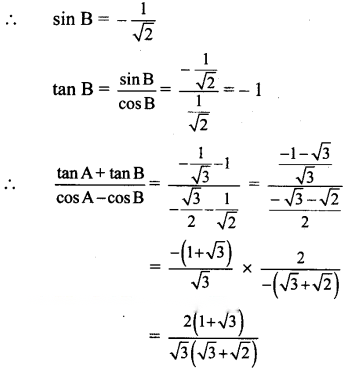
Given, 2sin A = 1 ∴ sin A = 1/2 we know that, cos2 A = 1 – sin2 A = 1 – ∴ cos A = Since < A < π A lies in the 2nd quadrant. We know that, Sin2 B = 1 – cos2 B = 1 – ∴ sin B = Since < B < 2π B lies in the 4th quadrant,

Solution & Step-by-Step Answer:
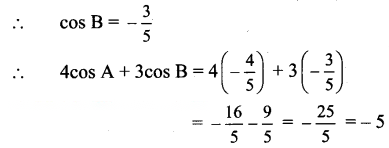
Given, ∴ sin A = and sin B = We know that, cos2 A = 1 – sin2 = 1 – = 1 – ∴ Cos A = ± Since A lies in the second quadrant, cos A < 0 ∴ Cos A = – Sin B = 4/5 We know that, cos2B = 1 – sin2B = 1 – ∴ Cos B = ± Since B lies in the second quadrant, cos B < 0
Solution & Step-by-Step Answer:

Solution & Step-by-Step Answer:
i. x = 3sec θ, y = 4tan θ ∴ sec θ = and tan θ= We know that, sec2θ – tan2θ = 1 ∴ 16x2 – 9y2 = 144
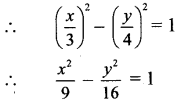
ii. x = 6cosec θ and y = 8cot θ
.’. cosec θ = and cot θ =
We know that,
cosec2θ – cot2θ =
16x2– 9y2= 576

iii. x = 4cos θ – 5 sin θ … (i)
y = 4sin θ + 5cos θ...(ii)
Squaring (i) and (ii) and adding, we get
x2+ y2= (4cos θ – 5sin θ)2+ (4sin θ + 5cos θ)2
= 16cos2θ – 40 sinθ cosθ + 25 sin2θ + 16 sin2θ + 40sin θ cos θ + 25 cos2θ
= 16(sin2θ + cos2θ) + 25(sin2θ + cos2θ)
= 16(1) + 25(1)
= 41
iv. x = 5 + 6cosec θ andy = 3 + 8cot θ
∴ x – 5 = 6cosec θ and y – 3 = 8cot θ
∴ cosec θ = and cot θ =
We know that,
cosec2θ – cot2θ = 1
∴ = 1
v. 2x = 3 – 4tan θ and 3y = 5 + 3sec θ
∴ 2x – 3 = -4tan θ and 3y – 5 = 3sec θ
∴ tan θ = and sec θ = θ
We know that, sec2θ – tan2θ = 1
∴ = 1
∴ = 1
Solution & Step-by-Step Answer:
2sin2 θ + 3sin θ = 0 ∴ sin θ (2sin θ + 3) = 0 ∴ sin θ = 0 or sin θ = Since – 1 ≤ sin θ ≤ 1, sin θ = 0 = 0 …[ ∵ sin2 θ = 1- cos2 θ] ∴ 1 – cos2 θ = 0 ∴ cos2 θ = 1 ∴ cos θ = ±1 …[∵ – 1 ≤ cos θ ≤ 1]
Solution & Step-by-Step Answer:
2cos2θ – 11 cos θ + 5 = 0 ∴ 2cos2 θ – 10 cos θ – cos θ + 5 = 0 ∴ 2cos θ(cos θ – 5) – 1 (cos θ – 5) = 0 ∴ (cos θ – 5) (2cos θ – 1) = 0 cos θ – 5 = 0 or 2cos θ – 1 = 0 ∴ cos θ = 5 or cos θ = 1/2 Since, -1 ≤ cos θ ≤ 1 ∴ cos θ = 1/2
Solution & Step-by-Step Answer:
2cos20 = 3sin θ ∴ 2(1 – sin2 θ) = 3sin θ ∴ 2 – 2sin2 θ = 3sin θ ∴ 2sin2 θ + 3sin 9-2 = θ ∴ 2sin2 θ + 4sin θ – sin θ – 2 = θ ∴ 2sin θ(sin θ + 2) -1 (sin θ + 2) = θ ∴ (sin θ + 2) (2sin θ – 1) = 0 ∴ sin θ + 2 = 0 or 2sin θ – 1 = 0 ∴ sin θ = -2 or sin θ = 1/2 Since, -1 ≤ sin θ ≤ 1 ∴ Sin θ = 1/2 ∴ θ = 30° …[ ∵ sin 30 = 1/2]
Solution & Step-by-Step Answer:
5tan2 θ + 3 = 9sec θ ∴ 5(sec2 θ – 1) + 3 = 9sec θ ∴ 5sec2 θ – 5 + 3 = 9sec θ ∴ 5sec2 θ – 9sec θ – 2 = 0 ∴ 5sec2 θ – 10 sec θ + sec θ – 2 = 0 ∴ 5sec θ(sec θ – 2) + 1(sec θ – 2) = 0 ∴ (sec θ – 2) (5sec θ + 1) = 0 ∴ sec θ – 2 = 0 or 5sec θ + 1 = 0 ∴ sec θ = 2 or sec θ = -1/5 Since sec θ ≥ 1 or sec θ ≤ -1, sec θ = 2 ∴ θ = 60° … [ ∵ sec 60° = 2]
Solution & Step-by-Step Answer:
3cos θ + 4sin θ = 4 ∴ 3cos θ = 4(1 – sin θ) Squaring both the sides, we get. 9cos2θ = 16(1 – sin θ)2 ∴ 9(1 – sin2 θ) = 16(1 + sin2 θ – 2sin θ) ∴ 9 – 9sin2 θ = 16 + 16sin2 θ – 32sin θ ∴ 25sin2 θ – 32sin θ + 7 = 0 ∴ 25sin2 θ – 25sin θ – 7sin θ + 7 = 0 25sin θ (sin θ – 1) – 7 (sin θ – 1) = 0 ∴ (sin θ – 1) (25sin θ – 7) = 0 ∴ sin θ – 1 = 0 or 25 sin θ – 7 = 0 ∴ sin θ = 1 or sin θ = Since, -1 ≤ sin θ ≤ 1 ∴ sin θ = 1 or [Note: Answer given in the textbook is 1. However, as per our calculation it is 1 or .]
Solution & Step-by-Step Answer:
cosec θ + cot θ = 5 ∴ ∴ ∴ 1 + cos θ = 5.sin θ Squaring both the sides, we get 1 + 2 cos θ + cos2 θ = 25 sin2 θ ∴ cos2 θ + 2 cos θ + 1 = 25 (1 – cos2 θ) ∴ cos2 θ + 2 cos θ + 1 = 25 – 25 cos2 θ ∴ 26 cos2 θ + 2 cos θ – 24 = 0 ∴ 26 cos2 θ + 26 cos θ – 24 cos θ – 24 = 0 ∴ 26 cos θ (cos θ + 1) – 24 (cos θ + 1) = 0 ∴ (cos θ + 1) (26 cos θ – 24) = 0 ∴ cos θ + 1 = θ or 26 cos θ – 24 = 0 ∴ cos θ = -1 or cos θ = When cos θ = -1, sin θ = 0 ∴ cot θ and cosec x are not defined, ∴ cos θ ≠ -1 ∴ cos θ = ∴ sec θ = [Note: Answer given in the textbook is -1 or . However, as per our calculation it is only .]
Solution & Step-by-Step Answer:
We know that, cosec2θ = 1 + cot2 θ = = 1 + ∴ cosec2 θ = ∴ cosec θ = Since π < θ < θ lies in the third quadrant. ∴ cosec θ < 0 ∴ cosec θ = – cot θ = tan θ = We know that, sec2 θ = 1 + tan2 θ = 1 + = 1 + ∴ sec θ = ± Since θ lies in the third quadrant, sec θ < 0 ∴ sec θ = – cos θ = ∴ 4cosec θ + 5cos θ = = -5 – 3 = -8 [Note: The question has been modified.]
Solution & Step-by-Step Answer:
i. (r, θ) = (3, 90°) Using x = r cos θ and y = r sin θ, where (x, y) are the required cartesian co-ordinates, we get x = 3cos 90° and y = 3sin 90° ∴ x = 3(0) = 0 and y = 3(1) = 3 ∴ the required cartesian co-ordinates are (0, 3).
ii. (r, θ) = (1, 180°)
Using x = r cos θ and y = r sin θ, where (x, y) are the required cartesian co-ordinates, we get
x = 1(cos 180°) and y = 1(sin 180°)
∴ x = -1 and y = 0
∴ the required cartesian co-ordinates are (-1, 0).
Solution & Step-by-Step Answer:
i. (x, y) = (5, 5) ∴ r = = tan θ = = 1 Since the given point lies in the 1st quadrant, θ = 45° …[∵ tan 45° = 1] ∴ the required polar co-ordinates are (, 45°).
ii. (x, y) = ( 1, )
∴ r =
tan θ =
Since the given point lies in the 1st quadrant,
θ = 60° …[∵ tan 60° = ]
∴ the required polar co-ordinates are (2, 60°).
iii. (x, y) = (-1, -1)
∴ r =
tan θ =
∴ tan θ = tan
Since the given point lies in the 3rd quadrant,
tan θ = tan …[∵ tan (n + x) = tanx]
∴ tan θ = tan
∴ θ = = 225°
∴ the required polar co-ordinates are (, 225°).
iv. (x, y) = (-, 1)
∴ r =
tan θ = = -tan
Since the given point lies in the 2nd quadrant,
tan θ = tan …[∵ tan (π – x) = – tanx]
∴ tan θ = tan
∴ θ = = 150°
∴ the required polar co-ordinates are (2, 150°)
Solution & Step-by-Step Answer:
i. We know that sine function is periodic with period 2π. sin = sin = sin
ii. We know that cosine function is periodic with period 2π.
cos 1140° = cos (3 × 360° + 60°)
= cos 60° =
iii. We know that cotangent function is periodic with period π.
cot = cot = cot =
dhana work.txt
Displaying dhana work.txt.