Maharashtra State Board Class 11 Geography Solutions Chapter 8 Biomes
1. (A) Complete the chain.
A | B | C |
(1) Boreal forest | (1) Hardwood species of tree | (1) Siberia |
(2) Deserts | (2) Tropical deciduous forest | (2) Myanmar |
(3) Teak | (3) Wide spectrum of bio-diversity | (3) Sahara Desert |
(4) Tropical rainforest | (4) Tundra region | (4) Brazil |
(5) Taiga forest | (5) Greenland | |
(6) Narrow spectrum of bio-diversity |
A | B | C | ||||||||||||||||||||||||||||||||||
(1) Boreal forest | (1) Taiga forest | (1) Siberia | ||||||||||||||||||||||||||||||||||
(2) Deserts | (2) Narrow spectrum of bio-diversity | (2) Sahara Desert | ||||||||||||||||||||||||||||||||||
(3) Teak | (3) Tropical deciduous forest | (3) Myanmar | ||||||||||||||||||||||||||||||||||
(4) Tropical rainforest | (4) Hardwood species of tree | (4) Brazil (B) Choose the correct option by identifying the correct correlation in the sentences.
Question 1
Maharashtra Board Solution
Ecosystem consists of interaction between ………………….. and abiotic factors. (a) biotic (b) animals (c) human beings (d) plants
Solution & Step-by-Step Answer:
(a) biotic
Question 2
Maharashtra Board Solution
The original meaning of savannah is …………………. (a) land with many trees (b) extensive perennial grassland (c) land which is full of trees with much grass (d) land which is without trees but with much grass
Solution & Step-by-Step Answer:
(b) extensive perennial grassland
Question 3
Maharashtra Board Solution
In Africa, tropical evergreen forest is predominantly found in …………………. (a) Amazon basin (b) Sahara Desert (c) Congo basin (d) Savannah
Solution & Step-by-Step Answer:
(c) Congo basin
Question 4
Maharashtra Board Solution
Mediterranean forest is also known as ………………… forests. (a) hardwood (b) chaparral (c) manmade (d) softwood
Solution & Step-by-Step Answer:
(b) chaparral
2. (A) Arrange the given statements as per given instructions.
Question 1
Maharashtra Board Solution
Arrange the following biomes in proper order from Equator to Pole. (a) Tundra (b) Tropical Rainforest (c) Boreal forest (d) Sahara Desert
Solution & Step-by-Step Answer:
(b), (d), (c), (a)
2. (B) Identify the incorrect factor.
Question 1
Maharashtra Board Solution
Trees in the tropical rainforest (a) Mahogany (b) Ebony (c) Pine (d) Rosewood
Solution & Step-by-Step Answer:
(c) Pine
Question 2
Maharashtra Board Solution
Temperate grassland in the world (a) Prairies – North America (b) Steppes – Eurasia (c) Downs – Africa (d) Pampas – South America
Solution & Step-by-Step Answer:
(c) Downs – Africa
Question 3
Maharashtra Board Solution
Major hot deserts in the world are (a) Gobi – Asia (b) Kalahari – Africa (c) Atacama – South America (d) Arabian – Asia.
Solution & Step-by-Step Answer:
(a) Gobi – Asia
3. Give geographical reasons.
Question 1
Maharashtra Board Solution
The trees in the tropical rainforests are broad-leaved while those in the taiga are coniferous.
Solution & Step-by-Step Answer:
Question 2
Maharashtra Board Solution
Desert biomes have thorny vegetation.
Solution & Step-by-Step Answer:
Therefore, desert biomes have thorny vegetation.
Question 3
Maharashtra Board Solution
Lumbering activity has developed in Taiga forests.
Solution & Step-by-Step Answer:
Hence, lumbering activity has developed in Taiga forests.
Question 4
Maharashtra Board Solution
Mediterranean biome has proved to be a catalyst to the development of cinema industry.
Solution & Step-by-Step Answer:
4. Write short notes on.
Question 1
Maharashtra Board Solution
Agriculture in temperate grassland biome.
Solution & Step-by-Step Answer:
Question 2
Maharashtra Board Solution
Human Life in Tundra biome.
Solution & Step-by-Step Answer:
Question 3
Maharashtra Board Solution
Animal adaptation in grasslands.
Solution & Step-by-Step Answer:
Question 4
Maharashtra Board Solution
Marine Biomes.
Solution & Step-by-Step Answer:
The biomes we find in ocean/sea water are called marine biome. Approximately 70% of the earth’s surface is covered by oceans. There are three layers in Marine biomes: (i) Euphotic Layer:
(ii) Disphotic Layer: (iii) Aphotic layer: 5. Differentiate between
Question 1
Maharashtra Board Solution
Biome and Ecosystem.
Solution & Step-by-Step Answer:
Question 2
Maharashtra Board Solution
Tropical and Temperate Grassland Biome.
Solution & Step-by-Step Answer:
Question 3
Maharashtra Board Solution
Human activities in Tropical Evergreen and Monsoon Regions.
Solution & Step-by-Step Answer:
6. Answer in detail.
Question 1
Maharashtra Board Solution
Give an account of the Desert Biome with the help of the following points (i) Location (ii) Plant life (iii) Animal life (iv) Human life
Solution & Step-by-Step Answer:
(i) Location: The Tropical Desert biome has the latitudinal extent of 20° to 30° N and S. (ii) Plant Life : The vegetal life is dispersed. It includes date palms, and thorny trees such as khejari, acacia, and bushes like century plant, cactus, etc. There is hardly any vegetal cover due to the dry climatic conditions. Characteristics of forests:
(iii) Animal life: Birds : Ostriches, various raptors; guinea fowl and bustards; desert eagle owls and barn owls; sand larks and pale crag martins; and brown-necked and fan-tailed ravens. (iv) Human life:
Question 2
Maharashtra Board Solution
Explain the reasons behind deforestation in your area. What measures will you suggest to minimize deforestation?
Solution & Step-by-Step Answer:
I am a resident of Goregaon, very close to the Aarey Colony which was formerly called the Aarey Milk Colony due to the presence of the Aarey Dairy that provided milk to the City of Mumbai. It was once known as the Lungs of Mumbai. It also housed a variety of flora and fauna. But soon deforestation began in phases. First came residential areas, followed by the Film City and now it is the metro car shed. In spite of protests from several citizen’s groups, NGOs and celebrities, more than 2000 trees were felled overnight, forcing the Supreme Court to intervene.
I would suggest the government to shift the metro car shed to some other location and immediately start planting saplings to replace the destroyed trees. 11th Geography Digest Chapter 8 Biomes Intext Questions and Answers Let us recall. Look at the fig. 8.1. Answer the following questions (Textbook Page No. 84)
Question 1
Maharashtra Board Solution
What does the figure show?
Solution & Step-by-Step Answer:
The figure shows the vegetation and animal life from equator to polar areas.
Question 2
Maharashtra Board Solution
What do the numbers on the figure represent?
Solution & Step-by-Step Answer:
The numbers in the figure represent latitudes.
Question 3
Maharashtra Board Solution
How does the latitude influence vegetation?
Solution & Step-by-Step Answer:
Vegetation in any area depend upon the elements of climate such as temperature, rainfall, humidity, soil condition and amount of insolation received. These conditions vary with latitude. For example, in the lower latitudes that is near the equator there is hot and wet climate, so dense evergreen forests grow. But in higher latitudes due to extreme cold climate and heavy snowfall, there are hardly trees but mosses and lichen grow. Following vegetation grows in different latitudes: 0° to 10° N and S – Dense, evergreen, hardwood forest 5° to 30° N and S – Tropical deciduous forest 10° to 20° N and S – Tropical grasslands 20° to 30° N and S – Tropical Desert. 30° to 40° N and S – Mediterranean (Evergreen and Deciduous Forest) 40° to 50° N and S – Temperate Deciduous Forest. 40° to 55° N and S – Temperate Grasslands. 50° to 55° N – Taiga (Coniferous Forests) 65° to 90° N – Tundra
Question 4
Maharashtra Board Solution
How does Latitude influence the fauna of a place?
Solution & Step-by-Step Answer:
As the vegetation changes with latitude, depending upon vegetation and climate, fauna also changes as per following.
Birds : Coucal, hornbills, Asian koel, peacock, vultures, falcon, pigeons, sparrows, etc. 10° to 20° N and S – Rich in herbivore animals, ranging from rabbits to elephants. Main species – antelopes, buffalo, zebra, rhinos, wild beasts, giraffes, warthogs, etc. The carnivore like cats, lions, leopards, cheetah, wild dogs, jackals, hyenas, etc. 20° to 30° N and S – Mainly carnivores, camels, rats, mongoose, desert turtles, many species of snakes, types of lizards, goats, sheep, donkeys, etc. 30° to 40° N and S – Rabbits, deer, goats, pigs, horses, brown bears, fox, berry deer, wild cats, goats and sheep. 40° to 50° N and S – Animals having thick and soft fur like brown bears, red fox, sable, mink, etc. are found. 40° to 55° N and S – Rich and varied animal life. Herbivores include gazelles, zebras, wild horses wolves, deer, rabbits, coyote is a carnivore. Ostriches are found in veld grasslands. Kangaroos and dingoes are found in the Downs of Australia. 50° to 55° N – The animals have thick hides and a thick layer of fats and are hairy. 65° N to 90° N – Very scarce animal life. Thick fur and layer of fats in their body helps them to face very cold climate. Herbivores such as musk ox, bears, reindeer, caribou, lemming, rabbits along with carnivores like Arctic fox, dogs, jackals are found. Birds : Ptarmigan, ravens, snowy owls and redpolls are found. Majority are migrants. Seals, walruses are found in coastal areas.
Question 5
Maharashtra Board Solution
Which latitude will have more biodiversity?
Solution & Step-by-Step Answer:
Biodiversity is very high in 0° to 10° N and S and 5° to 30° N and S.
Question 2
Maharashtra Board Solution
Make a list of products found in your home which have come from this biome. (Textbook Page No. 88)
Solution & Step-by-Step Answer:
This biome is Tropical Deciduous biome. The wood obtained from the teak tree is used for making furniture. Bamboo is used during painting of buildings. Bamboo products like mats, basket is used in our daily life. We use sandalwood soap, agarbatti as well as paste during pujas and rosewood paste for healing of wounds. We also find in our homes many ayurvedic medicines made from plants of these forests.
Think about it.
Question 1
Maharashtra Board Solution
Besides latitudes, what other conditions influence the biome? (Textbook Page No. 84)
Solution & Step-by-Step Answer:
Besides latitudes climate, trophic level, human activities development of agriculture, industries, transportation, tourism etc., also influence the biome.
Question 2
Maharashtra Board Solution
In which region in India, is desertification occurring? (Textbook Page No. 89)
Solution & Step-by-Step Answer:
Desertification is occurring in Rajasthan, Delhi, Goa, Maharashtra, Jharkhand, Nagaland, Tripura and Himachal Pradesh.
Question 3
Maharashtra Board Solution
Why is this type of biome not found in Southern Hemisphere? (Textbook Page No. 93)
Solution & Step-by-Step Answer:
Taiga biome is from 50° to 55° latitude. There is no landmass from 50° to 55° in southern hemisphere, therefore this type of biome is not found in southern hemisphere.
Question 4
Maharashtra Board Solution
Which activities of human life are affected most by the cold climate? (Textbook Page No. 94)
Solution & Step-by-Step Answer:
The very cold climate results in sparse human settlements. It affects human health, the soil and agriculture. Very cold climate causes thick fog that affects aviation, road, railway and water transport.
Try this.
Question 1
Maharashtra Board Solution
Find out more differences between an ecosystem and a biome. You can use the following points: scale of area occupied, types, flow of nutrients and energy, examples, etc. (Textbook Page No. 86)
Solution & Step-by-Step Answer:
Question 2
Maharashtra Board Solution
Write the names of major countries that lie in this biome. (Textbook Page No. 86)
Solution & Step-by-Step Answer:
This is Tropical Rainforest biome. The countries in this biome are Brazil, Congo, Ecuador; Indonesia, Peru, Columbia, Bolivia, Gabon, Guyana, India, Laos, Malaysia, Cameroon, Central African Republic, Mexico, Myanmar, Papua New Guinea, Suriname and Venezuela.
Question 3
Maharashtra Board Solution
Write the names of major countries that lie in this biome. (Textbook Page No. 87)
Solution & Step-by-Step Answer:
Central India, Bangladesh, Burma, Thailand, Vietnam, Laos, Cambodia, southern part of China and northern part of Australia.
Question 4
Maharashtra Board Solution
Write the names of the major countries that lie in this biome. (Textbook Page No. 88)
Solution & Step-by-Step Answer:
This is Savannah Grassland biome Africa : Kenya, Zimbabwe, Botswana, South Africa and Namibia. Australia, Central America : Belize and Honduras. South America : Venezuela and Columbia, Southern Asia.
Question 5
Maharashtra Board Solution
Write the names of the major countries that lie in this biome. (Textbook Page No. 89)
Solution & Step-by-Step Answer:
This is tropical desert biome. Sahara Desert in North Africa, the Australian Desert of Australia, the Arabian Desert and Syrian Desert in Western Asia, the Kalahari Desert in Southern Africa, Sonoran Desert in the U.S. and Mexico, Mojave Desert in the U.S., Thar Desert in India and Pakistan, Dasht-e-Margo and Registan Desert in Afghanistan and Dasht-e-Kavir and Dasht-e Lut in Iran.
Question 6
Maharashtra Board Solution
Write the names of major countries that lie in this biome. (Textbook Page No. 90)
Solution & Step-by-Step Answer:
This is Mediterranean biome. The major countries are Portugal, Spain, southern France, Italy, Yugoslavia, Turkey, Syria, Israel, Lebanon. Northern Africa, central Chile, California in USA, south west Africa and south west Australia.
Question 7
Maharashtra Board Solution
Write the names of the major countries that lie in this biome. (Textbook Page No. 91)
Solution & Step-by-Step Answer:
This biome is Temperate Deciduous biome. The major countries are the eastern parts of the United States and Canada, most of Europe and parts of China and Japan.
Read the following news item. (Textbook Page No. 91) A grizzly bear that killed a mother and her baby in Yukon last fall was emaciated and desperately pursuing unusual food sources at the time of the attack, according to an investigation by the territory’s government. Valerie Theoret, 37, and her 10-month-old daughter, Adele Roesholt, died on Nov. 26, 2018, when a grizzly bear attacked them near their trapping cabin in the remote Einarson Lake area northeast of the village of Mayo. Gordon Hitchcock, chief conservation officer for the Government of Yukon, said the 18-year-old male grizzly bear was emaciated to the point that it was incapable of hibernation. Additionally, it was in significant and chronic pain from having eaten a porcupine which bears do not typically eat – and had quills penetrating its digestive system from mouth to stomach, “This bear had started turning to uncommon food sources,” said Mr. Hitchcock, who presented findings of a necropsy in Whitehorse on Wednesday. -CNN News
Question 1
Maharashtra Board Solution
Why do such things occur?
Solution & Step-by-Step Answer:
Such things occur because man has done encroachment in the habitats of animals. Animals are not getting sufficient food, so they are attacking on human beings.
Question 2
Maharashtra Board Solution
Give examples of such similar incidents in Maharashtra wherein some animal has attacked people in particular region.
Solution & Step-by-Step Answer:
In Junnar taluka in Pune district, leopard attacked and killed one small girl and goat.
Question 1
Maharashtra Board Solution
Write the names of the major countries that lie in this biome. (Textbook Page No. 92)
Solution & Step-by-Step Answer:
The biome is temperate grassland region. The major countries are Prairies in USA and Canada, Steppes in Russia, Downs in Australia, Pampas in Argentina, Veld in south Africa.
Question 2
Maharashtra Board Solution
Write the names of the major countries that lie in this biome. (Textbook Page No. 92)
Solution & Step-by-Step Answer:
This is the Taiga biome. The major countries are parts North America, Eurasia, especially Canada and Russia respectively. In Northern Europe, the countries are Finland, Norway and Sweden and spans across Alaska and Scandinavia.
Question 3
Maharashtra Board Solution
Write the names of the major countries that lie in this biome. (Textbook Page No. 93)
Solution & Step-by-Step Answer:
This is Tundra biome. The major countries in this Biome are parts of the U.S., State of Alaska and the countries of Canada, Greenland, Iceland, Norway and Russia.
Question 4
Maharashtra Board Solution
Write the names of the major regions in this biome. (Textbook Page No. 94)
Solution & Step-by-Step Answer:
This biome is mountain or highland region. The Himalayas in Asia, the Scottish Highlands, the Scandinavian Mountains, American Cordillera in North and South Americas, the Rift mountains of Africa, Carpathian and Pyrenees Mountains in Europe and the Caucasus Mountains.
Can you tell? (Textbook Page No. 86)
Question 1
Maharashtra Board Solution
A person staying in Sahara Desert and a person staying in Arabian Desert belong to the same biome or ecosystem?
Solution & Step-by-Step Answer:
Yes, the person staying in Sahara Desert and a person staying in Arabian desert belong to the same biome or ecosystem, since climatic conditions are same. But there may be slight variation depending upon the impact of human activities.
Question 2
Maharashtra Board Solution
(i) The tropical deserts are mainly found in which direction of the continents? What could be the reason behind their formation there? (ii) In which continent is desert not found? (Textbook Page No. 90)
Solution & Step-by-Step Answer:
(i) Most of the world’s tropical deserts are located in the western margins of continents in the subtropics because the prevailing winds in the tropics are Tropical Easterly Winds. The Tropical Easterly Winds become dry by the time they reach the western margins of the continents and so they bring no rainfall.
(ii) There is no continent without a desert region. Despite its thick ice, Antarctica is classified as a desert because very little moisture falls from the sky.
Question 3
Maharashtra Board Solution
In India, where do you find such fruits? What are the reasons for them being found here? (Textbook Page No. 93)
Solution & Step-by-Step Answer:
The fruits like raspberry, strawberry, blueberry, gooseberry, salmonberry are found in the twin hill towns of Panchgani and Mahabaleshwar because of the cool climate in the summers.
Find out! (Textbook Page No. 86)
Question 1
Maharashtra Board Solution
Find out the regions in this biome where plantation agriculture has developed.
Solution & Step-by-Step Answer:
The regions where plantation agriculture is developed are tea plantations in NE India and Indonesia, coffee, cocoa and rubber plantations in Brazil, sugarcane plantations in Java island, rubber plantations in Malaysia and Indonesia, cocoa and coffee plantations in Africa.
Question 2
Maharashtra Board Solution
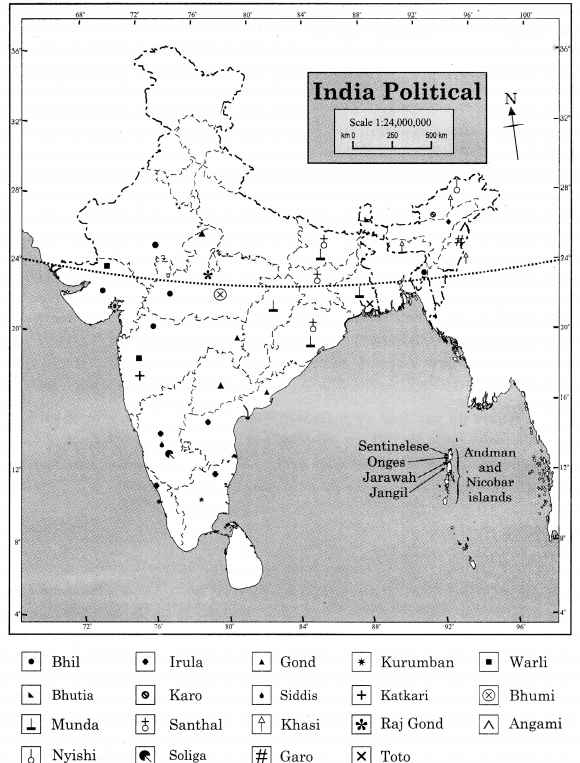
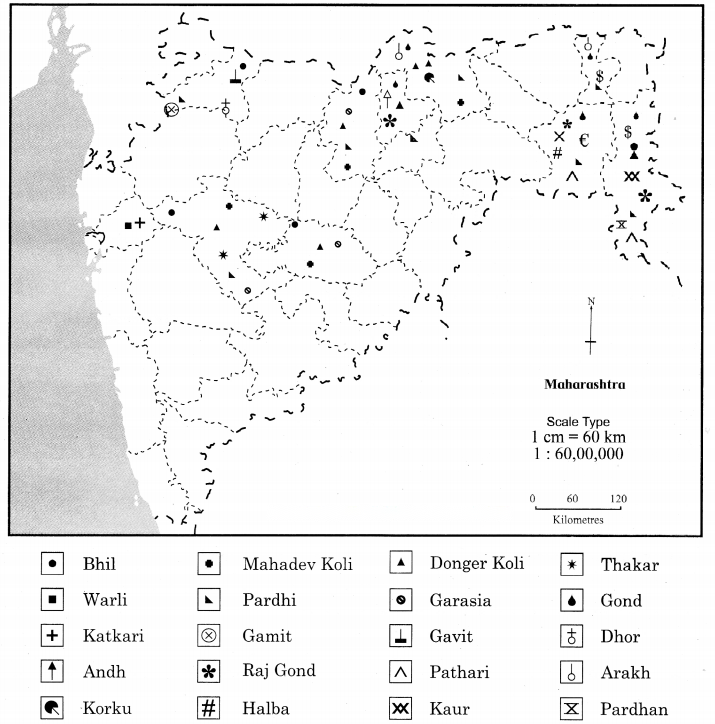
Look for the names of the tribes dependent on this biome in India including Maharashtra along with their habitats and show them on a map of India. (Textbook Page No. 87)
Solution & Step-by-Step Answer:
Major Tribes in India
Question 3
Maharashtra Board Solution
Obtain information regarding the tribes inhabiting this biome. Find out about their habitat, lifestyle, conventional ways of living with nature, cultural heritage, etc. (Textbook Page No. 89)
Solution & Step-by-Step Answer:
This Biome is the Savannah Grassland biome. The Masai is a Nilotic ethnic group.
Question 4
Maharashtra Board Solution
Find out the names of countries who produce and export wheat and maize. (Textbook Page No. 92)
Solution & Step-by-Step Answer:
The countries which produce and export wheat are Canada, USA, European union, Russian federation. The countries which produce and export maize are USA, Argentina, Brazil, Russian federation, and Ukraine.
|