Maharashtra State Board Class 11 Geography Solutions Chapter 5 Global Climate Change
1. Complete the chain.
A | B | C |
(1) Melting of snow | (1) Increase in sea level | (1) Flooding |
(2) Effects of insolation | (2) Erratic rains | (2) Increase in frequency of cyclones |
(3) Greenhouse gases | (3) Methane | (3) Agriculture |
(4) Climate change | (4) Average temperature of the earth | (4) Existence of life on Earth |
A | B | C |
(1) Melting of snow | (1) Methane | (1) Flooding |
(2) Effects of insolation | (2) Average temperature of the earth | (2) Agriculture |
(3) Greenhouse gases | (3) Erratic rains | (3) Existence of life on Earth |
(4) Climate change | (4) Increase in sea level | (4) Increase in frequency on cyclones 2. Identify the incorrect factor.
Question 1
Maharashtra Board Solution
The causes of global warming- (a) Emission of greenhouse gases (b) Deforestation (c) Apparent movement of the sun (d) Industrialization
Solution & Step-by-Step Answer:
(c) Apparent movement of the sun
Question 2
Maharashtra Board Solution
The indicators of climate change- (a) Retreat of glaciers (b) Increase in the frequency of floods (c) Increase in frequency of cyclones (d) Increase in the minimum and maximum temperature
Solution & Step-by-Step Answer:
(d) Increase in the minimum and maximum temperature
Question 3
Maharashtra Board Solution
The tools for studying climate change (a) Ice cores (b) Coral reef (c) Tree rings (d) Ancient forts
Solution & Step-by-Step Answer:
(d) Ancient forts
Question 4
Maharashtra Board Solution
Measures to combat climate change – (a) Banning the use of pesticides and insecticides (b) Promoting afforestation and banning deforestation (c) Banning public transport (d) Banning fossil fuels
Solution & Step-by-Step Answer:
(c) Banning public transport
3. Give geographical reasons.
Question 1
Maharashtra Board Solution
It is important to study climate change.
Solution & Step-by-Step Answer:
It is important to study climate change because –
Question 2
Maharashtra Board Solution
There is a great possibility that we may not see Maldives on the world map in the future.
Solution & Step-by-Step Answer:
There is a great possibility that we may not see Maldives on the world map in the future because-
Question 3
Maharashtra Board Solution
The snowline is retreating.
Solution & Step-by-Step Answer:
The snowline is retreating because –
Question 4
Maharashtra Board Solution
There is an increase in the frequency of droughts and cyclones.
Solution & Step-by-Step Answer:
There is an increase in the frequency of droughts and cyclones because-
4. Write short notes on.
Question 1
Maharashtra Board Solution
Bleaching of coral reefs
Solution & Step-by-Step Answer:
Question 2
Maharashtra Board Solution
Flash floods
Solution & Step-by-Step Answer:
Question 3
Maharashtra Board Solution
Tools to study Paleoclimatology
Solution & Step-by-Step Answer:
Paleoclimatology is the study of the weather and climate of the earth’s past. Scientists and meteorologists have been using instruments to measure climate and weather for the past 140 years. However, millions of years ago historical evidence called proxy data, which includes coral reefs, tree rings, ice cores, etc., were used to tell about the climate.
Coral reefs: Tree rings: Ice cores:
Question 4
Maharashtra Board Solution
Greenhouse gases
Solution & Step-by-Step Answer:
5. Answer in detail.
Question 1
Maharashtra Board Solution
Climate change has not always been anthropogenic in nature. Explain.
Solution & Step-by-Step Answer:
Though the human activities are a major cause behind climate change, there are some natural causes for climate change. They are as follows: Amount of energy output by the sun:
Milankovitch Oscillation: Volcanism: Goldilocks Zone:
Question 2
Maharashtra Board Solution
What measures will you suggest to combat climate change in your village/city.
Solution & Step-by-Step Answer:
Following measures can be taken to combat climate change in our village / city.
11th Geography Digest Chapter 5 Global Climate Change Intext Questions and Answers Can you tell? (Textbook Page No. 58) 1. The graph in the figure shows the difference between the global average temperature of the twentieth century and global monthly temperatures from 1985 to 2015. Answer the questions given below.
Question 1
Maharashtra Board Solution
In which year is the difference the least? Ans. Difference in the temperature is least in the year 1985. |

Question 2
Maharashtra Board Solution
What is the difference between the mean temperatures of the twentieth century and temperature in 2015?
Solution & Step-by-Step Answer:
block bg-white dark:bg-slate-900/80 border-l-4 border-emerald-500 rounded-r-xl p-5 my-3 shadow-xs border border-slate-200/60 dark:border-slate-800">
Solution & Step-by-Step Answer:
The difference between the mean temperature of twentieth century (1995-2000) and 2015 is 0.8°C.
Question 3
Maharashtra Board Solution
Why do the temperatures differ in different months?
Solution & Step-by-Step Answer:
The temperature differs in different months because of the occurrence of different seasons.
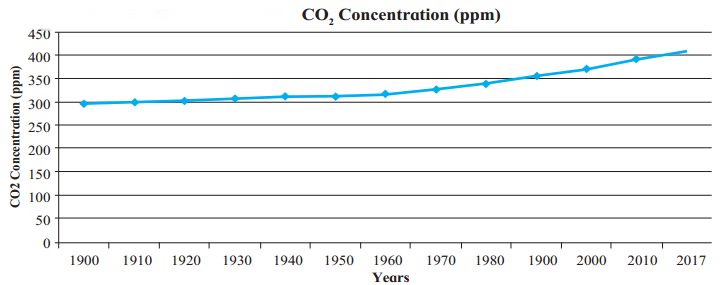
2. Look at the graph and answer the questions. (Textbook Page No. 63)
Question 1
Maharashtra Board Solution
What does this graph show? Ans. The graph shows CO2 concentration (ppm) and its increased level over the period of time from 1900 to 2017. |
Question 2
Maharashtra Board Solution
What does ppm mean?
Solution & Step-by-Step Answer:
block bg-white dark:bg-slate-900/80 border-l-4 border-emerald-500 rounded-r-xl p-5 my-3 shadow-xs border border-slate-200/60 dark:border-slate-800">
Solution & Step-by-Step Answer:
The abbreviation ppm means ‘parts per million’ of carbon concentration in the atmosphere.
Question 3
Maharashtra Board Solution
Since which year has the increase been phenomenal?
Solution & Step-by-Step Answer:
After 1980, there has been a phenomenal increase observed.
Question 4
Maharashtra Board Solution
Can you think of the reasons behind the increase in carbon dioxide?
Solution & Step-by-Step Answer:
The reasons behind the increase in carbon dioxide is due to combustion of fossil fuels and large- scale deforestation.
Try this. (Textbook Page No. 59) 1. Look at the following graph. Answer the following question.
Question 1
Maharashtra Board Solution
Which of these gases has the highest contribution?
Solution & Step-by-Step Answer:
Water vapour, shows the highest contribution.
Question 2
Maharashtra Board Solution
Which of these gases came from natural and man-made sources?
Solution & Step-by-Step Answer:
Water vapour, methane, NO2 and miscellaneous gases are naturally occurring gases while CO2 is man-made.
Question 3
Maharashtra Board Solution
Which activities are responsible for their emission?
Solution & Step-by-Step Answer:
Burning of fossil fuels like coal, etc., and deforestation are responsible for emission of CO2.
Question 4
Maharashtra Board Solution
Out of these, whose emission can be controlled by humans? Ans. The emission of CO2 can be controlled by humans. |

Question 2
Maharashtra Board Solution
Make a list of things you need to change in your lifestyle. (Textbook Page No. 67)
Solution & Step-by-Step Answer:
block bg-white dark:bg-slate-900/80 border-l-4 border-emerald-500 rounded-r-xl p-5 my-3 shadow-xs border border-slate-200/60 dark:border-slate-800">
Solution & Step-by-Step Answer:
Find out! (Textbook Page No. 62)
Question 1
Maharashtra Board Solution
Use internet and reference books on climate change and make a list of species vulnerable to climate change.
Solution & Step-by-Step Answer:
Species vulnerable to climate change are: corals, polar bear and frogs.
Question 2
Maharashtra Board Solution
Make a list of movies based on ice age and climate change. (Textbook Page No. 65)
Solution & Step-by-Step Answer:
Question 3
Maharashtra Board Solution
With the help of internet, find out the details of the National Action Plan on Climate Change (NAPCC), 2008 and its missions. (Textbook Page No. 66)
Solution & Step-by-Step Answer:
NAPCC is a government document that includes eight ambitious goals set for the country to achieve.
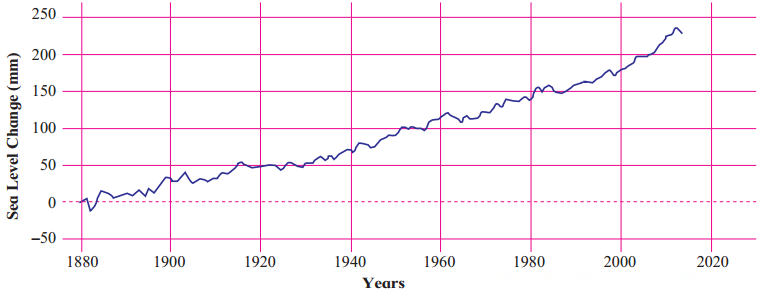
1. Look at the graph and answer the following questions. (Textbook Page No. 60)
Question 1
Maharashtra Board Solution
What does the graph show?
Solution & Step-by-Step Answer:
The graph shows an increase in the global sea level from 1880 till date.
Question 2
Maharashtra Board Solution
In which year is the change around 225 mm?
Solution & Step-by-Step Answer:
The change around 225 mm is observed is the year 2018.
Question 3
Maharashtra Board Solution
What conclusions can you draw by seeing the graph?
Solution & Step-by-Step Answer:
With the continued global warming the sea levels are likely to rise.
Question 4
Maharashtra Board Solution
What correlation can be seen in this graph and the graph of rising temperature?
Solution & Step-by-Step Answer:
With the rising temperature the sea level is rising. We can conclude this from both the graphs.
Question 2
Maharashtra Board Solution
Compare both the satellite images in fig 5.3 (A) and (B). (Textbook Page No. 61)
Solution & Step-by-Step Answer:
Fig. 5.3 (A) shows the snow-covered Gangotri glacier area in Dec. 1984, whereas in Fig. 5.3 (B) the snow-covered region of the Gangotri glacier has retreated by 2018.
|