Maharashtra State Board Class 11 Economics Solutions Chapter 9 Economic Policy of India Since 1991
1. Complete the following statements by choosing the correct alternative:
Solution & Step-by-Step Answer:
(c) Mixed economy
Solution & Step-by-Step Answer:
(d) High priority industries
Solution & Step-by-Step Answer:
(d) 2
2. Assertion and Reasoning questions:
Solution & Step-by-Step Answer:
(c) (A) and (R) both are TRUE and (R) is the correct explanation of (A)
Solution & Step-by-Step Answer:
(a) (A) is TRUE but (R) is FALSE
Solution & Step-by-Step Answer:
(b) (A) is FALSE but (R) is TRUE
Solution & Step-by-Step Answer:
(d) (A) and (R) both are TRUE but (R) is not the correct explanation of (A)
3. Find the odd word out:
Solution & Step-by-Step Answer:
Demonetization
Solution & Step-by-Step Answer:
agro-based industries
Solution & Step-by-Step Answer:
SPCL
Solution & Step-by-Step Answer:
NTPC
4. Identify and explain the concepts from the given illustrations:
Solution & Step-by-Step Answer:
Globalization. Globalization means the interaction of the domestic economy with the rest of the world with regard to foreign investment, trade, production, and financial matters.
Solution & Step-by-Step Answer:
Disinvestment. A disinvestment is an act of selling shares of sick public sector units to the private sector. Eg. Disinvestment of Maruti, ITDC hotels, VSNL, etc.
Solution & Step-by-Step Answer:
Foreign Direct Investment (FDI). FDI was approved under the Industrial Policy of 1991, to encourage investment in high-priority industries which require high investment and technology.
5. State with reasons whether you agree or disagree with the following statements:
Solution & Step-by-Step Answer:
Solution & Step-by-Step Answer:
Yes, I do agree with the statement.
Solution & Step-by-Step Answer:
No, I do not agree with the statement.
Solution & Step-by-Step Answer:
Yes, I do agree with the statement.
Solution & Step-by-Step Answer:
Yes, I do agree with the statement.
6. Answer in detail:
Solution & Step-by-Step Answer:
The process of the new economic policy started in 1985 and got momentum in 1991.
Features of Economic Policy, 1991:
Solution & Step-by-Step Answer:
Globalization means the interaction of the domestic economy with the rest of the world with regard to foreign investment, trade, production, and financial matters.
Measures were taken for Globalisation:
7. Read the following passage carefully and answer the questions:
The Indian ice cream industry is one of the fastest-growing segments of the dairy and food processing sector. India has a low per capita consumption of ice cream of 400 ml whereas in the USA it is 22,000 ml and in China, it is 3000ml.
The per capita consumption of ice cream is low in India because it is a country filled with traditional sweets of more than 100 varieties. In developed countries, people have either pastries or ice-creams for dessert. In the era of globalization, the mindset of the people is fast changing. This is because multi-national companies have set up a number of ice-cream parlors, with a lot more varieties and flavours that attract the younger lot. Besides this, there are better delivery systems.
The ice-cream sector has great potential for growth in the country due to improvement in the cold chain infrastructure, increasing disposable income, and changing the lifestyle of the people. However, it is taxed higher with 18 percent GST while other dairy products in the same basket such as butter and cheese are taxed at 12 percent.
The ice-cream industry has generated revenue of more than $1.5 billion in 2016-17. With the employment of 15 lakh people directly or indirectly, it is also considered one of the largest employers of the dairy and food processing industry.
Solution & Step-by-Step Answer:
In India, traditional sweets are available, which are having more than 100 varieties.
Solution & Step-by-Step Answer:
Due to globalisation, multinational companies have set up a number of ice-cream parlours with a lot of varieties and flavours. It helps to attract the younger generation of today.
Solution & Step-by-Step Answer:
In India Ice-cream industry has wider scope because there is an improvement in cold chain infrastructure, increase in disposable income, and changing lifestyle of the people.
Solution & Step-by-Step Answer:
The ice-cream sector is indirectly dependent on the primary sector. If the demand for ice cream increased then the income of cattle owners will grow. 18% GST on ice cream is high because ice cream is made from milk which is good for health as compared to tobacco, pan masala. Same GST (18%) is imposed on tobacco and pan masala but it is injurious to health and finally, the burden of GST will transfer to customers.
11th Economics Digest Chapter 9 Economic Policy of India Since 1991 Intext Questions and Answers
Find out: (Textbook Page No. 58)
Names of five Private Banks and Foreign Banks.
Answer:
Find out: (Textbook Page No. 60)
Names of companies coming under Maharatna and Miniratna status.
Answer:
Maharatna
Miniratna
Stimulate your memory: (Textbook Page No. 61)
What is Corporate Social Responsibility (CSR)? How does it help society?
Answer:
Activity-Based Questions
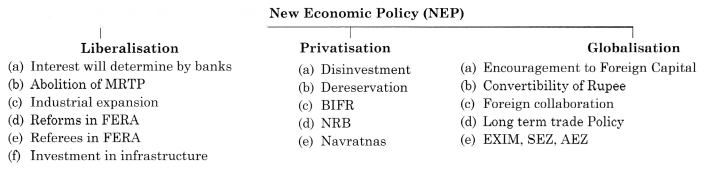
Observe the chart and answer the following question.
Solution & Step-by-Step Answer:
Globalisation is a process of integrating the domestic economy with the rest of the world with regard to foreign investment, trade, production, and financial matters.
Solution & Step-by-Step Answer:
Disinvestment is a process of selling shares of sick Public Sector Units (PSUs) to the private sector, so as to increase the production activities of that units and to achieve efficiency in the allocation of resources, improvement in management, etc. E.g. Disinvestment of Maruti, ITDC hotels. IPCL. VSNL, etc.
Solution & Step-by-Step Answer:
Solution & Step-by-Step Answer:
National Renewal Board was created to look after the retrenched workers who become unemployed due to the closure of loss-making Public Sector Units (PSUs). Through this Board, the government took the responsibility of providing compensations to the retrenched workers and also to take care of those seeking voluntary retirement
Solution & Step-by-Step Answer:
FERA was replaced by FEMA to encourage international trade and to bring flexibility in the laws relating to foreign exchange.