Balbharati Maharashtra State Board11th Commerce Maths Solution Book PdfChapter 9 Commercial Mathematics Ex 9.2 Questions and Answers.
Maharashtra State Board 11th Commerce Maths Solutions Chapter 9 Commercial Mathematics Ex 9.2
Question 1
Maharashtra Board Solution
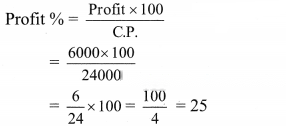
Mr. Sarad purchased a laptop for ₹ 24,000 and sold it for ₹ 30,000. What was the profit percentage?
Solution & Step-by-Step Answer:
Cost price (C.P.) = ₹ 24000 Selling price (S. P.) = ₹ 30,000 Profit = S.P. – C.P. = 30,000 – 24,000 = 6,000 ∴ Profit Percentage = 25%
Question 2
Maharashtra Board Solution
Shraddha purchased a mobile phone and refrigerator for ₹ 18,000 and ₹ 15,000 respectively. She sold the refrigerator at a loss of 20% and the mobile at a profit of 20%. What is her overall profit or loss?
Solution & Step-by-Step Answer:
C.P. of mobile phone = ₹ 18,000 Profit percentage on mobile phone = 20% Selling price (S.P.) of mobile phone = 18,000 (1 + ) = 18,000 (1 + ) = 18,000 × = ₹ 21,600 C.P. of refrigerator = 15,000 Loss percentage on refrigerator = 20% ∴ Selling price (S.P.) = 15,000(1 – ) = 15,000(1 – ) = 15,000 × = ₹ 12,000 ∴ Total gelling price for the transaction = 21,600 + 12,000 = ₹ 33,600 Total cost price (purchase price) for the transaction = 18,000 + 15,000 = ₹ 33,000 ∴ Overall profit made by Shraddha = Total S.P. – Total C.P. = 33,600 – 33,000 = ₹ 600 Thus, Shraddha made on overall profit of ₹ 600.
Question 3
Maharashtra Board Solution
A vendor bought toffees at 6 for ₹ 10. How many for ₹ 10 must he sell to gain 20%?
Solution & Step-by-Step Answer:
Vendor bought toffees at the rate of 6 for ₹ 10 ∴ Cost price of one toffee = i.e. C.P. = …….(i) Let x be the number of toffees he must sell in ₹ 10 to gain 20% i.e. S.P. = …….(ii) Profit percentage = Using (i) and (ii) we have ∴ 30(6 – x) = 6x ∴ 180 – 30x = 6x ∴ 36x = 180 ∴ x = 5 The vendor must sell 5 toffees for ₹ 10 in order to gain 20%.

Question 4
Maharashtra Board Solution
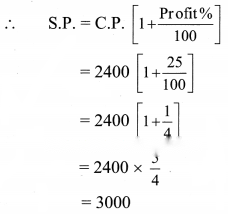
The percentage profit earned by selling an article for ₹ 2,880 is equal to the percentage loss incurred by selling the same article for ₹ 1,920. At what price the article should be sold to earn a 25% profit?
Solution & Step-by-Step Answer:
Let x be C.P. of the article Let y % be both, the gain and loss made when article is sold at ₹ 2,880 and ₹ 1,920 respectively. Then x + x = 2880 ……(i) x – x = 1920 …..(ii) Adding (i) and (ii), we get 2x = 4800 ∴ x = 2400 i.e. C.P. of the article = ₹ 2400 Required profit percentage = 25% ∴ The article should be sold at ₹ 3000 to earn 25% profit.
Question 5
Maharashtra Board Solution
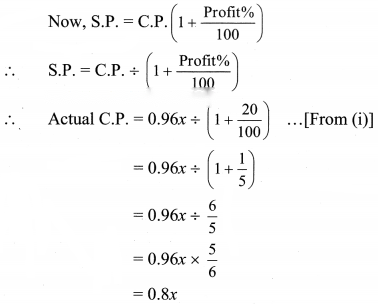
A cloth merchant advertises for selling cloth at a 4% loss. By using a faulty meter scale, he is earning a profit of 20%. What is the actual length of the scale?
Solution & Step-by-Step Answer:
Let the cost price of the cloth be ₹ ‘x’ per meter He claims a loss of 4% ∴ Selling price of the cloth S.P. = C.P.(1 – ) = x(1 – ) = 0.96x …..(i) The actual cost price of the cloth is lower as the cloth is measured by a faulty meter scale. Given that shopkeeper’s profit = 20% ∴ The actual cost price is 0.8 times the cost price as advertised. In other words, the meter scale used for the fraud is 0.8 times the meter scale that should have been used. ∴ The length of the faulty meter scale used = 0.8 × 1 = 0.8 meter ∴ The actual length of the scale is 0.8 meters.
Question 6
Maharashtra Board Solution
Sunil sells his bike worth ₹ 25,000 to Rohit at a profit of 20%. After 6 months Rohit sells the bike back to Sunil at a loss of 20%. Find the total profit percent of Sunil considering both the transactions.
Solution & Step-by-Step Answer:
Sunil sells his bike to Rohit at 20% profit. So S.P. of the bike for Sunil = 25000 + × 25000 = 25000 + 5000 = 30000 ∴ Cost price of bike to Rohit = ₹ 30000 Rohit sells the bike back to Sunil at 20% loss ∴ S.P. of the bike for Rohit = 30000 – × 30000 = 30000 – 6000 = 24000 ∴ In second transaction Sunil pays 24000 to Rohit In the first transaction, he had received 30000 from Rohit ∴ Sunil made a profit of ₹ (30000 – 24000) = ₹ 6000 Sunil earned this profit on the bike which costed him ₹ 25000 ∴ Total profit % that Sunil makes = × 100 = = 24 ∴ Sunil makes 24% profit considering both the transactions.
Question 7
Maharashtra Board Solution
By selling a book at ₹ 405 bookseller incurs a loss of 25%. Find the cost price of the book.
Solution & Step-by-Step Answer:
S.P. = ₹ 405 Loss% = 25 S.P. when there is a loss is given by S.P. = C.P. × ∴ The cost price of the book is ₹ 540.

Question 8
Maharashtra Board Solution
A cloth costs ₹ 675. If it is sold at a loss of 20%, what is its cost price as a percentage of its selling price?
Solution & Step-by-Step Answer:
C.P. = ₹ 675 Loss% = 20% ∴ Loss made in selling = × 675 = ₹ 135 S.P. = C.P. – Loss = 675 – 135 = ₹ 540 Let C.P. be x % S.P., Then 675 = × 540 ∴ x = = 125 ∴ Cost price is 125% of the selling price.
Question 9
Maharashtra Board Solution
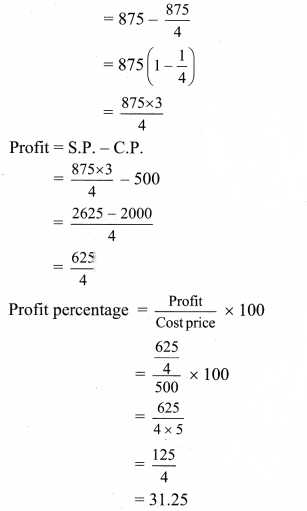
Ashwin buys an article for ₹ 500. He marks it for sale at 75% more than the cost price. He offers a 25% discount on the marked price to his customer. Calculate the actual percentage of profit made by Ashwin.
Solution & Step-by-Step Answer:
C.P. = ₹ 500 Marked price = C.P. + × C.P. = × 500 = 500 + 75 × 5 = 500 + 375 = 875 25% discount was given on marked price ∴ Discount = × 875 = Selling price = marked price – discount ∴ Ashwin makes 31.25% profit.
Question 10
Maharashtra Board Solution
The combined cost price of a refrigerator and a mixer is ₹ 12,400. If the refrigerator costs 600% more than the mixer, find the cost price of the mixer.
Solution & Step-by-Step Answer:
Let ₹ x be the cost price of the mixer. The cost price of the refrigerator = x + x = x + 6x = 7x Total cost price =12400 …..[Given] i.e. x + 7x = 12400 i.e. 8x = 12400 ∴ x = = 1550 ∴ The cost price of mixer is ₹ 1550.
Question 11
Maharashtra Board Solution
Find the single discount equivalent to the discount series of 5%, 7%, and 9%.
Solution & Step-by-Step Answer:
Let the marked price be ₹ 100 After 1st discount the price = 100(1 – ) = 95 After 2nd discount the price = 95(1 – ) = After 3rd discount the price = = = = 80.3985 ~ 80.4 Selling price after 3 discounts is ₹ 80.4 Single equivalent discount = Marked price – Selling price = 100 – 80.4 = ₹ 19.6 ∴ Single equivalent discount is 19.6%.
Question 12
Maharashtra Board Solution
The printed price of a shirt is ₹ 390. Lokesh pays ₹ 175.50 for it after getting two successive discounts. If the first discount is 10%, find the second discount.
Solution & Step-by-Step Answer:
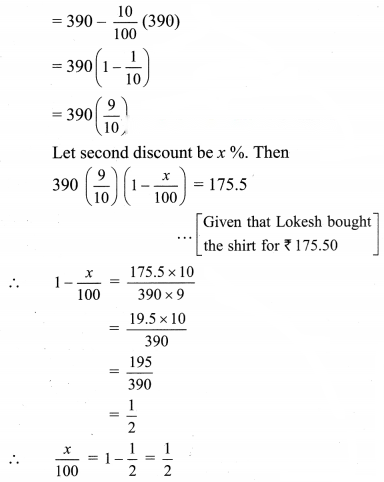
Marked price = ₹ 390 After the first discount of 10%, the price of the shirt ∴ x = 50 ∴ Second discount is 50%
Question 13
Maharashtra Board Solution
Amar, a manufacturer, gives a discount of 25% on the list price to his distributor Akbar, Akbar sells at a 10% discount on the list price to his customer Anthony. Anthony paid ₹ 540 for the article. What is the profit percentage of Akbar on his cost price?
Solution & Step-by-Step Answer:
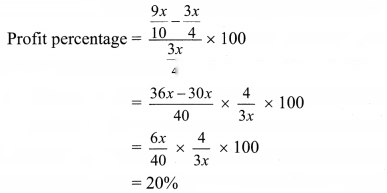
Let ₹ ‘x’ be the list price of the article. Amar gives a discount of 25% on the list price. ∴ Selling price for Amar = = = ₹ Amar sells the article to Akbar Cost price of article for Akbar = ₹ ……(i) Akbar sells the article to Anthony at 10% discount on list price ∴ Selling price for Akbar = = = ₹ …..(ii) Profit percentage = Using (i) and (ii), we have the profit percentage for Akbar as, ∴ Akbar gets a profit of 20% on his cost price.
Question 14
Maharashtra Board Solution
A man sells an article at a profit of 25%. If he had bought it at a 10% loss and sold it for ₹ 7 less, he would have gained 35%. Find the cost price of the article.
Solution & Step-by-Step Answer:
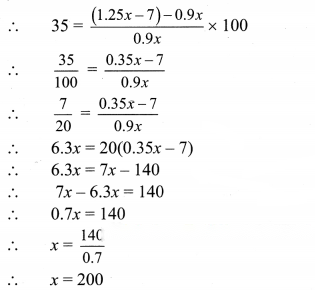
Let ₹ ‘x’ be the C.P. of the article ∴ Article was sold at 25% profit ∴ S.P. of the article = = = 1.25x If the article was bought at 10% loss i.e., the new C.P. = = = 0.9x and sold at ₹ 7 less ∴ New S.P. = 1.25x – 7 Then, the profit would have been 35% Using profit percentage = ∴ Cost price of the article is ₹ 200
Question 15
Maharashtra Board Solution
Mr. Mehta sold his two luxury cars at ₹ 39,10,000 each. On one he gains 15% but on the other, he loses 15%. How much does he gain or lose in the whole transaction?
Solution & Step-by-Step Answer:
Let x, y be the C.P. of two cars. S.P. of both the cars = 39,10,000 …..[Given] ∴ One car is sold at 15% loss ∴ S.P. of the first car = x – x ∴ x = 39,10,000 ∴ x = ∴ x = 46,000 × 100 ∴ x = 46,00,000 Other car is sold at 15% gain ∴ S.P. of second car = y + y ∴ y + y = 39,10,000 ∴ y = 39,10,000 ∴ y = ∴ y = 34,000 × 100 ∴ y = 34,00,000 x + y = Total C.P. of two cars = 46,00,000 + 34,00,000 = 80,00,000 Total S.P. = 39,10,000 + 39,10,000 = 78,20,000 ∴ S.P. < C.P. ∴ There is a loss of ₹ (80,00,000 – 78,20,000) = ₹ 1,80,000 ∴ Loss % = = = 2.25 ∴ Mr. Mehta bears a 2.25% loss in the whole transaction.