Balbharati Maharashtra State Board11th Commerce Maths Solution Book PdfChapter 5 Locus and Straight Line Ex 5.2 Questions and Answers.
Maharashtra State Board 11th Commerce Maths Solutions Chapter 5 Locus and Straight Line Ex 5.2
Solution & Step-by-Step Answer:
(a) Let A = (x1, y1) = (2, -1) and B = (x2, y2) = (4, 3). Slope of line AB = = = = 2
(b) Let C = (x1, y1) = (-2, 3) and D = (x2, y2) = (5, 7)
Slope of line CD =
=
=
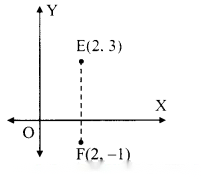
(c) Let E = (2, 3) = (x1, y1) and F = (2, -1) = (x2, y2)
Since x1= x2= 2
∴ The slope of EF is not defined. ……[EF || y-axis]
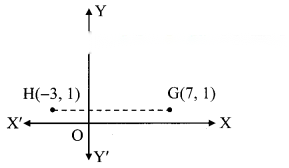
(d) Let G = (7, 1) = (x1, y1) and H = (-3, 1) = (x2, y2) say.
Since y1= y2
∴ The slope of GH = 0 …..[GH || x-axis]
Solution & Step-by-Step Answer:
Given, x-intercept of line L is 2 and y-intercept of line L is 3 ∴ the line L intersects X-axis at (2, 0) and Y-axis at (0, 3). i.e. the line L passes through (2, 0) = (x1, y1) and (0, 3) = (x2, y2) say. Slope of line L = = =
Solution & Step-by-Step Answer:
Given, inclination (θ) = 30° Slope of the line = tan θ = tan 30° =
Solution & Step-by-Step Answer:
Given, inclination (θ) = 45° Slope of the line = tan θ = tan 45° = 1
Solution & Step-by-Step Answer:
Given, x-intercept of line is 3 and y-intercept of line is 3 ∴ The line intersects X-axis at (3, 0) and Y-axis at (0, 3). i.e. the line passes through (3, 0) = (x1, y1) and (0, 3) = (x2, y2) say. Slope of line = = = -1
Solution & Step-by-Step Answer:
Given, A(4, 4) = (x1, y1), B(3, 5) = (x2, y2), C(-1, -1) = (x3, y3) Slope of AB = Slope of BC = Slope of AC = Slope of AB × slope of AC = -1 × 1 = -1 ∴ side AB ⊥ side AC ∴ ΔABC is a right angled triangle, right angled at A. ∴ The given points are the vertices of a right angled triangle.
Solution & Step-by-Step Answer:
Since, the line makes an angle of 45° with positive direction of Y-axis in anticlockwise direction. ∴ Inclination of the line (θ) = (90° + 45°) ∴ Slope of the line = tan(90° + 45°) = -cot 45° …….[tan(90 + θ°) = -cot θ] = -1

Solution & Step-by-Step Answer:
Given, points P(k, -1), Q(2, 1), and R(4, 5) are collinear. ∴ Slope of PQ = Slope of QR ∴ ∴ ∴ 1 = 2 – k ∴ k = 2 – 1 = 1
Check:
For collinear points P, Q, R,
Slope of PQ = Slope of QR = Slop of PR
For k = 1, if the given points are collinear, then our answer is correct.
P(1, -1), Q(2, 1) and R(4, 5)
Slope of PQ =
Slope of QR =
Slope of PQ = Slope of QR
∴ The given points are collinear.
Thus, our answer is correct.