Maharashtra State Board Class 10 Science Solutions Part 1 Chapter 8 Metallurgy
b.Molecular formula of common ore of aluminium.
Answer:
Al2O3.nH2O
c. The oxide that forms salt and water by reacting with both acid and base.
Answer:
Aluminium oxide (Al2O3).
d. device used for grinding an ore.
Answer:
The device used for grinding an ore is grinding mill.
e. The nonmetal having electrical conductivity.
Answer:
Graphite having electrical conductivity.
f. The reagent that dissolves noble metals.
Answer:
Aqua regia is the reagent that dissolves noble metals like gold and platinum.
Column I | Column II |
Substance | Property |
(1) Potassium bromide | (a) Combustible |
(2) Gold | (b) Soluble in water |
(3) Sulphur | (c) No chemical reaction |
(4) Neon | (d) High ductility |
(e) Magnetic ingredient |
(1) Potassium bromide – Soluble in water
(2) Gold – High ductility
(3) Sulphur – Combustible
(4) Neon – No chemical reaction
Question 3
Maharashtra Board Solution
Identify the pairs of metals and their ores from the following.
Solution & Step-by-Step Answer:
(1) Bauxite – Aluminium
(2) Cassiterite – Tin (3) Cinnabar – Mercury
Question 4
Maharashtra Board Solution
Explain the terms. a. Metallurgy
Solution & Step-by-Step Answer:
Metallurgy: The process used for extraction of metals in their pure form from their ores, then metals are further purified by different methods of purification. All the process is called metallurgy.
b. Ores. c. Minerals. d. Gangue.
Question 5
Maharashtra Board Solution
Write scientific reasons. a. Lemon or tamarind is used for cleaning copper vessels turned greenish.
Solution & Step-by-Step Answer:
b. Generally the ionic compounds have high melting points. c. Sodium is always kept in kerosene. d. Pine oil is used in the froth floatation process. e. Anodes need to be replaced from time to time during the electrolysis of alumina.
Question 6
Maharashtra Board Solution
When a copper coin is dipped in silver nitrate solution, a glitter appears on the coin after some time. Why does this happen? Write the chemical equation.
Solution & Step-by-Step Answer:
When a copper coin is dipped in a silver nitrate solution, more reactive copper displaces silver from silver nitrate solution. The silver so liberated deposits on the copper coin. As a result, a shiny coat of silver is formed on the coin. Cu(s) + 2AgNO3(aq) → Cu(NO3)2(aq) + 2Ag(s)
Question 7
Maharashtra Board Solution
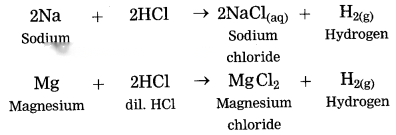
The electronic configuration of metal ‘A’ is 2, 8, 1 and that of metal ‘B’ is 2, 8, 2. Which of the two metals is more reactive? Identify these metals. Write their reaction with dilute hydrochloric acid. (Practice Activity Sheet – 1)
Solution & Step-by-Step Answer:
If the number of electrons in the outermost orbit is less, then the metal is more reactive. Metal A contains one electron in the outermost shell, while metal B contains two electrons. Hence, metal A is more reactive than metal B.
Metal A is sodium and metal B is magnesium. Reactions of Na and Mg with dil. HCl are,
Question 8
Maharashtra Board Solution
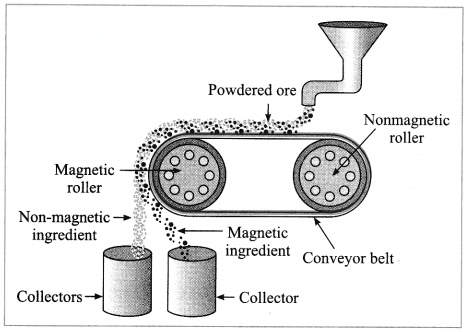
Draw a neat labelled diagram. a. Magnetic separation method.
Solution & Step-by-Step Answer:
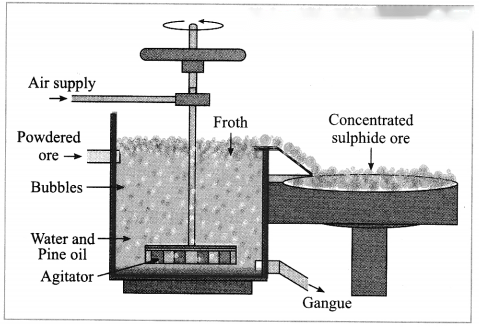
b. Forth floatation.
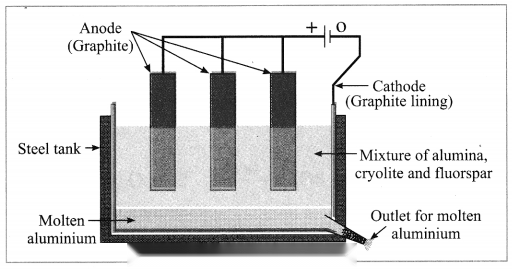
c. Electrolytic reduction of alumina.
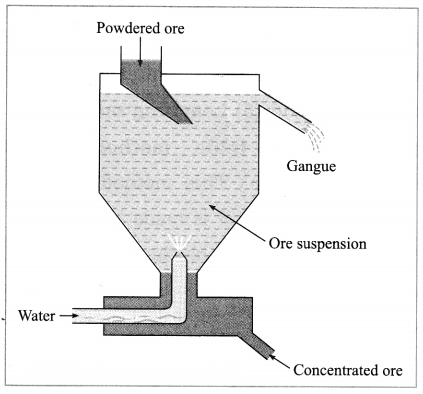
d. Hydraulic separation method.
Question 9
Maharashtra Board Solution
Write chemical equation for the following events. a. Aluminium came in contact with air.
Solution & Step-by-Step Answer:
When aluminium is exposed to air, it develops a thin oxide layer of aluminium.
b. Iron filings are dropped in aqueous solution of copper sulphate.
c. A reaction was brought about between ferric oxide and aluminium. The chemical reaction for the above is as follows: d. Electrolysis of alumina is done. e. Zinc oxide is dissolved in dilute hydrochloric acid.
Question 10
Maharashtra Board Solution
Complete the following statement using every given options. During the extraction of aluminium a. Ingredients and gangue in bauxite. b. Use of leuching during the concentration of ore. c. Chemical reaction of transformation of bauxite into alumina by Hall’s process. d. Heating the aluminium ore with concentrated caustic soda.
Solution & Step-by-Step Answer:
c. Chemical reaction of transformation of bauxite into alumina by Hall’s process.
Question 11
Maharashtra Board Solution
Divide the metals Cu, Zn, Ca, Mg, Fe, Na, Li into three groups, namely, reactive metals, moderately reactive metals and less reactive metals.
Solution & Step-by-Step Answer:
Reactive metals: Na, Li, Ca Moderately reactive metals: Zn, Fe, Mg, Less reactive metals: Cu
Project: (Do it your self) Collect metal vessels and various metal articles. Write detailed informciton. write the steps in the procedure that can be done in the laboratory for giving glitter to these. Seek guidance from your teacher. Can you recall? (Text Book Page No. 93)
Question 1
Maharashtra Board Solution
what are the physical properties of metals and nonmetals?
Solution & Step-by-Step Answer:
Properties of metals:
Properties or nonmetals: Can you recall? (Text Book Page No. 102)
Question 1
Maharashtra Board Solution
What is the electronic definition of oxidation and reduction?
Solution & Step-by-Step Answer:
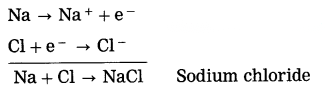
When a metal loses çlectrons the process is called an oxidation while when a nonmetal gains electrons, it is called a reduction, Na → Na+ + e– (oxidation) Cl– + e– → Cl (reduction)
Can you recall? (Text Book Page No. 106)
Question 1
Maharashtra Board Solution
What is meant by corrosion?
Solution & Step-by-Step Answer:
Corrosion is degradation of a material due toreaction with its environment.
Question 2
Maharashtra Board Solution
Have you observed the following things? (1) Old iron bars in the builthngs.
Solution & Step-by-Step Answer:
When old iron bars in the buildings are exposed to moist air for a long time, they acquire a coating of browm nlaky substance called rust. (Fe2O3.H2O)
(2) Copper vessels not cleaned for a long time.
Question 3
Maharashtra Board Solution
Silver ornaments or idols exposed to air for a long time.
Solution & Step-by-Step Answer:
When silver ornaments or idols are kept exposed to air for a long time, silver reacts with sulphur in the air to form a coating of black silver sulphide. (Ag2S)
Question 4
Maharashtra Board Solution
Old vehicles fit to be thrown away.
Solution & Step-by-Step Answer:
The metallic parts of the body of old cars are corroded, eaten up and sometimes become perforated. The old cars also lose the original colour due to formation of flakes of rust.
Use your brain power! (Text Book Page No. 98)
Question 1
Maharashtra Board Solution
In the reaction between chlorine and HBr a transformation or HBr into Br2 takes place. Can this transformation be called oxidation? What Is the oxidant that brings about this oxidation?
Solution & Step-by-Step Answer:
The conversion of HBr to Br2 is an oxidation process. In the above reaction, Cl2 in the oxidant.
Can you tell? (Text Book Page No. 104)
Question 1
Maharashtra Board Solution
what are the moderately reactive metals?
Solution & Step-by-Step Answer:
In the middle of the reactivity series, metals such as iron. zinc, lead, copper are moderately reactive.
Question 2
Maharashtra Board Solution
In which form to the moderately reactive metals occur in nature?
Solution & Step-by-Step Answer:
The moderately reactive metals which occur in nature are in the form of their sulphide salts or carbonate salts.
Think about it (Text Book Page No. 106)
Question 1
Maharashtra Board Solution
Why do silver articles turn blackish while copper vessels turn greenish on keeping in air for long time?
Solution & Step-by-Step Answer:
Question 2
Maharashtra Board Solution
Why do pure gold and platinum always glitter?
Solution & Step-by-Step Answer:
Gold and platinum are noble metals as they do not react with moisture, O2 and CO2 from air also acids and alkalis, therefore, pure gold and platinum always glitter.
Use your brain power! (Text Book Page No. 103)
Question 1
Maharashtra Board Solution
Write the electrode reaction for electrolysis of molten magnesium chloride and calcium chloride.
Solution & Step-by-Step Answer:
(1) Magnesium chloride (MgCl2): MgCl2 → Mg2+ + 2Cl– At the cathode: Mg2+ + 2e– → Mg At the anode: 2Cl– → Cl2 + 2e–
(2) Calcium chloride (CaCl2): Can you tell? (Text Book Page No. 106)
Question 1
Maharashtra Board Solution
Which measures would you suggest to stop the corrosion of metallic articles or not allow the corrosion to start?
Solution & Step-by-Step Answer:
Various types of methods are used to protect metals from corrosion. Almost in all the methods, special attention is paid so that iron does not rust. It is possible to lower the rate of the process of rusting of iron. Corrosion of metals can be stopped by detaching the air from metals.
Some methods are as follows :
Question 2
Maharashtra Board Solution
What is done so to prevent rusting of iron windows and iron doors of your house?
Solution & Step-by-Step Answer:
To prevent rusting of iron windows and iron doors in the house, they are painted so that they do not rust.
Question 3
Maharashtra Board Solution
What is done so to prevent rusting or iron windows and iron doors of your house?
Solution & Step-by-Step Answer:
To prevent rusting of iron windows and iron doors in the house, they are painted so that they do not rust.
Use your brain power! (Text Book Page No. 107)
Question 1
Maharashtra Board Solution
Can we permanently prevent the rusting of an iron article by applying a layer of paint on its surface?
Solution & Step-by-Step Answer:
The method of painting is alright for some time. We cannot protect the articles permanently from rusting by painting them.
Question 2
Maharashtra Board Solution
Why do new iron sheets appear shiny?
Solution & Step-by-Step Answer:
The new iron sheets appear shiny because a layer of non-corrosionable metal is fixed on the surface of corrosionable metal.
Collect information. (Text Book Page No. 108)
Question 1
Maharashtra Board Solution
What are the various alloys used in daily life? Where are those used?
Solution & Step-by-Step Answer:
Question 2
Maharashtra Board Solution
What are the properties that the alloy used for minting coins should have?
Solution & Step-by-Step Answer:
The alloy used for minting coins should have excellent wear resistance and anti-corrosion properties.
Fill in the blanks:
Question 1
Maharashtra Board Solution
……………has the highest melting point.
Solution & Step-by-Step Answer:
Tungsten has the highest melting point.
Question 2
Maharashtra Board Solution
Mercury and…………are two metals in the liquid state at room temperature.
Solution & Step-by-Step Answer:
Mercury and galium are two metals in the liquid state at room temperature.
Question 3
Maharashtra Board Solution
…………is the hardest natural substance.
Solution & Step-by-Step Answer:
Diamond is the hardest natural substance.
Question 4
Maharashtra Board Solution
The naturally occurring compounds of metals along with other impurities are known as………….
Solution & Step-by-Step Answer:
The naturally occurring compounds of metals along with other impurities are known as minerals.
Question 5
Maharashtra Board Solution
The minerals from which metals are extracted profitably and conveniently are called…………..
Solution & Step-by-Step Answer:
The minerals from which metals are extracted profitably and conveniently are called ores.
Question 6
Maharashtra Board Solution
An ore contains some of the impurities like soil, sand, etc. These impurities are called…………
Solution & Step-by-Step Answer:
An ore contains some of the impurities like soil, sand, etc. These impurities are called gangue.
Question 7
Maharashtra Board Solution
The process of extraction of a metal from its ore is called……….
Solution & Step-by-Step Answer:
The process of extraction of a metal from its ore is called metallurgy.
Question 8
Maharashtra Board Solution
Bauxite is a common ore of………..
Solution & Step-by-Step Answer:
Bauxite is a common ore of aluminium.
Question 9
Maharashtra Board Solution
…………. process is used for the purification of bauxite.
Solution & Step-by-Step Answer:
Bayer’s process is used for the purification of bauxite.
Question 10
Maharashtra Board Solution
During the electrolysis of alumina, ………..is liberated at the anode.
Solution & Step-by-Step Answer:
During the electrolysis of alumina, oxygen is liberated at the anode.
Question 11
Maharashtra Board Solution
The reaction of iron oxide with aluminium is known as…………..reaction.
Solution & Step-by-Step Answer:
The reaction of iron oxide with aluminium is known as thermit reaction.
Question 12
Maharashtra Board Solution
The process of coating a thin layer of zinc on iron is known as…………
Solution & Step-by-Step Answer:
The process of coating a thin layer of zinc on iron is known as galvanising.
Question 13
Maharashtra Board Solution
The metal that produces a sound on striking a hard surface is said to be………….
Solution & Step-by-Step Answer:
The metal that produces a sound on striking a hard surface is said to be sonorous.
Question 14
Maharashtra Board Solution
The process in which carbonate ores are changed into oxides by heating strongly in limited air is known as …………….
Solution & Step-by-Step Answer:
The process in which carbonate ores are changed into oxides by heating strongly in limited air is known as calcination.
Question 15
Maharashtra Board Solution
…………compounds are insoluble in solvents like kerosene and petrol.
Solution & Step-by-Step Answer:
Ionic compounds are insoluble in solvents like kerosene and petrol.
Question 16
Maharashtra Board Solution
…………… is used to obtain pure metals from impure metals.
Solution & Step-by-Step Answer:
Electrolys is method is used to obtain pure metals from impure metals.
Question 17
Maharashtra Board Solution
Corrosion can be prevented-by putting a layer of…………metal on corrosionable metal.
Solution & Step-by-Step Answer:
Corrosion can be prevented by putting a layer of non-corrosionable metal on corrosionable metal.
Rewrite the following statements by selecting the correct options:
Question 1
Maharashtra Board Solution
………… is a metal. (a) Mg (b) S (c) P (d) Br
Solution & Step-by-Step Answer:
Mg is a metal.
Question 2
Maharashtra Board Solution
………. is a nonmetal. (a) Au (b) Hg (c) Br (d) Cu
Solution & Step-by-Step Answer:
Br is a nonmetal.
Question 3
Maharashtra Board Solution
………… is a metalloid. (a) Aluminium (b) Antimony (c) Zinc (d) Mercury
Solution & Step-by-Step Answer:
Antimony is a metalloid.
Question 4
Maharashtra Board Solution
Metalloids have properties of ……….. (a) metals (b) nonmetals (c) both metals and nonmetals (d) neither metals nor nonmetals
Solution & Step-by-Step Answer:
Metalloids have properties of both metals and nonmetals.
Question 5
Maharashtra Board Solution
…………. is a good conductor of electricity. (a) Bromine (b) Iodine (c) Graphite (d) Sulphur
Solution & Step-by-Step Answer:
Graphite is a good conductor of electricity.
Question 6
Maharashtra Board Solution
………. is a metal which is in liquid form at ordinary temperature and pressure. (a) Magnesium (b) Sodium (c) Scandium (d) Mercury
Solution & Step-by-Step Answer:
Mercury is a metal which is in liquid form at ordinary temperature and pressure.
Question 7
Maharashtra Board Solution
………. is an amphoteric oxide. (a) Na2O (b) MgO (c) ZnO (d) SO2
Solution & Step-by-Step Answer:
ZnO is an amphoteric oxide.
Question 8
Maharashtra Board Solution
……….. is an acidic oxide. (a) Na2O (b) CO2 (c) FeO3 (d) H2O
Solution & Step-by-Step Answer:
CO2 is an acidic oxide.
Question 9
Maharashtra Board Solution
………. is a basic oxide. (a) CO2 (b) K2O (C) SO2 (d) Al2O3
Solution & Step-by-Step Answer:
K2O is a basic oxide.
Question 10
Maharashtra Board Solution
………… is an ore of aluminium. (a) Cryolite (b) Bauxite (c) Haematite (d) Aluminium carbonate
Solution & Step-by-Step Answer:
Bauxite is an ore of aluminium.
Question 11
Maharashtra Board Solution
Bronze is an alloy of ……….. (a) copper and tin (b) copper and zinc (c) copper and iron (d) iron and nickel
Solution & Step-by-Step Answer:
Bronze is an alloy of copper and tin.
Question 12
Maharashtra Board Solution
An alloy prepared from iron, nickel and chromium is known as ………… (a) brass (b) bronze (c) stainless steel (d) amalgam
Solution & Step-by-Step Answer:
An alloy prepared from iron, nickel and chromium is known as stainless steel.
Question 13
Maharashtra Board Solution
…………. is an allotropic form of a nonmetal which conducts electricity. (a) Sulphur (b) Graphite (c) Chlorine (d) Iodine
Solution & Step-by-Step Answer:
Graphite is an allotropic form of a nonmetal which conducts electricity.
Question 14
Maharashtra Board Solution
………….. has an oxide which is soluble in sodium hydroxide. (a) Calcium (b) Magnesium (c) Iron (d) Zinc.
Solution & Step-by-Step Answer:
Zinc has an oxide which is soluble in sodium hydroxide.
Question 15
Maharashtra Board Solution
………… prevents the rusting of iron. (a) Copper (b) Zinc (c) Aluminium (d) Silver
Solution & Step-by-Step Answer:
Zinc prevents the rusting of iron.
Question 16
Maharashtra Board Solution
………….. is obtained by the reduction of its oxide by carbon. (a) Zinc (b) Aluminium (c) Sodium (d) Potassium
Solution & Step-by-Step Answer:
Zinc is obtained by the reduction of its oxide by carbon.
Question 17
Maharashtra Board Solution
………….. is used as an anode during the electrolytic reduction of bauxite. (a) Sulphur (b) Graphite (c) Platinum (d) Aluminium
Solution & Step-by-Step Answer:
Graphite is used as an anode during the electrolytic reduction of bauxite.
Question 18
Maharashtra Board Solution
Silver gets corroded due to ………… in air. (a) oxygen (b) hydrogen sulphide (c) carbon dioxide (d) nitrogen
Solution & Step-by-Step Answer:
Silver gets corroded due to hydrogen sulphide in air.
Question 19
Maharashtra Board Solution
…………. is the hardest substance and has the highest melting and boiling points. (a) Iodine (b) Sulphur (c) Diamond (d) Phosphorus
Solution & Step-by-Step Answer:
Diamond is the hardest substance and has the highest melting and boiling points.
Question 20
Maharashtra Board Solution
Jewellery articles are gold plated …………. (a) to prevent corrosion (b) to prevent rusting of the base metal (c) to make articles attractive (d) all of these
Solution & Step-by-Step Answer:
(d) all of these
Question 21
Maharashtra Board Solution
To show that zinc is more reactive than copper, the correct procedure is to ……….. (a) prepare copper sulphate solution and dip a zinc strip in it (b) prepare zinc sulphate solution and dip a copper strip in it (c) heat together zinc and copper strips (d) add dil. nitric acid to both the strips
Solution & Step-by-Step Answer:
To show that zinc is more reactive than copper, the correct procedure is to prepare copper sulphate solution and dip a zinc strip in it.
Question 22
Maharashtra Board Solution
Iron is ……… (a) more reactive than zinc (b) more reactive than aluminuium (c) less reactive than copper (d) less reactive than aluminium
Solution & Step-by-Step Answer:
Iron is less reactive than aluminium.
Question 23
Maharashtra Board Solution
A solution of Al2(SO4)3 in water is ………… (a) blue (b) pink (c) green (d) colourless
Solution & Step-by-Step Answer:
A solution of Al2(SO4)3 in water is colourless.
Question 24
Maharashtra Board Solution
A solution of ………… in water is blue in colour. (a) CuSO4 (b) FeSO4 (c) ZnSO4 (d) Al2(SO4)3
Solution & Step-by-Step Answer:
A solution of CuSO4 in water is blue in colour.
Question 25
Maharashtra Board Solution
A solution of …………. n water is green in colour. (a) CuSO4 (b) FeSO4 (c) ZnSO4 (d) Al2(SO4)3
Solution & Step-by-Step Answer:
A solution of FeSO4 in water is green in colour.
Question 26
Maharashtra Board Solution
What would be the correct order if Zn, Fe, Al and Cu are arranged in increasing order of reactivity? (a) Cu, Fe, Zn, Al (b) Al, Cu, Fe, Zn (c) Zn, Al, Cu, Fe (d) Fe, Zn, Al, Cu (Practice Activity Sheet – 2)
Solution & Step-by-Step Answer:
(a) Cu, Fe, Zn, Al
Question 27
Maharashtra Board Solution
During the extraction of aluminium ………. (a) Ingredients and gangue in bauxite (b) Use of leaching during the concentration of ore (c) Chemical reaction of transformation of bauxite into alumina by Hall’s process. (d) Heating the aluminium ore with concentrated caustic soda.
Solution & Step-by-Step Answer:
During the extraction of aluminium Chemical reaction of transformation of bauxite into alumina by Hall’s process.
Question 28
Maharashtra Board Solution
A solution of CuSO4 in water is ………… in colour. (a) pink (b) blue (c) colourless (d) green
Solution & Step-by-Step Answer:
A solution of CuSO4 in water is blue in colour.
Question 29
Maharashtra Board Solution
Which of the following process is to be carried out to avoid the formation of greenish layer on brass vessels due to corrosion? (a) Plating (b) Anodization (c) Tinning (d) Alloying (Practice Activity Sheet – 3)
Solution & Step-by-Step Answer:
(c) Tinning
State whether the following statements are True or False (If a statement is false, correct it and rewrite it.):
Question 1
Maharashtra Board Solution
Metals are known as sonar metals.
Solution & Step-by-Step Answer:
True.
Question 2
Maharashtra Board Solution
Diamond is the softest natural substance.
Solution & Step-by-Step Answer:
False. (Diamond is the hardest natural substance.)
Question 3
Maharashtra Board Solution
Electrolysis method is used to obtain pure metals from impure metals.
Solution & Step-by-Step Answer:
True.
Question 4
Maharashtra Board Solution
Iodine and diamond are lustrous substances.
Solution & Step-by-Step Answer:
True.
Question 5
Maharashtra Board Solution
Aqua Regia is a mixture of conc. HCl and conc. HNO3 in the ratio of 1:3.
Solution & Step-by-Step Answer:
False. (Aqua Regia is a mixture of conc. HCl and conc. HNO3 in the ratio of 3:1.)
Question 6
Maharashtra Board Solution
Corrosion of metals can be stopped by detaching the air from metals.
Solution & Step-by-Step Answer:
True.
Question 7
Maharashtra Board Solution
Due to corrosion a greenish layer forms on the surface of copper or brass vessel.
Solution & Step-by-Step Answer:
True.
Question 8
Maharashtra Board Solution
Ionic compounds are soluble in kerosene.
Solution & Step-by-Step Answer:
False. (Ionic compounds are soluble in water and insoluble in kerosene.)
Question 9
Maharashtra Board Solution
Ionic compounds in the solid state conduct electricity.
Solution & Step-by-Step Answer:
False. (Ionic compounds in the solid state do not conduct electricity.)
Question 10
Maharashtra Board Solution
Mercury, silver and gold are very reactive metals.
Solution & Step-by-Step Answer:
False. (Mercury, silver and gold are least reactive metals.)
Question 11
Maharashtra Board Solution
In electroplating a metal is coated with another metal using electrolysis.
Solution & Step-by-Step Answer:
True.
Question 12
Maharashtra Board Solution
In anodising method. the copper or aluminium article is used as anode.
Solution & Step-by-Step Answer:
True.
Question 13
Maharashtra Board Solution
Silver plated spoon, gold plated ornaments are the examples of alloying.
Solution & Step-by-Step Answer:
False. (Silver plated spoon, gold plated ornaments are the examples of electroplating)
Question 14
Maharashtra Board Solution
silver amalgam is mainly used by dentists.
Solution & Step-by-Step Answer:
True.
Question 15
Maharashtra Board Solution
Aluminium oxide is an acidic oxide.
Solution & Step-by-Step Answer:
False. (Aluminium oxide is an amphoteric oxide.)
Question 16
Maharashtra Board Solution
copper reacts with moist carbon form copper carbonate.
Solution & Step-by-Step Answer:
True.
Question 17
Maharashtra Board Solution
Corrosion is degradation of a reaction with its environment.
Solution & Step-by-Step Answer:
True.
Find the correlation in the given pair and rewrite the answer:
Question 1
Maharashtra Board Solution
Brass : Copper and Zinc :: Bronze :………….
Solution & Step-by-Step Answer:
Brass : Copper and Zinc :: Bronze : Copper and tin
Question 2
Maharashtra Board Solution
Tinning : Tin :: Galvanizing :…………….
Solution & Step-by-Step Answer:
Tinning : Tin :: Galvanizing : Zinc
Question 3
Maharashtra Board Solution
Pressure cooker : Anodizing :: Silver plated spoons :…………..
Solution & Step-by-Step Answer:
Pressure cooker : Anodizing :: Silver plated spoons : Electro-plating
Question 4
Maharashtra Board Solution
The sulphides ores are strongly heated in air : Roasting :: The carbonates ores are strongly heated in a limited supply of air :………….
Solution & Step-by-Step Answer:
The sulphides ores are strongly heated in air : Roasting :: The carbonates ores are strongly heated in a limited supply of air : Calcination.
Question 5
Maharashtra Board Solution
Sulphide ores : Froth floatation method : Cassiterite ore :………..
Solution & Step-by-Step Answer:
Sulphide ores : Froth floatation method : Cassiterite ore : Magnetic separation method.
Find the odd one out:
Question 1
Maharashtra Board Solution
Sodium, Potassium, Silver, Sulphur
Solution & Step-by-Step Answer:
Sulphur. (All except sulphur, others are metals.)
Question 2
Maharashtra Board Solution
Boron, Chlorine, Bromine, Fluorine
Solution & Step-by-Step Answer:
Boron. (All except boron, others are nonmetals.)
Question 3
Maharashtra Board Solution
Copper, Iron, Mercury, Brass
Solution & Step-by-Step Answer:
Brass. (All except brass, others are metals.)
Question 4
Maharashtra Board Solution
Brass, Bronze, Phosphorus, Stainless steel
Solution & Step-by-Step Answer:
Phosphorus. (All except phosphorus, others are alloys.)
Question 5
Maharashtra Board Solution
Magnesium chloride, Sodium chloride, Water, Zinc chloride
Solution & Step-by-Step Answer:
Water. (All except water, others are ionic compounds.)
Question 6
Maharashtra Board Solution
Tinning, Anodization, Alloying, Froth floatation (March 2019)
Solution & Step-by-Step Answer:
Froth floatation. (All except froth floatation, others are processes of coating a thin layer of metal on the surface of other metals.)
Match the following:
Question 1
Maharashtra Board Solution
|



Column I | Column II |
(1) ZnS | (a) Cuprous sulphide |
(2) HgS | (b) Bauxite |
(3) Cu2S | (c) Zinc blend |
(4) Al2O3.H2O | (d) Cinnabar |
(e) Cryolite |
(1) ZnS – Zinc blend
(2) HgS – Cinnabar
(3) Cu4S – Cuprous sulphide
(4) Al2O3.H2O – Bauxite.
Question 2
Maharashtra Board Solution
Solution & Step-by-Step Answer:
(1) Copper and zinc – Brass
(2) Copper and tin – Bronze (3) Iron, nickel and chromium – Stainless steel (4) Mercury and zinc – Zinc amalgam.
Question 3
Maharashtra Board Solution
|
Column I | Column II |
(1) Galvanising | (a) Pressure cooker |
(2) Tinning | (b) Silver plated spoons |
(3) Electroplating | (c) Coating of tin on copper |
(4) Anodizing | (d) Coating of Zn on iron |
(1) Galvanising – Coating of Zn on iron
(2) Tinning – Coating of tin on copper
(3) Electroplating – Silver plated spoons
(4) Anodizing – Pressure cooker.
Translate the following statements into chemical equations and then balance them:
Question 1
Maharashtra Board Solution
steam is passed over aluminium.
Solution & Step-by-Step Answer:
Question 2
Maharashtra Board Solution
Extraction of copper from its sulphide ore.
Solution & Step-by-Step Answer:
Question 3
Maharashtra Board Solution
Thermit reaction.
Solution & Step-by-Step Answer:
Question 4
Maharashtra Board Solution
Magnesium reacts with hot water.
Solution & Step-by-Step Answer:
Question 5
Maharashtra Board Solution
what happens when aluminium oxide dissolves in aqueous sodium hydroxide?
Solution & Step-by-Step Answer:
Question 6
Maharashtra Board Solution
Zinc reacts with sulphuric acid.
Solution & Step-by-Step Answer:
Question 7
Maharashtra Board Solution
Iron reacts with sulphuric acid.
Solution & Step-by-Step Answer:
Name the following:
Question 1
Maharashtra Board Solution
A metal which forms an amphoteric oxide.
Solution & Step-by-Step Answer:
Aluminium forms an amphoteric oxide.
Question 2
Maharashtra Board Solution
An alloy of copper and zinc.
Solution & Step-by-Step Answer:
An alloy of copper and zinc is termed as brass.
Question 3
Maharashtra Board Solution
A compound which is added to lower the fusion temperature.
Solution & Step-by-Step Answer:
Cryolite (AlF3, 3NaF) and fluorspar (CaF2) are added to lower the fusion temperature.
Question 4
Maharashtra Board Solution
A metal which does not react with cold water but reacts with steam.
Solution & Step-by-Step Answer:
Aluminium does not react With cold water but reacts with Steam.
Question 5
Maharashtra Board Solution
A common ore of aluminium.
Solution & Step-by-Step Answer:
Bauxite (Al2O3.H2O) is a common ore of aluminium.
Question 6
Maharashtra Board Solution
A metal which is in liquid state at ordinary temperature.
Solution & Step-by-Step Answer:
Mercury is in liquid state at ordinary temperature.
Question 7
Maharashtra Board Solution
Two metals which are malleable.
Solution & Step-by-Step Answer:
Iron and aluminium are malleable metals.
Question 8
Maharashtra Board Solution
Two metals which are ductile.
Solution & Step-by-Step Answer:
Gold and silver are ductile metals.
Question 9
Maharashtra Board Solution
Two metals which are good conductors of heat.
Solution & Step-by-Step Answer:
Silver and copper are good conductors of heat.
Question 10
Maharashtra Board Solution
Two metals which are good conductors of electricity.
Solution & Step-by-Step Answer:
Copper and aluminium are good conductors of electricity.
Question 11
Maharashtra Board Solution
Two metals which are used for making cooking vessels.
Solution & Step-by-Step Answer:
Copper and aluminium are used in making cooking vessels.
Question 12
Maharashtra Board Solution
Two metals having low melting points.
Solution & Step-by-Step Answer:
Sodium and potassium have low melting points.
Question 13
Maharashtra Board Solution
Two highly reactive metals.
Solution & Step-by-Step Answer:
Sodium and potassium are highly reactive metals.
Question 14
Maharashtra Board Solution
A nonmetal which is in liquid state at room temperature.
Solution & Step-by-Step Answer:
Bromine is in liquid state at room temperature.
Question 15
Maharashtra Board Solution
Two ionic compounds.
Solution & Step-by-Step Answer:
Sodium chloride (NaCl) and magnesium chloride (MgCl2) are ionic compounds.
Question 16
Maharashtra Board Solution
The process of heating the sulphide ore to a high temperature in the excess of air.
Solution & Step-by-Step Answer:
In roasting, sulphide ore is heated to a high temperature in the excess of air.
Question 17
Maharashtra Board Solution
The process of heating the carbonate ore to a high temperature in limited air.
Solution & Step-by-Step Answer:
In calcination, carbonated ore is heated to a high temperature in limited air.
Question 18
Maharashtra Board Solution
The compound formed by the reaction between aluminium oxide and sodium hydroxide.
Solution & Step-by-Step Answer:
Sodium aluminate is formed by the reaction between aluminium oxide and sodium hydroxide.
Question 19
Maharashtra Board Solution
Two metals which are found in the free state in nature.
Solution & Step-by-Step Answer:
Gold (Au) and silver (Ag) are found in the free state in nature.
Question 20
Maharashtra Board Solution
A metal which has the highest melting point.
Solution & Step-by-Step Answer:
Tungsten has the highest melting point.
Question 21
Maharashtra Board Solution
Two nonmetals which are lustrous.
Solution & Step-by-Step Answer:
Iodine and diamond are lustrous in nature.
Answer the following questions in one sentence each:
Question 1
Maharashtra Board Solution
State the property of the metals due to which they can be drawn into wires.
Solution & Step-by-Step Answer:
The property of the metal due to which they can be drawn into wires is called ductility.
Question 2
Maharashtra Board Solution
State the property of the metals due to which they can be beaten into thin sheets.
Solution & Step-by-Step Answer:
The property of the metals due to which they can be beaten into thin sheets is called malleability.
Question 3
Maharashtra Board Solution
Which is the hardest substance?
Solution & Step-by-Step Answer:
Diamond which is a form of carbon is the hardest substance.
Question 4
Maharashtra Board Solution
What material is used to coat electrical wires?
Solution & Step-by-Step Answer:
PVC (Polyvinyl chloride) is used to coat electrical wires.
Question 5
Maharashtra Board Solution
State two metals which can be cut easily with a knife.
Solution & Step-by-Step Answer:
Sodium and potassium are soft metals and can be cut easily with a knife.
Question 6
Maharashtra Board Solution
Which of the following metals react with cold water? Sodium, iron, copper, potassium.
Solution & Step-by-Step Answer:
Sodium and potassium metals react with cold water.
Question 7
Maharashtra Board Solution
Which of the following metals do not react with cold water or hot water? Sodium, potassium, aluminium, iron.
Solution & Step-by-Step Answer:
Aluminium and iron do not react with cold water or hot water.
Question 8
Maharashtra Board Solution
State two metals which displace hydrogen from dilute acids and two metals which do not do so.
Solution & Step-by-Step Answer:
Metals which displace hydrogen from dilute acids are: Magnesium and zinc. Metals which do not displace hydrogen from dilute acids are: Copper and silver.
Question 9
Maharashtra Board Solution
Arrange the following metals in the increasing order of their activity: Copper, Silver, Aluminium, Iron. (Practice Activity Sheet – 1)
Solution & Step-by-Step Answer:
The arrangement of metals in the increasing order of their activity: Silver < Copper < Iron < Aluminium
Question 10
Maharashtra Board Solution
Write the chemical equation for the reaction of hot iron with steam.
Solution & Step-by-Step Answer:
Question 11
Maharashtra Board Solution
Complete the following reactions: (1) Zn(s) + H2O(g) → _____________
Solution & Step-by-Step Answer:
(1) Zn(s) + H2O(g) → ZnO(s) + H2(g)
Question 12
Maharashtra Board Solution
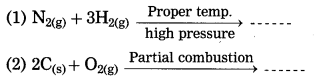
Complete the following reactions:
Solution & Step-by-Step Answer:
Question 13
Maharashtra Board Solution
3MnO2 + 4Al → 3Mn + 2Al2O3 + heat. Identify the substances undergone oxidation and reduction reactions.
Solution & Step-by-Step Answer:
MnO2 is reduced to Mn. Al is oxidised to Al2O3
Question 14
Maharashtra Board Solution
State the impurities present in the bauxite ore.
Solution & Step-by-Step Answer:
The main impurities present in the bauxite ore are silica (SiO2) and iron oxide (Fe2O3).
Question 15
Maharashtra Board Solution
Write the formula of (i) bauxite (ii) cryolite.
Solution & Step-by-Step Answer:
The formula of bauxite is Al2O3·H2O and that of cryolite is (Na3AlF6).
Question 16
Maharashtra Board Solution
What is galvanization?
Solution & Step-by-Step Answer:
The process of coating a thin layer of zinc on iron or steel is called galvanization.
Question 17
Maharashtra Board Solution
Name the reaction in which aluminium is used as a reducing agent.
Solution & Step-by-Step Answer:
The thermite reaction in which iron oxide is reduced by aluminium. Aluminium is used as a reducing agent in the thermit reaction.
Question 18
Maharashtra Board Solution
What are the constituents of bronze?
Solution & Step-by-Step Answer:
Copper and tin are the constituents of bronze.
Question 19
Maharashtra Board Solution
State the term used to express the purity of gold.
Solution & Step-by-Step Answer:
The purity of gold is expressed in carat.
Question 20
Maharashtra Board Solution
What is meant by amalgam?
Solution & Step-by-Step Answer:
The amalgam is an alloy in which one of the metals is mercury.
Question 21
Maharashtra Board Solution
What is meant by electroplating?
Solution & Step-by-Step Answer:
A process in which a less reactive metal is coated on a more reactive metal by electrolysis is called electroplating.
Question 22
Maharashtra Board Solution
Why are metals called electropositive elements?
Solution & Step-by-Step Answer:
Metals are reactive. They lose electrons and become positively charged ions. Therefore, metals are called electropositive elements.
Answer the following questions:
Question 1
Maharashtra Board Solution
Distinguish between the physical properties of metals and nonmetals with respect to the following points: (1) Physical state (2) Lustre (3) Ductility and malleability (4) Conduction of heat and electricity (5) Hardness (6) Melting and boiling points.
Solution & Step-by-Step Answer:
(1) Physical state: Under ordinary conditions, metals are generally solids. Exceptions: mercury and gallium are liquids. Under ordinary conditions, nonmetals may be solids or gases. Exception: bromine is in liquid state.
(2) Lustre: Metals usually have a high lustre (called metallic lustre). They can be polished to give a highly reflective surface. With the exceptions of gold and copper, metals usually have silvery grey colour. Nonmetals lack lustre, exceptions: graphite and iodine. Some nonmetals are colourless and others possess a variety of colours. (3) Ductility and malleability: Metals are ductile and malleable. Nonmetals are not ductile and mallfeable. (4) Conduction of heat and electricity: Metals are good conductors of heat and electricity. Nonmetals are bad conductors of heat and electricity. Exception: Graphite is a good conductor of electricity. (5) Hardness: Metals are usually hard, but not brittle, exceptions: sodium, potassium, lead, zinc. Nonmetals are brittle in the solid state, exception: diamond. (6) Melting and boiling points: The melting and boiling points of metals are high, exceptions: sodium, potassium, mercury, gallium. The melting and boiling points of nonmetals are low, exceptions: carbon, silicon.
Question 2
Maharashtra Board Solution
Write any three physical properties of nonmetals.
Solution & Step-by-Step Answer:
Question 3
Maharashtra Board Solution
Metals are good conductors of heat. Explain why.
Solution & Step-by-Step Answer:
(1) The electrons in the outermost shells of atoms of a metal are free to move throughout the metal. (2) When a metal is heated, these electrons start moving with higher velocity and conduct heat. Hence, metals are good conductors of heat.
Question 4
Maharashtra Board Solution
Metals are good conductors of electricity. Explain why.
Solution & Step-by-Step Answer:
(1) The electrons in the outermost shells of atoms of a metal are free to move throughout the metal. (2) When a potential difference is applied between the ends of a metal wire, the net movement of the electrons in a particular direction, from a point at lower potential to a point at higher potential, constitutes an electric current. Hence, metals are good conductors of electricity.
Question 5
Maharashtra Board Solution
A metal can be drawn into a wire. Explain why.
Solution & Step-by-Step Answer:
Question 6
Maharashtra Board Solution
A metal can be hammered into a thin sheet. Explain why.
Solution & Step-by-Step Answer:
Question 7
Maharashtra Board Solution
How do metals react with oxygen?
Solution & Step-by-Step Answer:
Metals combine with oxygen on heating in air and metal oxides are formed. Metal + Oxygen → Metal oxide
Question 8
Maharashtra Board Solution
How does a metal react with water?
Solution & Step-by-Step Answer:
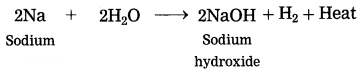
Sodium and potassium react vigorously with water to evolve hydrogen. Calcium reacts with water slowly and less vigorously to evolve hydrogen and the metal floats on water. Magnesium reacts with hot water to evolve hydrogen. Aluminium, iron and zinc do not react with cold or hot water but they react with steam to evolve their oxides and hydrogen. 2Na(s) + 2H2O(l) → 2NaOH(aq) + H2(g) + heat energy 2K(s) + 2H2O(l) → 2KOH(aq) + H2(g) + heat energy 2Ca(s) + 2H2O(l) → 2Ca(OH)2(aq) + H2(g) Mg(s) + 2H2O(hot) → Mg(OH)2(aq) + H2(g) 2Al(s) + 3H2O steam → Al2O3(s) + 3H2(g) 3Fe(s) + 4H2O steam → Fe3O4 + 4H2(g) Zn(s) + H2O steam → ZnO(s) + H2(g)
Question 9
Maharashtra Board Solution
(9) How does a metal react with an acid?
Solution & Step-by-Step Answer:
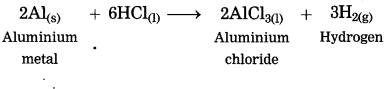
Reaction of metals with acids: Metals react with dilute hydrochloric acid or dilute sulphuric acid to form metal chloride or metal sulphate and hydrogen gas. The rate of evolution of H2 is maximum in case of magnesium. The reactivity decreases in the order Mg > Al > Zn > Fe. Mg(s) + 2HCl(aq) → MgCl2(s) + H2(g) 2Al(s) + 6HCl(aq) → 2AlCl3(aq) + 3H2(g) Zn(s) + 2HCl(aq) → ZnCl2(aq) + H2(g) Fe(s) + 2HCl(aq) → FeCl2(aq) + H2(g) Fe(s) + H2SO4(aq) → FeSO4 + H2(g) Zn(s) + H2SO4(aq) → ZnSO4 + H2(g) Mg(s) + H2SO4(aq) → MgSO4(aq) + H2(g)
Question 10
Maharashtra Board Solution
How does a metal react with nitric acid?
Solution & Step-by-Step Answer:
Metals react with nitric acid to form nitrate salts. Depending on the concentration of nitric acid, various oxides of nitrogen (NO, NO2) are formed.
Question 11
Maharashtra Board Solution
Arrange the following metals in the decreasing order of chemical reactivity: Cu, Mg, Fe, Ca, Zn, Na.
Solution & Step-by-Step Answer:
The reactivity of metal decreases in the following order: Na > Mg > Ca > Zn > Fe > Cu.
Question 12
Maharashtra Board Solution
What is meant by aqua regia?
Solution & Step-by-Step Answer:
Aqua regia is a highly corrosive and fuming liquid. It is a freshly prepared mixture of conc. HCl and conc. HNO3 in the ratio of 3:1. Most of the substances dissolve in it. Aqua regia is a reagent which dissolves gold and platinum.
Question 13
Maharashtra Board Solution
How does a metal react with salts of other metals?
Solution & Step-by-Step Answer:
The reaction of metals with solutions of salts of other metals is the displacement reaction. If a metal A displaces other metal B from the solution of its salt, it means that the metal A is more reactive than the metal B. Metal A + Salt solution of metal B → Salt solution of metal A + metal B In this reaction Fe has displaced Cu from CuSO4. It means Fe is more reactive than Cu.
Question 14
Maharashtra Board Solution
Explain the reactivity series of the metals.
Solution & Step-by-Step Answer:
The arrangement of metals in decreasing order of their reactivity in the form of a series is called the reactivity or activity series of the metals. The most reactive metal is placed at the top of the list and least reactive metal is placed at the bottom of the list.
On the basis of reactivity, we can classify metals into the following categories: 1. Extraction of High reactivity metals: The metals which are placed at the top of the reactivity series are very reactive. They are never found in nature as free elements, e.g., sodium, potassium, calcium and aluminium. These metals are obtained by electrolytic reduction. 2. Extraction of Moderately reactive metals: The metals in the middle of reactivity series such as iron, zinc, lead, copper are moderately reactive. These elements are present as sulphides or carbonates in nature. Generally metals are obtained from their oxide as compared to their sulphides and carbonates. 3. Extraction of Less reactive metals: The metals which are placed at the bottom of the reactivity series are least reactive. They occur in free state, e.g. gold, silver and copper. Copper and silver are also found in the combined state as sulphide and oxide ores. These metals are obtained from their ores by just heating the ores in air.
Question 15
Maharashtra Board Solution
Atomic number of metal “A” is 11, while atomic number of metal “B” is 20. Which of them will be more reactive? Write the chemical reaction of dilute HCl with metal “A”. (Practice Activity Sheet – 2)
Solution & Step-by-Step Answer:
Metal ‘A’ is more reactive than metal ‘B’. Atomic number of metal ‘A’ is 11, hence it is Na. 2Na + 2HCl → 2NaCl(aq) + H2(g)
Question 16
Maharashtra Board Solution
How does a metal react with a nonmetal?
Solution & Step-by-Step Answer:
By oxidation of a metal, cations are formed, on the other hand by reduction of a nonmetal, anions are formed. The ionic compound is formed due to the metal losing electrons while the nonmetal accepts the electrons. The ionic compound of sodium chloride is formed as sodium loses one electron while chlorine accepts one electron. Similarly Mg and K form ionic compounds MgCl2 and KCl.
Question 17
Maharashtra Board Solution
How do nonmetals react with oxygen?
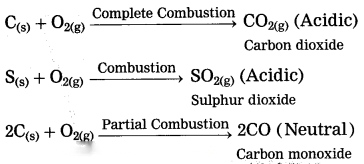
Solution & Step-by-Step Answer:
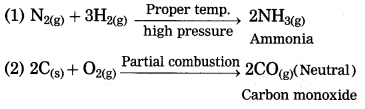
Nonmetals combine with oxygen to form acidic oxides. In some cases, neutral oxides are formed.
Question 18
Maharashtra Board Solution
How do nonmetals react with water?
Solution & Step-by-Step Answer:
Nonmetals do not react with water, (exception : halogen). Chlorine dissolves in water giving hypochlorous acid.
Question 19
Maharashtra Board Solution
How do nonmetals react with dilute acids?
Solution & Step-by-Step Answer:
Nonmetals do not react with dilute acid, (exception: halogen). Chlorine reacts with dil. hydrobromic acid to form bromine and HCl.
Question 20
Maharashtra Board Solution
How do nonmetals react with hydrogen?
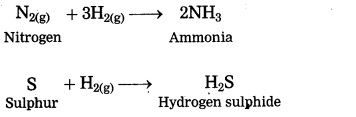
Solution & Step-by-Step Answer:
Nonmetals react with hydrogen under certain conditions (such as proper temperature, pressure, catalyst, etc.)
Question 21
Maharashtra Board Solution
What is meant by an ionic compound?
Solution & Step-by-Step Answer:
The compound formed from two units, namely cation and anion is called an ionic compound.
Question 22
Maharashtra Board Solution
What is meant by an ionic bond?
Solution & Step-by-Step Answer:
The cation and anion being oppositely charged, there is an electrostatic force of attraction between them, this force of attraction between cation and anion is called the ionic bond.
Question 23
Maharashtra Board Solution
State the general properties of ionic compounds.
Solution & Step-by-Step Answer:
Question 24
Maharashtra Board Solution
Explain the following terms: 1. Concentration of ores 2. Roasting 3. Calcination 4. Refining
Solution & Step-by-Step Answer:
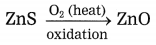
1. Concentration of ores: The process of separating gangue from the other ores is called concentration of ores. 2. Roasting: The process of heating an ore to a high temperature in excess of air and converting it into its oxide is called roasting. Examples: ZnS (zinc blend), PbS (Galena) 3. Calcination: The process of heating an ore in a limited supply of air and converting it into its oxide is called calcination. Example: Zinc carbonate (ZnCO3) ZnCO3 → ZnO + CO2 ↑ 4. Refining: The metal obtained by chemical reduction contains impurities. The process of electrolysis method is used to obtain pure metals from impure metals is known as refining.
Question 25
Maharashtra Board Solution
State two methods of concentration of ores in which the heavy particles of ores can be separated from the light gangue particles by the gravitational method.
Solution & Step-by-Step Answer:
Question 26
Maharashtra Board Solution
What are the different methods used for removing gangue from ores? (OR) Write the five methods of concentration of ores.
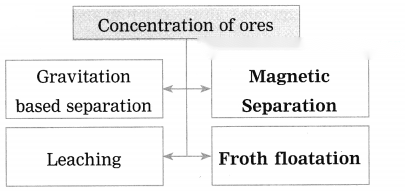
Solution & Step-by-Step Answer:
Question 27
Maharashtra Board Solution
Write short notes on: (1) Wilfley table method (2) Hydraulic separation method (3) Magnetic separation method (4) Froth floatation method (5) Leaching method.
Solution & Step-by-Step Answer:
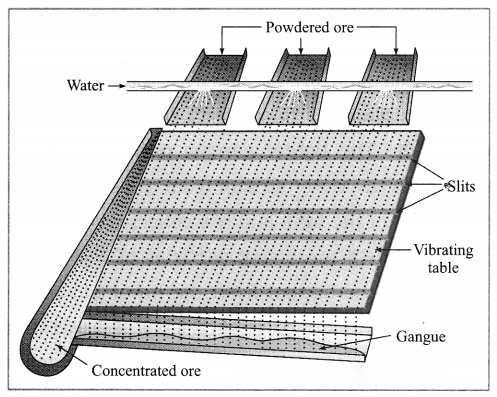
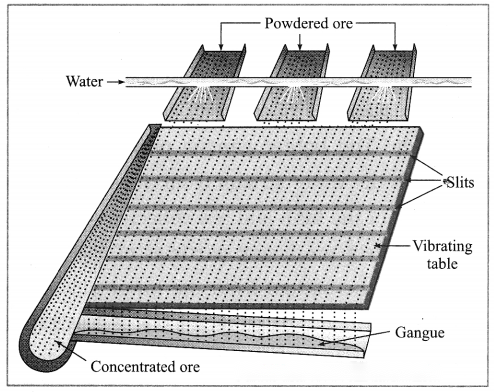
(1) Wilfley table method : (Separation based on gravitation) This method of separation uses the Wilfley table, it is made by fixing narrow and thin wooden wedges/blocks on inclined surface with low slope. The table is kept continuously vibrating. Lumps of the ore is made powdered ore by using ball mill. This powdered ore is poured on the table and a stream of water is simultaneously released from the upper side. This result in the lighter gangue particles getting carried away along with the flowing water, while the heavier particles in which proportion of minerals is more and proportion of gangue particles is less, are blocked by the wooden wedges and is collected through the slits between them.
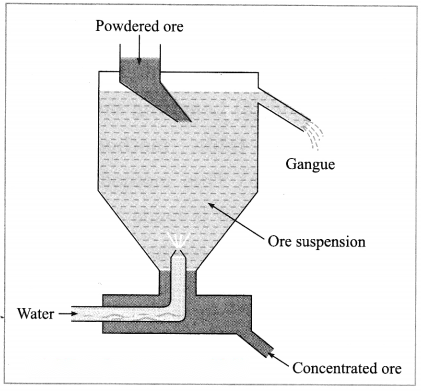
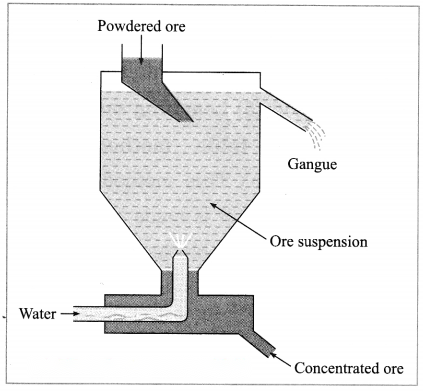
(2) Hydraulic separation method: The hydraulic separation method is based on the working of a mill. This is a tapering vessel similar to that used in a grinding mill. It opens in a tank like a container that is tapering on the lower side. The tank has an outlet for water on the upper side and a water inlet on the lower side.
(3) Magnetic separation method: Electro-magnetic machine is used in this method. The main parts of this machine are two types of iron rollers and the conveyor belt continuously moving around them. One of the rollers is nonmagnetic while the other is electromagnetic. The conveyor belt moving around the rollers is made up of leather or brass (nonmagnetic). The powdered ore is poured at that end of the conveyor belt which is on the side of the nonmagnetic roller. Two collector vessels are placed below the magnetic roller. The particles of the nonmagnetic part in the ore are not attracted towards the magnetic roller. Therefore, they are carried out further along the belt and fall in the collector vessel which is away from the magnetic roller. Simultaneously the particles of the magnetic ingredients of the ore stick to the magnetic roller and therefore fall in the collector vessel near the belt.
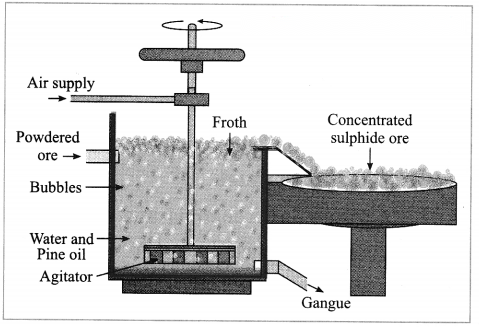
(4) Froth floatation method: The froth floatation method is based on the two opposite properties, hydrophilic and hydrophobic, of the particles. The metal sulphides particles get wet mainly with oil due to their hydrophobic property. The gangue particles get wet with water due to the hydrophilic property.
A foam is formed from oil, water and air bubbles together, due to the agitating. This foam rises to the surface of the water and floats. Hence this method is called froth floatation. Sulphide minerals float with the foam on water as they get and can be removed. The gangue particles are wetted by water, settles down at the bottom. This method is used for concentration of zinc blend (ZnS) and copper pyrite (CuFeS2). (5) Leaching: Leaching is the first step in the extraction of the metals like aluminium, gold and silver from their ores. In this method the ore is soaked in a particular solution for long time. The ore dissolves in that solution due to specific chemical reaction. The gangue, however, does not react and therefore does not dissolve in that solution. It can be separated easily. For example, concentration of bauxite, the aluminium ore, is done by leaching method. Bauxite is soaked in aqueous NaOH or aqueous Na2CO3which dissolves the main ingredient alumina in it. This means that bauxite is leached by sodium hydroxide.
Question 28
Maharashtra Board Solution
Draw a neat labelled diagram of the arrangement of the equipment used in (1) Wilfley table method (2) Hydraulic separation method.
Solution & Step-by-Step Answer:
1. Wilfley table method:
2. Hydraulic separation method:
Question 29
Maharashtra Board Solution
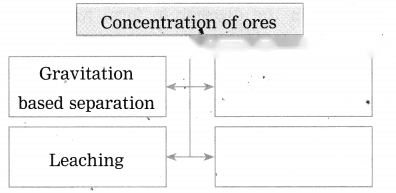
Complete the following flow chart and answer the questions below: (i) In which method pine oil is used? (ii) Explain that method of concentration in brief. (Practice Activity Sheet – 2)
Solution & Step-by-Step Answer:
(i) Pine oil is used in froth floatation method.
(ii) The finely powdered ore and vegetable oil such as pine oil, eucalyptus oil are mixed with water for formation of froth. The pressurised air is blown through the mixture. The agitator is used as per the requirement. Bubbles are formed due to the blown air. A foam is formed from oil, water and air bubbles together, due to the agitating. This foam rises to the surface of the water and floats. Hence this method is called froth floatation. Sulphide minerals float with the foam on water as they get and can be removed. The gangue particles are wetted by water, settles down at the bottom. This method is used for concentration of zinc blend (ZnS) and copper pyrite (CuFeS2).
Question 30
Maharashtra Board Solution
A tapping vessel opens in a tank like container that is tapering on the lower side. The tank has an outlet for water on the upper side and a water inlet on the lower side. Finely ground ore is released in the tank. A forceful jet of water is introduced in the tank from lower side and gangue particles and pure ore are separated by this method. (i) The above description is of which gravitation separation method? (ii) Draw labelled diagram of this method. (March 2019)
Solution & Step-by-Step Answer:
(i) Hydraulic separation method. (ii)
Question 31
Maharashtra Board Solution
How are sodium, magnesium and potassium obtained from their molten chloride salts?
Solution & Step-by-Step Answer:
The metals sodium, calcium and magnesium are obtained by electrolysis of their molten chloride salts. In this process metal is deposited on the cathode while chlorine gas is liberated at the anode.
Question 32
Maharashtra Board Solution
Name the main ore of aluminium.
Solution & Step-by-Step Answer:
Bauxite (Al2O3·H2O) is the main ore of aluminium.
Question 33
Maharashtra Board Solution
What is bauxite? What are the main impurities found in this ore?
Solution & Step-by-Step Answer:
Bauxite (Al2O3·H2O) is hydrated aluminium oxide. It contains 30% to 70% Al2O3. The main impurities present in it are iron oxide (Fe2O3) and sand (SiO2).
Question 34
Maharashtra Board Solution
From which ore is aluminium extracted? What are the stages in its extraction (give only names)?
Solution & Step-by-Step Answer:
Aluminium is extracted from bauxite (Al2O3·nH2O). Stages id the extraction: (i) Concentration of ore, i.e., conversion of bauxite into alumina, (ii) Electrolytic reduction of alumina.
Question 35
Maharashtra Board Solution
Describe Bayer’s process for concentration of bauxite.
Solution & Step-by-Step Answer:
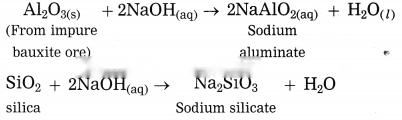
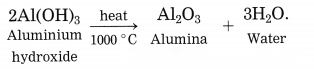
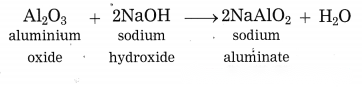
(1) Bayer’s process is used to obtain pure aluminium oxide from bauxite. (2) Bauxite is then concentrated by chemical separation. Bauxite contains impurities like iron oxide (Fe2O3) and silica (SiO2). (3) Bauxite ore is powdered and heated with sodium hydroxide under high pressure for 2 to 8 hours at 140 °C in the digester. The aluminium oxide being amphoteric in nature present in bauxite reacts with sodium hydroxide to form water soluble sodium aluminate. This means that bauxite leached by sodium hydroxide. Silica reacts with sodium hydroxide to form soluble sodium silicate. The basic iron oxide (Fe2O3) in the gangue remains unaffected. It is separated by filtration. (4) The filtrate containing sodium aluminate and sodium silicate is stirred with water and then cooling to 50° C. It is hydrolysed to give precipitate of aluminium hydroxide. (5) Aluminium hydroxide is then filtered, washed with water, dried and then calcinated by heating at 1000 °C to get pure aluminium oxide.
Question 36
Maharashtra Board Solution
Describe Hall’s process for concentration of bauxite.
Solution & Step-by-Step Answer:
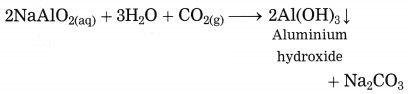
In Hall’s process the ore is powdered and then it is leached by heating with aqueous sodium carbonate in the digester to form water soluble sodium aluminate. Then the insoluble impurities are filtered opt. The filtrate is warmed and neutralised by passing carbon dioxide gas through it. This result in precipitation of aluminium hydroxide. The precipitate of Al(OH)3 obtained in this processes is filtered, washed, dried and then calcinated by heating at 1000 °C to obtain alumina.
Question 37
Maharashtra Board Solution
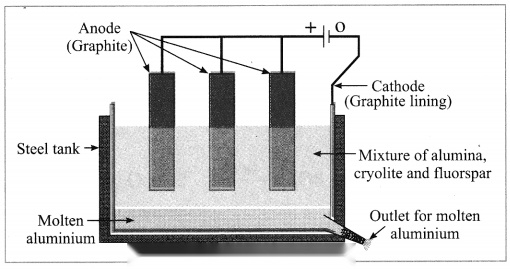
Describe the process of preparation of aluminium by the electrolysis of alumina. (OR) Draw and label the diagram of electrolysis of alumina and explain the electrolytic reduction of alumina.
Solution & Step-by-Step Answer:
Electrolytic reduction of alumina: (1) The electrolytic cell consists of a rectangular steel tank lined from inside with graphite. (2) The carbon lining (graphite) acts as a cathode. The anode consists of graphite rods suspended in the molten electrolyte. (3) Alumina has very high melting point ( > 2000 °C). The electrolysis of alumina is carried out at a low temperature by dissolving it in molten cryolite (Na3AlF6). The solution of alumina in cryolite and small amount of fluorspar (CaF2) is added in the mixture to lower its melting point up to 1000 °C. (4) On passing an electric current, alumina is electrolysed. (5) Molten aluminium is collected at the cathode, while oxygen gas is evolved at the anode. The electrode reactions are shown below: Al2O3 → 2Al3+ + 3O2- Anode reaction: 2O2- → O2(g) + 4e– Cathode reaction: Al3+ + 3e– → Al The molten aluminium is heavier than the electrolyte. Therefore, it sinks to the bottom of the electrolyte and is removed from time to time. About 99% pure aluminium is obtained by this process. The oxygen gas liberated reacts with carbon anode and forms carbon dioxide. As the anode gets oxidised during the electrolysis of alumina, it has to be replaced from time to time.
Question 38
Maharashtra Board Solution
In the extraction of aluminium: (i) Name the process of concentration of bauxite.
Solution & Step-by-Step Answer:
The process of concentration of bauxite is known as Bayer’s process.
(ii) Write the cathode reaction in electrolytic reduction of alumina. (iii) Write the function and formula of cryolite in the extraction of aluminium. (iv) write an equation for the action of heat on aluminium hydroxide.
(v) Draw the diagram of extraction of aluminium.
(vi) Write the anode reaction in electrolytic reduction of alumina. (vii) Write the cathode reaction in electrolytic reduction of alumina.
Question 39
Maharashtra Board Solution
What happens when aluminium ore is heated with caustic soda? Write the balanced chemical equation for the same.
Solution & Step-by-Step Answer:
When aluminium ore is heated with caustic soda solution under high pressure for 2 to 8 hours and at 140 °C to 150 °C, aluminium oxide from aluminium ore, being amphoteric in nature, dissolves in caustic soda solution to form sodium aluminate.
Question 40
Maharashtra Board Solution
How is zinc extracted from its ore zinc sulphide or zinc carbonate?
Solution & Step-by-Step Answer:
The crude zinc sulphide ore is heated strongly in excess of air. Zinc sulphide is converted into zinc oxide. This process is known as roasting. (OR) The crude zinc carbonate ore is heated strongly in limited supply of air. Zinc carbonate is converted into zinc oxide. This process is known as calcination. The zinc oxide is reduced to zinc by using a reducing agent such as carbon.
Question 41
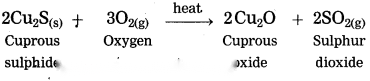
Maharashtra Board Solution
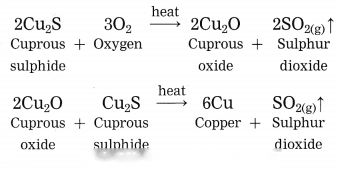
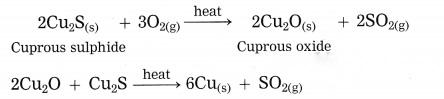
How is copper extracted from its sulphide ore?
Solution & Step-by-Step Answer:
Copper is found as cuprous sulphide (Cu2S) in nature. When Cu2S is heated in air, copper is obtained.
Question 42
Maharashtra Board Solution
How is mercury extracted from cinnabar? (OR) Extraction of mercury from its ore cinnabar and write the corresponding chemical reaction.
Solution & Step-by-Step Answer:
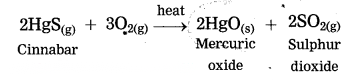
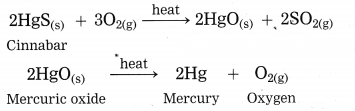
Cinnabar is an ore of mercury. When cinnabar is heated (roasted), it is converted into mercuric oxide (HgO). Mercuric oxide is then reduced to mercury on further heating.
Question 43
Maharashtra Board Solution
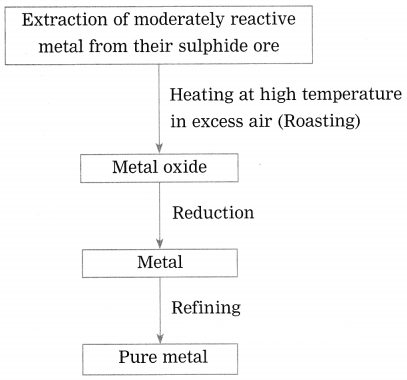
Show the steps involved in the extraction of moderately reactive metals from their sulphide ores.
Solution & Step-by-Step Answer:
Moderately reactive elements are present as sulphides or carbonates in nature.
Question 44
Maharashtra Board Solution
In the reactivity series of metals, some metals are misplaced. Rearrange these metals in the decreasing order of their reactivity.
Solution & Step-by-Step Answer:
Question 45
Maharashtra Board Solution
Complete the table, if a metal reacts with the reagent then mark ✓ and if not then ✗. |

























Metal | Ferrous | Silver | Copper | Zinc |
Cu | ||||
Al |
Metal | Ferrous | Silver | Copper | Zinc |
Cu | ✗ | ✓ | ✗ | ✗ |
Al | ✓ | ✓ | ✓ | ✓
Question 46
Maharashtra Board Solution
Explain the term corrosion with a suitable example. (OR) What is corrosion ?
Solution & Step-by-Step Answer:
The process in which a metal is destroyed gradually by the action of air, moisture or a chemical (like an acid) on its surface is called corrosion. (OR) Corrosion is degradation of a material due to reaction with its environment. The major problem of corrosion occurs with iron, as it is used as a structural material in construction, bridges, shipbuilding. Iron gets covered by reddish brown flakes when exposed to atmosphere. This is an example of corrosion.
Question 47
Maharashtra Board Solution
Explain the different methods to prevent corrosion of metals.
Solution & Step-by-Step Answer:
(1) Corrosion of a metal can be prevented if the contact between metal and air is cut off. (2) Corrosion of a metal is prevented by coating with something which does not allow moisture and oxygen to react with it. (3) A layer of oil or paint or grease is applied on the surface of a metal to prevent corrosion. The rusting or corrosion of iron can be prevented by this method. (4) Corrosion is also prevented by coating a corrosive metal with a noncorrosive metal. Galvanising, tinning, electroplating, anodising and alloying are the different methods in which a metal is coated with a noncorrosive metal to prevent corrosion.
Question 48
Maharashtra Board Solution
Write three methods of preventing rusting of iron.
Solution & Step-by-Step Answer:
Question 49
Maharashtra Board Solution
What is meant by an alloy? Give two examples with chemical composition.
Solution & Step-by-Step Answer:
The homogeneous mixture formed by mixing a metal with other metals or nonmetals in certain proportion is called an alloy. Examples: 1. Bronze: Bronze is an alloy formed from 90% copper and 10% tin. Bronze statues stay well in sun and rain. 2. Stainless steel: Stainless steel alloy is made from 74% iron, 18% chromium and 8% carbon. This alloy does not get stained with air or water and does not rust.
Write short notes on the following:
Question 1
Maharashtra Board Solution
Galvanizing.
Solution & Step-by-Step Answer:
(1) The process of coating a thin layer of zinc on iron or steel is called galvanization. (2) In this method corrosion of zinc occurs first because zinc is more electropositive than iron. After a few years zinc layer goes away and the iron layer gets exposed and starts rusting. (3) In galvanization an iron object is dipped into molten zinc. A thin layer of zinc is formed all over the iron object. Examples: Shiny iron nails, pin, iron pipes.
Question 2
Maharashtra Board Solution
Tinning.
Solution & Step-by-Step Answer:
The process of coating a thin layer of tin (molten tin) on copper or brass is called tinning. Cooking vessels made of copper and brass get a greenish coating due to corrosion. The greenish substance is copper carbonate and it is poisonous. If buttermilk or curry is placed in such a vessel it gets spoiled. Therefore, these vessels are coated with tin to prevent corrosion.
Question 3
Maharashtra Board Solution
Electroplating.
Solution & Step-by-Step Answer:
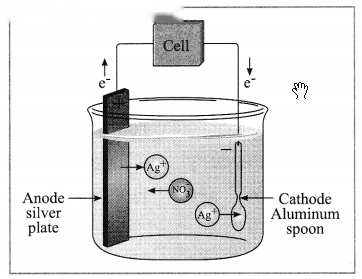
The process in which a less reactive metal is coated on a more reactive metal by electrolysis is called electroplating. Examples: Silver-plated spoon, gold-plated jewellery. (1) Which process will you study with the help of above material and solutions. Answer: With the help of above material and solutions, electroplating process is studied.
(2) Define the process. (3) Write the anode and cathode reactions.
Question 4
Maharashtra Board Solution
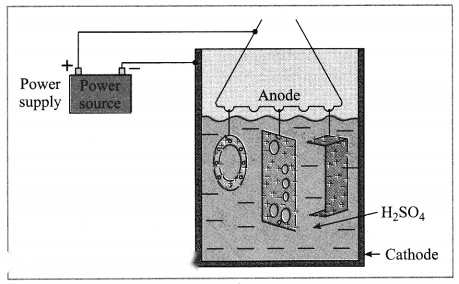
Anodizing. (OR) Identify the process shown in the above diagram and explain it in brief. (Practice Activity Sheet – 3)
Solution & Step-by-Step Answer:
The anodizing technique is an application of electrolysis. In this method copper or aluminium article is used as anode and it is coated with a strong film of their oxides by means of electrolysis. This oxide layer is strong and uniform all over the surface. This thin film protects the metals from corrosion. The protection can be further increased by making the oxide layer thicker during the anodization. Examples: Kitchen articles such as ; anodized pressure cooker and anodized pan.
Question 5
Maharashtra Board Solution
Alloying.
Solution & Step-by-Step Answer:
A homogenous mixture of two or more metals or a metal and a nonmetal in a definite proportion is called an alloy. The physical properties of an alloy are different from those of its constituents. Alloys are corrosion resistant. Alloy decreases the intensity of corrosion of metals.
Examples: Brass is made from copper and zinc, 90 % Copper and 10 % tin are used to make an alloy called bronze, Stainless steel is made from 74% iron, 8 % carbon and 18 % chromium. Distinguish between: (Two points of distinction)
Question 1
Maharashtra Board Solution
Metals and Nonmetals.
Solution & Step-by-Step Answer:
Metals:
Nonmetals:
Question 2
Maharashtra Board Solution
Roasting and Calcination.
Solution & Step-by-Step Answer:
Roasting:
Calcination: Give scientific reasons for the following:
Question 1
Maharashtra Board Solution
Calcium floats on water during the reaction with water.
Solution & Step-by-Step Answer:
Question 2
Maharashtra Board Solution
Common salt has high melting and boiling points.
Solution & Step-by-Step Answer:
Question 3
Maharashtra Board Solution
Metals are good conductors, while non-metals are poor conductors of electricity.
Solution & Step-by-Step Answer:
Question 4
Maharashtra Board Solution
Sodium is more reactive than aluminium.
Solution & Step-by-Step Answer:
Question 5
Maharashtra Board Solution
When zinc granules are added to copper sulphate solution, the blue coloured solution turns colourless.
Solution & Step-by-Step Answer:
Question 6
Maharashtra Board Solution
When an iron nail is dipped into a copper solution, a shiny coat of copper is formed on the nail.
Solution & Step-by-Step Answer:
Question 7
Maharashtra Board Solution
Cryolite (Na3AlF6) and fluorspar (CaF2) are added to the electrolytic mixture containing pure alumina.
Solution & Step-by-Step Answer:
(1) Alumina has very high melting point ( > 2000 °C). Cryolite (Na3AlF6) and fluorspar (CaF2) lower the fusion temperature of the mixture containing alumina from 2000 ° C to 1000 ° C, thereby saving electrical energy. (2) They increase the conductivity and the mobility of the fused mixture. Hence, cryolite and fluorspar are added to the electrolytic mixture containing pure alumina.
Question 8
Maharashtra Board Solution
Air is bubbled through the mixture in Froth floatation process.
Solution & Step-by-Step Answer:
(1) In the froth floatation process, in a tank water, ore and an oil are mixed. When air is bubbled through the mixture the oil forms froth. (2) The mineral particles are wetted by the oil and float on the surface. (3) The gangue particles are wetted by water and settle down. Hence, the ore can be concentrated. Hence, air is bubbled through the mixture in froth floatation process.
Question 9
Maharashtra Board Solution
Silver amalgam is used for filling dental cavities.
Solution & Step-by-Step Answer:
(1) Silver is a soft metal and wears off on constant usage particularly due to abrasion. Silver amalgam is an alloy of silver with mercury. (2) It is a hard substance. It is nontoxic. Besides these properties it is a lustrous shining substance. It melts at a comparatively low temperature and can therefore conveniently fill in the cavities. Hence, silver amalgam is used for filling dental cavities.
Explain the following reactions with the help of balanced equations:
Question 1
Maharashtra Board Solution
Out of sodium and sulphur which is a metal? Explain its reaction with oxygen. (March 2019)
Solution & Step-by-Step Answer:
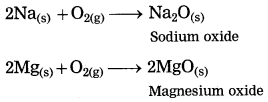
Sodium is a metal. Sodium reacts with oxygen in air at room temperature to form sodium oxide.
Question 2
Maharashtra Board Solution
Magnesium burns in air.
Solution & Step-by-Step Answer:
When magnesium bums in air, it combines with oxygen, emitting intense light and heat to form magnesium oxide.
Question 3
Maharashtra Board Solution
Copper reacts with air.
Solution & Step-by-Step Answer:
Copper tarnishes in moist air and forms black coloured oxide when strongly heated.
Question 4
Maharashtra Board Solution
Sodium reacts with water.
Solution & Step-by-Step Answer:
When sodium reacts with water, it evolves hydrogen which immediately catches fire producing a lot of heat.
Question 5
Maharashtra Board Solution
Calcium reacts with water.
Solution & Step-by-Step Answer:
Calcium reacts with water less vigorously to form hydrogen gas and calcium hydroxide. In this reaction, the heat evolved is not sufficient for hydrogen to catch fire.
Question 6
Maharashtra Board Solution
Steam is passed over aluminium.
Solution & Step-by-Step Answer:
When steam is passed over aluminium, hydrogen gas and aluminium oxide are formed.
Question 7
Maharashtra Board Solution
Steam is passed over iron.
Solution & Step-by-Step Answer:
When steam is passed over iron, iron (III) oxide and hydrogen gas are formed.
Question 8
Maharashtra Board Solution
Magnesium reacts with dil. hydrochloric acid.
Solution & Step-by-Step Answer:
When magnesium reacts with dil. hydrochloric acid, magnesium chloride is formed and hydrogen gas is evolved.
Question 9
Maharashtra Board Solution
Aluminium is treated with dil. hydrochloric acid.
Solution & Step-by-Step Answer:
When aluminium is treated with dil. hydrochloric acid, aluminium chloride and hydrogen gas are formed.
Question 10
Maharashtra Board Solution
Zinc reacts with dil. hydrochloric acid.
Solution & Step-by-Step Answer:
When zinc reacts with dil. hydrochloric acid, zinc chloride and hydrogen gas are formed.
Question 11
Maharashtra Board Solution
Iron is treated with dil. hydrochloric acid.
Solution & Step-by-Step Answer:
When iron reacts with dil. hydrochloric acid, ferrous chloride and hydrogen gas is formed.
Question 12
Maharashtra Board Solution
Copper is reacted with cone, nitric acid.
Solution & Step-by-Step Answer:
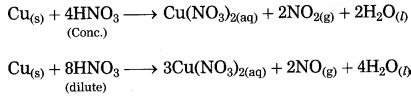
When copper is reacted with cone, nitric acid, copper nitrate and reddish brown nitrogen dioxide are formed.
Question 13
Maharashtra Board Solution
Copper is reacted with dil. nitric acid.
Solution & Step-by-Step Answer:
When copper is reacted with dil. nitric acid, copper nitrate and nitric oxide are formed.
Question 14
Maharashtra Board Solution
Sodium metal is reacted chlorine gas.
Solution & Step-by-Step Answer:
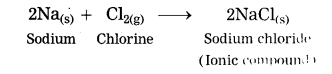
When sodium metal is reacted with chlorine, sodium chloride an ionic compound is formed.
Question 15
Maharashtra Board Solution
Sulphur burns in air.
Solution & Step-by-Step Answer:
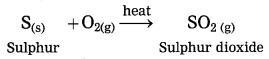
When sulphur burns in air, it combines with oxygen to form acidic sulphur dioxide.
Question 16
Maharashtra Board Solution
Chlorine dissolves in water.
Solution & Step-by-Step Answer:
When chlorine dissolves in water, hypochlorous acid is formed.
Question 17
Maharashtra Board Solution
Chlorine is treated with hydrobromic acid.
Solution & Step-by-Step Answer:
When chlorine is treated with hydrobromic acid, chlorine displaces bromine from hydrobromic acid. Cl2(g) + 2HBr(aq) → 2HCl(aq) + Br2(aq)
Question 18
Maharashtra Board Solution
Hydrogen gas is passed over boiling sulphur.
Solution & Step-by-Step Answer:
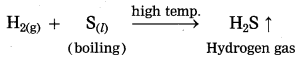
When hydrogen gas is passed over boiling sulphur, sulphur combines with hydrogen to form hydrogen sulphide which has rotten egg smell.
Question 19
Maharashtra Board Solution
Sodium aluminate is treated with water.
Solution & Step-by-Step Answer:
When sodium aluminate is treated with water, it is hydrolysed to give a precipitate of aluminium hydroxide.
Question 20
Maharashtra Board Solution
Dry aluminium hydroxide is ignited at 1000 °C.
Solution & Step-by-Step Answer:
When dry aluminium hydroxide is ignited at 1000 °C, alumina (Al2O3) formed.
Question 21
Maharashtra Board Solution
Zinc sulphide is heated strongly in excess of air.
Solution & Step-by-Step Answer:
When zinc sulphide is heated strongly in excess of air, it forms zinc oxide and sulphur dioxide gas.
Question 22
Maharashtra Board Solution
Zinc carbonate is heated strongly in a limited supply of air.
Solution & Step-by-Step Answer:
When zinc carbonate is heated strongly in a limited supply of air, it gives zinc oxide and carbon dioxide.
Question 23
Maharashtra Board Solution
Zinc oxide is treated with carbon.
Solution & Step-by-Step Answer:
When zinc oxide is treated with carbon, it is reduced to zinc. In this reaction, carbon acts as reducing agent.
Question 24
Maharashtra Board Solution
Manganese dioxide is heated with aluminium.
Solution & Step-by-Step Answer:
When manganese dioxide is heated with aluminium, manganese dioxide is reduced to manganese and large amount of heat is evolved.
Question 25
Maharashtra Board Solution
Cinnabar is heated in air.
Solution & Step-by-Step Answer:
When cinnabar is heated in air, it forms mercuric oxide and sulphur dioxide.
Question 26
Maharashtra Board Solution
Cuprous sulphide is heated in air.
Solution & Step-by-Step Answer:
When cuprous sulphide is heated in air, cuprous oxide is formed. Cuprous oxide is reduced to copper in the presence of ore.
Project: (Do it your self) Project 1. Project 2. |