Maharashtra State Board Class 10 Science Solutions Part 2 Chapter 8 Cell Biology and Biotechnology
b. ……….. is the revolutionary event in biotechnology after cloning.
(a) Human genome project
(b) DNA discovery
(c) Stem cell research
(d) All the above
Answer:
(c) Stem cell research
c. The disease related with the synthesis of insulin is …………..
(a) cancer
(b) arthritis
(c) cardiac problems
(d) diabetes
Answer:
(d) diabetes
d. Government of India has encouraged the ……….. for improving the productivity by launching NKM-16.
(a) aquaculture
(b) poultry
(c) piggery
(d) apiculture
Answer:
(a) aquaculture
Column ‘A’ | Column ‘B’ |
(1) Interferon | (a) Diabetes |
(2) Factor VIII * | (b) Dwarfness |
(3) Somatostatin | (c) Viral infection |
(4) Interleukin | (d) Cancer |
(e) Haemophilia |
[Note: In examination match the column question will have 2 components in Column A’ with 4 alternatives in Column B’.]
(1) Interferon – Viral infection
(2) Factor VIII – Haemophilia
(3) Somatostatin – Dwarfness
(4) Interleukin – Cancer
[Note: Factor VIII* is an important protein factor and it should not be just factor as given in the textbook.]
Question 3
Maharashtra Board Solution
Rewrite the following wrong statements after corrections: a. Changes in genes of the cells are brought about in non-genetic technique.
Solution & Step-by-Step Answer:
Non-genetic biotechnology involves use of either cell or tissue.
b. Gene from Bacillus thuringiensis is introduced into soyabean.
Question 4
Maharashtra Board Solution
Write short notes. a. Biotechnology: Professional uses. (Commercial uses)
Solution & Step-by-Step Answer:
(1) Biotechnology can be used in the following professional fields, viz. crop biotechnology, animal husbandry, human health, etc.
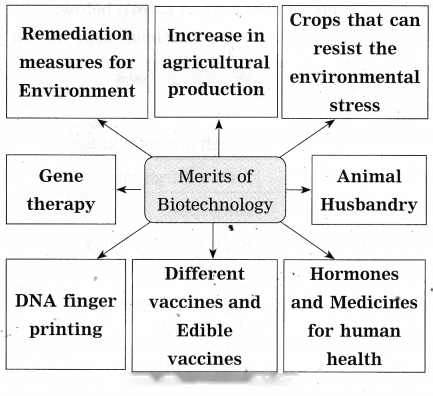
(2) In crop biotechnology, improvement in the yield and variety of agricultural field is done. The hybrid seeds, genetically modified crops, herbicide tolerant plants are some of the areas in which lot of biotechnological research is being done. By such research, high yielding and disease resistant varieties and varieties which can tolerate stresses such as alkalinity, weeds, cold and drought etc. are produced. BT cotton, BT Brinjal and golden rice are some GMO plants which have become popular in India. Due to herbicide tolerant plants, the weeds are now selectively destroyed. By using biofertilizers, the use of chemical fertilizers is reduced. Use of bacteria such as Rhizobium, Azotobacter, Nostoc, Anaixiena and plants like Azolla the nitrogen fixation and phosphate solubilization abilities of the plants are improved. (3) Animal husbandry is now using the methods of artificial insemination and embryo transfer by which the breeds of cattle are improved. (4) To improve and to manage the human health, diagnosis ahd treatment of diseases have to be focussed. Diagnosis of diabetes, heart diseases and infectious diseases such as AIDS and dengue can be done rapidly due to biotechnology. (5) The treatment and prevention of diseases need hormones, interferons, antibiotics and different vaccine which are now manufactured through biotechnology. Gene therapy is also used to treat hereditary disorders. (6) Industrial products and clean technology to combat environmental pollution uses biotechnology practices. (7) DNA fingerprinting has revolutionized the profession of forensic science. b. Importance of medicinal plants.
Question 5
Maharashtra Board Solution
Answer the following questions in your own words. a. Which products produced through biotechnology do you use in your daily life?
Solution & Step-by-Step Answer:
b. Which precautions will you take during spraying of pesticides? c. Why some of the organs in human body are most valuable? d. Explain the importance of fruit processing in human life? e. Explain the meaning of vaccination.
Question 6
Maharashtra Board Solution
Complete the following chart.
Solution & Step-by-Step Answer:
Question 7
Maharashtra Board Solution
Write the correct answer in blank boxes.
Solution & Step-by-Step Answer:
Question 8
Maharashtra Board Solution
Identify and complete the following correlations: a. Insulin : Diabetes : : Interleukin : …………….
Solution & Step-by-Step Answer:
Insulin : Diabetes : : Interleukin : Cancer
b. Interferon : ………. : : Erythropoietin : Anaemia. c. ……….. : Dwarfness : : Factor VIII : Haemophilia. d. White revolution : Dairy : : Blue revolution : ………
Question 9
Maharashtra Board Solution
Write a comparative note on usefulness and harmfulness of biotechnology. (OR) “Biotechnology is not only beneficial but it has some harmful effects too”. Express your opinion about this statement.
Solution & Step-by-Step Answer:
(1) Biotechnology has proved to be useful in the field of agriculture, medicine, clean technology and industrial products. (2) Due to various biotechnological experiments, the food production is increased substantially. The milk and milk products are now freely available. People no longer die of hunger due to abundant food supply. (3) The sophisticated vaccines have stopped the spread of epidemics. (4) The diseases like diabetes can be controlled due to human insulin injections that can be manufactured by biotechnology. (5) The problems of pollution control, solid waste management and fuels are partially tackled by biotechnological alternatives. (6) Though all such positive aspects are there, the biotechnology also poses some problems. The genetic changes are breaking the principles of nature. By inserting human genes in bacteria or virus, the products that are needed only for humans are produced. (7) Human cloning is also a debatable issue. It will cause social and ethical problems. The new generations formed by cloning will have mothers but no fathers. If man tries to manipulate the genomes of other living organisms, it will cause disturbances in the natural balance. The long ternT effects of all such genetic manipulations can be disastrous. Thus, according to some views, biotechnology can be dangerous too.
Projects: (Do it your self) Project 1. Project 2. Project 3. Can you recall? (Text Book Page No. 88)
Question 1
Maharashtra Board Solution
What is cell?
Solution & Step-by-Step Answer:
The structural and functional unit of the body is called a cell.
Question 2
Maharashtra Board Solution
What is tissue? What are the functions of tissue?
Solution & Step-by-Step Answer:
Tissue is a group of cells that performs a similar and definite function. E.g. The muscular tissues in the body perform contraction and extensions thereby helping in locomotion. The conducting tissues of the plants like xylem and phloem transport the water and food respectively.
Question 3
Maharashtra Board Solution
Which technique in relation to tissues have you studied in earlier classes?
Solution & Step-by-Step Answer:
The technique of tissue culture and genetic engineering has been studied last year. Tissue culture is ‘Ex vivo growth of cells or tissues in an aseptic and nutrient-rich medium’. Genetic engineering and its use has also been studied under, ‘Introduction to biotechnology’.
Question 4
Maharashtra Board Solution
Which are the various processes in tissue culture?
Solution & Step-by-Step Answer:
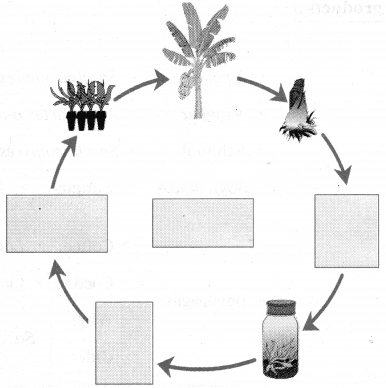
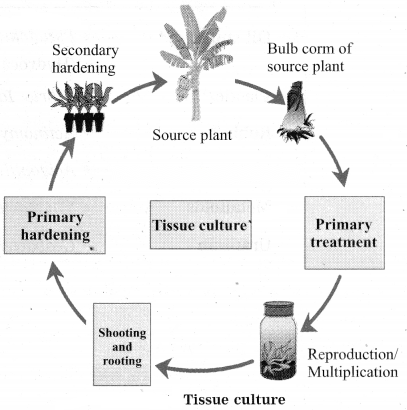
Various step-wise processes are done while performing the-tissue culture. These processes are primary treatment, reproduction/cell division/multiplication, shooting or rooting, primary hardening, secondary hardening, etc.
Observe: (Text Book Page No. 88)
Question 1
Maharashtra Board Solution
Assign names in the figure given below. Explain the various stages those are kept blank:
Solution & Step-by-Step Answer:
Tissue Culture: Tissue culture is the technique in which ‘ex vivo growth of cells or tissues in an aseptic and nutrient-rich medium’ is done. While performing experiments of tissue culture, a liquid, solid or gel-like ” medium prepared from agar, is used. Such medium supplies nutrients and energy necessary for tissue culture technique. Different processes are to be done while performing tissue culture, viz. primary treatment, reproduction or multiplication, shooting and rooting, primary hardening, secondary hardening, etc. From the source plant, required tissues are taken out and all the processes are carried in an aseptic medium in laboratory.
(Use your brain power. (Text Book Page No. 89)
Question 1
Maharashtra Board Solution
Just like the grafting in plants, is the organ transplantation possible in humans?
Solution & Step-by-Step Answer:
The grafting as done in case of plants, cannot be done in human beings. But the transplantation of certain organs can be done. Liver, kidney, heart, eyes, etc. can be transplanted. But for these transplantations the donor and the recipient should match with each other in respect of their bloodr groups, age, disease condition, etc. In future, the stem cell research can bring about certain changes in the field of transplantations.
(Text Book Page No. 94)
Question 1
Maharashtra Board Solution
What will happen if the transgenic potatoes are cooked before consumption?
Solution & Step-by-Step Answer:
Some types of transgenic potatotes that contain edible vaccine against Hepatitis can be cooked. The cooking does not destroy the antigen incorporated into these transgenic potatoes. But according to some scientists, transgenic potatoes with enterotoxin vaccine, if cooked shows denaturation of vaccine.
Choose the correct alternative and write its alphabet against the sub-question number:
Question 1
Maharashtra Board Solution
The property of stem cells is called …………. (a) diversity (b) equality (c) differentiation (d) pluripotency
Solution & Step-by-Step Answer:
(d) pluripotency
Question 2
Maharashtra Board Solution
Cell ……….. starts from 14th day of conception. (a) development (b) specialization (c) growth (d) differentiation
Solution & Step-by-Step Answer:
(d) differentiation
Question 3
Maharashtra Board Solution
Availability of ………… is an important requirement in organ transplantation. (a) doctor (b) clinic (c) donor (d) ambulance
Solution & Step-by-Step Answer:
(c) donor
Question 4
Maharashtra Board Solution
The toxin which is lethal for ……….. was produced in leaves and bolls of BT cotton. (a) bollworm (b) locust (c) birds (d) frogs
Solution & Step-by-Step Answer:
(a) bollworm
Question 5
Maharashtra Board Solution
Transgenic raw potatoes generate the immunity against ………… disease. (a) plague (b) cholera (c) leprosy (d) TB
Solution & Step-by-Step Answer:
(b) cholera
Rewrite the following wrong statements after corrections:
Question 1
Maharashtra Board Solution
High-class varieties of crops have been developed through the technique of transplantation.
Solution & Step-by-Step Answer:
High-class varieties of crops have been developed through the technique of tissue-culture.
Question 2
Maharashtra Board Solution
Earlier, insulin was being collected from, the pancreas of pigs.
Solution & Step-by-Step Answer:
Earlier, insulin was being collected from the- pancreas of horses.
Question 3
Maharashtra Board Solution
Malaria arises due to genetic changes in hepatocytes.
Solution & Step-by-Step Answer:
Phenylketonuria (PKT) arises due to genetic changes in hepatocytes.
Question 4
Maharashtra Board Solution
The E.coli bacteria are useful for cleaning the hydrocarbon and oil pollutants from soil and water.
Solution & Step-by-Step Answer:
The Pseudomonas bacteria are useful for cleaning the hydrocarbon and oil pollutants from soil and water.
Question 5
Maharashtra Board Solution
Various essential elements like N, P, K are removed and hence become unavailable to the crops due to earthworms and fungi.
Solution & Step-by-Step Answer:
Various essential elements like N, P, K become available to crops due to earthworms and fungi.
Question 6
Maharashtra Board Solution
We do not have any tradition that cures the diseases with the help of natural resources.
Solution & Step-by-Step Answer:
We have a great tradition of ayurveda that cures the diseases with the help of natural resources.
Match the pairs:
Question 1
Maharashtra Board Solution
|

Scientist | Contribution |
(1) Dr. Anand Mohan Chakravarti | (a) Wheat production in America |
(2) Dr. M. S. Swaminathan | (b) White revolution |
(c) Green revolution in India | |
(d) Cleaning the oil spill |
(1) Dr. Anand Mohan Chakravarti – Cleaning the oil spill
(2) Dr. M.S. Swaminathan – Green revolution in India
Question 2
Maharashtra Board Solution
Solution & Step-by-Step Answer:
(1) Pseudomonas – Hydrocarbons
(2) Pteris vitata – Arsenic Find the odd man out:
Question 1
Maharashtra Board Solution
Green revolution, Industrial revolution, White revolution, Blue revolution
Solution & Step-by-Step Answer:
Industrial revolution. (All others are concerned with food.)
Question 2
Maharashtra Board Solution
DDT, malathion, chloropyriphos, Humus
Solution & Step-by-Step Answer:
Humus. (All others are insecticides.)
Question 3
Maharashtra Board Solution
Sodium, Aluminium, Potassium, Phosphorus
Solution & Step-by-Step Answer:
Aluminium. (All others are essential elements for plant growth.)
Question 4
Maharashtra Board Solution
Diabetes, Anaemia, Leukaemia, Thalassemia
Solution & Step-by-Step Answer:
Diabetes. (All other diseases involve reduction in the number of blood cells.)
Question 5
Maharashtra Board Solution
Drying, Salting, Cooking, Soaking with sugar
Solution & Step-by-Step Answer:
Cooking. (All others are food preservative methods.)
Identify and complete the following correlations:
Question 1
Maharashtra Board Solution
White revolution : Increase in dairy production : : Green revolution : ………. (March 2019)
Solution & Step-by-Step Answer:
White revolution : Increase in dairy production : : Green revolution : Increase in agricultural production or crop yield
Question 2
Maharashtra Board Solution
Nostoc, Anabaena : Biofertilizers : : Alfalfa : ………..
Solution & Step-by-Step Answer:
Nostoc, Anabaena : Biofertilizers : : Alfalfa : Phytoremediation.
Give definition/Give meanings:
Question 1
Maharashtra Board Solution
Stem cell or what are stem cells?
Solution & Step-by-Step Answer:
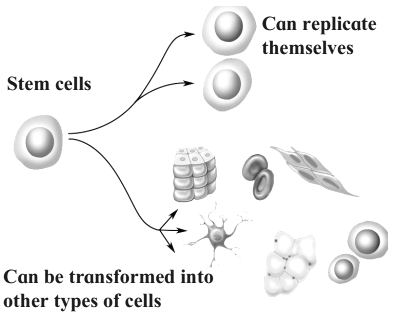
The special cells having pluripotency and ability to divide and differentiate into new cells are called stem cells. They are present in multicellular living beings.
Question 2
Maharashtra Board Solution
Biotechnology.
Solution & Step-by-Step Answer:
Technology that brings about artificial genetic changes and hybridization in organisms for human welfare is called biotechnology.
Question 3
Maharashtra Board Solution
Genetically modified crops.
Solution & Step-by-Step Answer:
Crops having desired characters are developed by integrating foreign gene with their genome, such crops have modified genome and are known as genetically modified crops.
Question 4
Maharashtra Board Solution
Golden rice.
Solution & Step-by-Step Answer:
Biotechnologically developed variety of rice in which gene synthesizing the vitamin A (Beta carotene) has been incorporated and which contains 23 times more amount of beta carotene than that of the normal variety is called golden rice. It was developed in 2005.
Question 5
Maharashtra Board Solution
Vaccine.
Solution & Step-by-Step Answer:
The ‘antigen’ containing material given to a person or animal to acquire either permanent or temporary immunity against a specific pathogen or disease is called a vaccine.
Question 6
Maharashtra Board Solution
Cloning.
Solution & Step-by-Step Answer:
Production of replica of any cell or organ or entire organism through biotechnological process is called cloning.
Question 7
Maharashtra Board Solution
DNA fingerprint.
Solution & Step-by-Step Answer:
The nucleotide sequence present on the DNA of each person is unique just like the fingerprint, thus for establishing the identity of any person DNA can be analysed, this technique is known as DNA fingerprinting.
Question 8
Maharashtra Board Solution
Green revolution.
Solution & Step-by-Step Answer:
All the methods applied for harvesting maximum yield from minimum land are collectively referred to as green revolution.
Question 9
Maharashtra Board Solution
White revolution.
Solution & Step-by-Step Answer:
Achieving the self-sufficiency in dairy business, by performing various experiments for quality control, bringing about newer dairy products and their preservation and thus raising economic standards is called white revolution.
Question 10
Maharashtra Board Solution
Blue revolution.
Solution & Step-by-Step Answer:
The aquaculture practices to increase the yield of edible aquatic organisms is called blue revolution.
Name the following:
Question 1
Maharashtra Board Solution
Research institutes involved with cell science.
Solution & Step-by-Step Answer:
Question 2
Maharashtra Board Solution
Sources of stem cells.
Solution & Step-by-Step Answer:
Question 3
Maharashtra Board Solution
Types of Stem cells.
Solution & Step-by-Step Answer:
Question 4
Maharashtra Board Solution
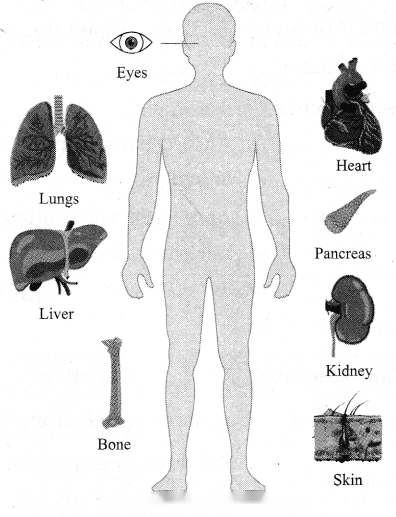
Organs that can be donated.
Solution & Step-by-Step Answer:
Eyes, heart, pancreas, liver, kidneys, skin, J bones, lungs.
Question 5
Maharashtra Board Solution
Organisms used as biofertilizers.
Solution & Step-by-Step Answer:
Rhizobium, Azotobacter, Nostoc, Anabaena, Azolla.
Question 6
Maharashtra Board Solution
Two main methods used in animal husbandry.
Solution & Step-by-Step Answer:
Question 7
Maharashtra Board Solution
Two important aspects of human health management.
Solution & Step-by-Step Answer:
Question 8
Maharashtra Board Solution
Place where DNA fingerprinting research is done in India.
Solution & Step-by-Step Answer:
Centre of DNA fingerprinting and Diagnostics, Hyderabad.
Question 9
Maharashtra Board Solution
One benefit of biotechnology to the agriculture.
Solution & Step-by-Step Answer:
Expenses on the pesticides are reduced.
scientific reasons:
Question 1
Maharashtra Board Solution
Nowadays, safer vaccines are being produced.
Solution & Step-by-Step Answer:
Question 2
Maharashtra Board Solution
Awareness about organ donation after death is increasing.
Solution & Step-by-Step Answer:
Answer the following questions:
Question 1
Maharashtra Board Solution
Write two uses of biotechnology related to human health. (Board’s Model Activity Sheet)
Solution & Step-by-Step Answer:
Question 2
Maharashtra Board Solution
Answer the following questions: (a) What is biotechnology? (b) Explain any two commercial applications of it. (March 2019)
Solution & Step-by-Step Answer:
(a) Biotechnology: Technology that brings about artificial genetic changes and hybridization in organisms for human welfare is called biotechnology.
(b)
Question 3
Maharashtra Board Solution
What is mainly included under biotechnology?
Solution & Step-by-Step Answer:
Biotechnology includes the following main areas:
Question 4
Maharashtra Board Solution
What are edible vaccines?
Solution & Step-by-Step Answer:
Question 5
Maharashtra Board Solution
What is DNA fingerprinting? Explain it in brief. Where is this technique used? Give any two examples. (Board’s Model Activity Sheet)
Solution & Step-by-Step Answer:
Write short notes on:
Question 1
Maharashtra Board Solution
Uses of stem cells.
Solution & Step-by-Step Answer:
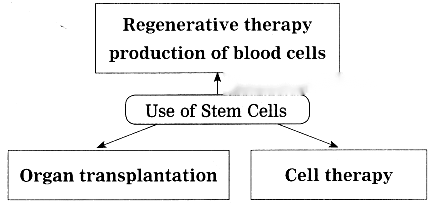
Stem cells are used for following purposes:
Question 2
Maharashtra Board Solution
Cloning.
Solution & Step-by-Step Answer:
Question 3
Maharashtra Board Solution
Dolly.
Solution & Step-by-Step Answer:
Question 4
Maharashtra Board Solution
Green revolution.
Solution & Step-by-Step Answer:
Question 5
Maharashtra Board Solution
White revolution.
Solution & Step-by-Step Answer:
Question 6
Maharashtra Board Solution
Blue Revolution.
Solution & Step-by-Step Answer:
Complete the paragraph by choosing the appropriate words given in the bracket:
Question 1
Maharashtra Board Solution
(degenerated, red bone marrow, adipose connective tissue, blastocyst, umbilical cord, Differentiation) ………… of stem cells form can form various tissues, in the body. Stem cells are present in the ………….. by which the foetus is joined to the uterus of the mother. Stem cells are also present in the ……….. stage of embryonic development. Stem cells are present in ……….. and ………… of adult human beings. It has become possible to produce different types of tissues and the ……… part of any organ with the help of these stem cells.
Solution & Step-by-Step Answer:
Differentiation of stem cells form can form various tissues in the body. Stem cells are present in the umbilical cord by which the foetus is joined to the uterus of the mother. Stem cells are also present in the blastocyst stage of embryonic development. Stem cells are present in red bone marrow and adipose connective tissue of adult human beings. It has become possible to produce different types of tissues and the degenerated part of any organ with the help of these stem cells.
Paragraph-based questions : 1. Green corridor refers to a special road route that enables harvested organs meant for transplants to reach the destined hospital. A 45-year-old woman, a victim of a railway accident, was declared brain dead, her husband and children agreed to donate her kidneys, liver and heart. One of her kidneys was transplanted to a patient in MGM Hospital and the second kidney helped a patient in Jaslok hospital. Her liver helped the transplant of a patient in Wockhardt Hospital. And her heart was sent to Fortis to the patient on a super urgent priority list, transported via a green corridor covering 18km in less than 16 minutes. This was possible due to Green corridor.
Question 1
Maharashtra Board Solution
What is Green corridor?
Solution & Step-by-Step Answer:
Green corridor is a special road route that enables harvested organs meant for transplants to reach the destined hospital
Question 2
Maharashtra Board Solution
Which organs of brain-dead lady were transplanted?
Solution & Step-by-Step Answer:
Two kidneys, liver and heart of the brain- dead lady were transplanted.
Question 3
Maharashtra Board Solution
How many lives were saved from organs of one lady?
Solution & Step-by-Step Answer:
Four patients lives were saved due to organ donation of one lady.
Question 4
Maharashtra Board Solution
How was distance of 18km covered in 16 minutes? Why?
Solution & Step-by-Step Answer:
The distance was covered because the concept of Green corridor was applied. The heart was sent from one hospital to another, where the recipient was kept ready. The quick transportation is necessary to keep heart in living condition.
Question 5
Maharashtra Board Solution
Who takes the decision to donate the organs?
Solution & Step-by-Step Answer:
The close relatives of deceased person take the decision to donate the organs.
2. Read the following extract and answer the questions that follow: (March 2019) Life of many people can be saved by organ and body donation. Blinds can regain their vision. Life of many people can be rendered comfortable by donation of organs like liver, kidneys, heart, heart valves, skin, etc. Similarly, body can be made available for research in medical studies. Many government and social organizations are working towards increasing the awareness about body donation.
Question 1
Maharashtra Board Solution
What is the liberal view behind the organ and body donation?
Solution & Step-by-Step Answer:
By body donation, research in medical studies is possible. The needy persons can get vital organs which can save their lives.
Question 2
Maharashtra Board Solution
Name any four organs that can be donated.
Solution & Step-by-Step Answer:
Liver, Kidneys, heart, eyes, skin, etc. can be donated.
Complete the following table:
Question 1
Maharashtra Board Solution
|
Plant/Microbes | Functions |
(1) Pteris vitata | ______________________________ |
(2) Pseudomonas | ______________________________ |
(3) ______________________________ | Absorption of uranium and arsenic |
(4) ______________________________ | Absorption of radiations of nuclear waste |
Plant/Microbes | Functions |
(1) Pteris vitata | Absorbs arsenic from soil. |
(2) Pseudomonas | Separates hydrocarbon and oil from water and soil |
(3) Sunflower | Absorption of uranium and arsenic |
(4) Deinococcus radiodurans | Absorption of radiations of nuclear waste Diagram/chart based questions:
Question 1
Maharashtra Board Solution
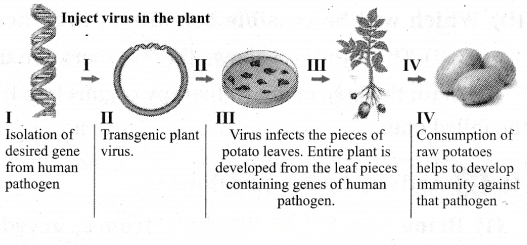
(A) Which process is shown in the above figure? *
Solution & Step-by-Step Answer:
The figure shows process to make transgenic
(B) Describe in brief the steps I, II, III and IV.
Question 2
Maharashtra Board Solution
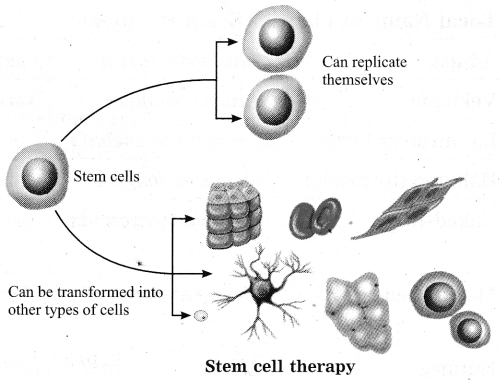
Draw well labelled diagram of Stem cell therapy.
Solution & Step-by-Step Answer:
Question 3
Maharashtra Board Solution
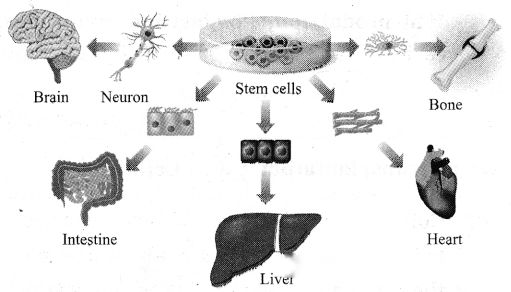
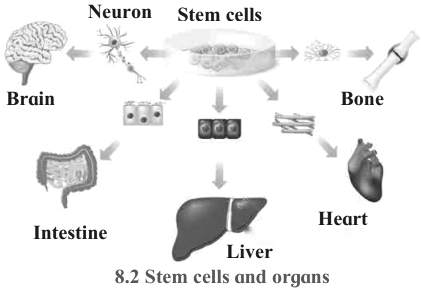
Label the following diagram : (i) Stem cells and organ transplantation,
Solution & Step-by-Step Answer:
(ii) Organs that can be donated:
Question 4
Maharashtra Board Solution
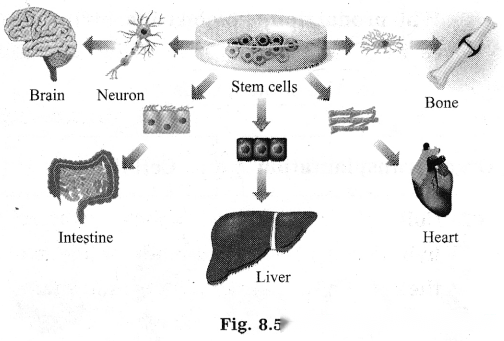
(i) Which therapy is shown in the Fig. 8.5? (ii) Which will be possible benefits of this therapy in organ transplantation ?
Solution & Step-by-Step Answer:
(i) The figure 8.5 shows the ‘regenerative therapy’ using stem cells. Also called stem cell therapy. (ii) With the help of above therapy organs like liver, kidney from stem cells can be redeveloped to replace the failed ones.
Activity based questions:
Question 1
Maharashtra Board Solution
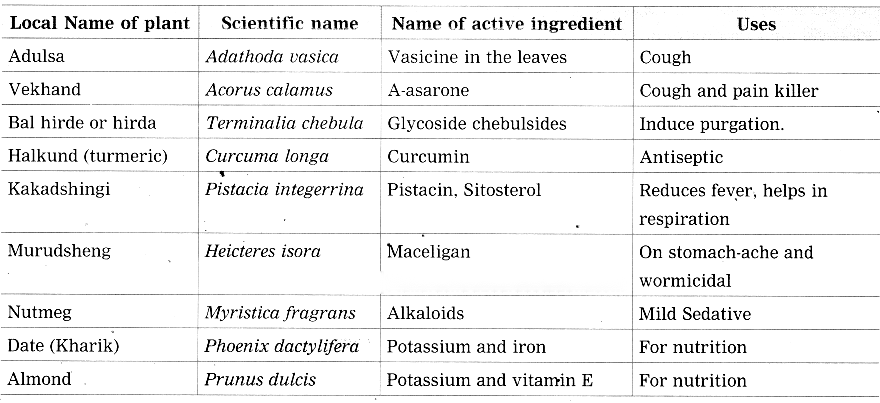
Bring a packet of ‘Balghuti’ from ayurveda shop. Learn the information about each component in it. Collect information about various other medicines and prepare the chart as shown below. (Try this: Textbook page no. 99)
Solution & Step-by-Step Answer:
Question 2
Maharashtra Board Solution
Give five examples of each of the fruiting and flowering plants developed through tissue culture and mention their benefits. (Make a list and discuss: Textbook page no. 93)
Solution & Step-by-Step Answer:
I. Fruiting trees: Banana, Chikoo (Sapota), Tomato, Fig, Pineapple.
II. Flowering trees: Orchids, Roses, Chrysanthemum, Gerbera, Begonia, Carnation, Lili. Benefits of such plants may be varied. Mostly fruits developed are made seedless and tastier. III. Benefits of plants produced through technique of tissue culture:
Question 3
Maharashtra Board Solution
Which new species of the rice have been developed in India? (Collect Information: Textbook page no. 97)
Solution & Step-by-Step Answer:
Question 4
Maharashtra Board Solution
Discuss about stem cells and organ transplantation in the class with the help of figures given on textbook page no. 90. (Observe: Textbook page no. 90)
Solution & Step-by-Step Answer:
Organ transplantation: Various organs in the human body either become less efficient or completely functionless due to various reasons like aging, accidents, infections, disorders, etc. Life of such person becomes difficult or even fatality may occur under such conditions. However, if a person gets the necessary organ under such conditions, its life can be saved.
Availability of donor is an important requirement in organ transplantation. Each person has a pair of kidneys. As the process of excretion can occur with the help of single kidney, person can donate another one. Similarly, skin from certain parts of the body can also be donated. Various factors like blood group, diseases, disorders, age, etc. of the donor and recipient need to be paid attention during transplantation. However, other organs cannot be donated during life time. Organs like liver, heart, eyes can be donated after death only. This has lead to the emergence of concepts like posthumous (after death) donation of body and organs. Organ and Body Donation: human bodies are disposed off after death as per traditional customs. However due to progress in science, it has been realized that many organs remain functional for certain period even after death occurs under specific conditions. Concepts like organ donation and body donation have emerged recently after realization that such organs can be used to save the life of other needful persons. A liberal view behind the concept of organ and body donation is that after death, our body should be useful to other needful persons so that their miserable life would become comfortable. Awareness about these concepts is increasing in our country and people are voluntarily donating their bodies. Life of many people can be saved by organ and body donation. Blinds can regain the vision. Life of many people can be rendered comfortable by donation of organs like liver, kidneys, heart, heart valves, skin. etc. Similarly, body can be made available for research in medical studies. Many government and social organizations are working towards increasing the awareness about body donation.
Question 5
Maharashtra Board Solution
Which fruits processing industries you observe in your surrounding? What is their effect? (Make a list and discuss: Textbook page no. 99)
Solution & Step-by-Step Answer:
Fruit Processing: we are daily using various products prepared from fruits. All are consuming the products like chocolates, juices, jams and jellies. All these products can be produced by processing on fruits. Fruits are perishable agro-produce. It needs the processing in such a way that it can be used throughout the year. Fruit processing includes various methods ranging from storage in cold storage to drying, salting, air tight pucking, preparing murabba, evaporating, etc.
Projects: (Do it your self) Project 1. Project 2. Project 3. Project 4. |