Maharashtra State Board Class 10 Science Solutions Part 2 Chapter 4 Environmental management
The people’s participation in the conservation movement is essential. From school age, the environmental values are inculcated in the young minds. Conservation of environment is the social responsibility of everyone. Judicial use of natural resources conservation also way of environmental conservation.
b. Chipko Movement of Bishnoi.
Answer:
Chipko Movement of Bishnoi or Bishnoi Andolan:
Khejarli or Khejadli is a village in Rajasthan, where Bishnoi community is located. The name of the town is derived from Khejri trees.
The first event of Chipko Movement took place in Khejadli village in 1730 AD. In this village 363 Bishnois, led by Amrita Devi sacrificed their lives for protecting the trees of Khejri trees, which trees are considered as sacred by Bishnoi.
Amrita Devi said, “if a tree is saved even at the cost of one’s head, it’s worth it”. She was killed with the axes that were brought to chop off the trees. The three young daughters Asu, Ratna and Bhagubai also sacrificed their lives for trees.
83 Bishnoi villages came together and villagers sacrificed their lives after hearing about Amrita Devi’s sacrifice. Three hundred and sixty-three Bishnois were killed as they opposed the king. After realizing the mistake, the king ordered stoppage of the felling of trees. Honouring the courage of the Bishnoi community, the ruler of Jodhpur, Maharaja Abhay Singh, apologized. He issued a royal decree to protect trees and wild life.
Chipko movement of 20th century in Uttar Pradesh also followed the same pattern of embracing the trees and saving them from cutting.
c. Biodiversity.
Answer:
Biodiversity means the diverse life forms that inhabit any area. Biodiversity is seen due to variety of life forms and different ecosystems that lodge these organisms. In nature there is biodiversity on the three different levels, viz. genetic diversity, species diversity and ecosystem diversity. This means that there is diversity in the individuals belonging to the same specips due to genetic reasons, there is diversity among the different species of organisms and there is also a diversity in the ecosystems that are present in any region.
Due to development of mankind, the biodiversity is threatened. There are special efforts taken to restore the lost and threatened biodiversity. Some of these are establishing sanctuaries, National Parks, biodiversity hotspots and reserves etc. Certain endangered species are protected by carrying out conservation projects.
d. Sacred Groves.
Answer:
Sacred grove is the green patch of the forest which is conserved by local people in the name of God. It does not belong to forest department. It is like a sanctuary that is conserved by the common people and tribals in the area. It is rich in the biodiversity.
It is conserved as there is a faith that God or deity reside in the sacred grove. Hence in local language, they are known as Deorai. Due to this reason, people do not fell the trees. Also hunting of any wild life is not done here. More than 13000 sacred groves have been reported in India. Most of these are in Western Ghats in Maharashtra, Karnataka and Kerala. Also, in remaining parts of India sacred groves are reported. Role of sacred grove is tremendous in conserving the biodiversity.
e. Disaster and its management.
Answer:
1. Tree plantation is one such easier project that can be undertaken to conserve environment. The further nurturing of the tree will also be our responsibility. While selecting the tree, the local and sturdy varieties will be selected. Such trees can survive in polluted environment too and even under the pressure of urbanization.
2. Solid waste management is another very important project that should be undertaken by every society, colony or school. Segregation of waste into dry and wet types and then its proper disposal will be taught to all the people in the neighbouring area.
3. To ban the plastic and make people aware about harmful effects of plastic is another very significant project.
4. Fossil fuels are non-renewable and polluting. Therefore, their use should be reduced as far as possible. Therefore, using bicycle, or walking down for shorter distances or using public transport systems are the better alternatives. The awareness drive about these facts will be taken up as a project.
5. To take care of stray animals, provide shelter, feeding endangered birds like sparrows and allowing them to survive with our support is also one of the essential act to conserve other species.
6. Attempts will be made for bringing awareness among minds of everyone. Such small acts can bring about major shift in the attitude of the people. This will certainly help in the environmental conservation.
b. Human beings have important place in environment.
Answer:
c. Write the types and examples of biodiversity.
Answer:
Biodiversity is documented on the following three levels, viz. genetic diversity, species diversity and ecosystem diversity.
1. Genetic Diversity: Diversity seen among the organisms of same species due to genetic differences is called genetic diversity. E.g. The individual human beings are different from each other. No two animals or plants are exactly alike.
2. Species Diversity: The difference between the different species is the species diversity, e.g. All the species of plants, animals and microbes which are seen in any natural environment.
3. Ecosystem Diversity: In one region there may be different ecosystems, such diversity in the ecosystems is called ecosystem diversity. Ecosystems are natural or artificial. Every region shows different types of ecosystems such as aquatic, terrestrial, desert or forest ecosystems. Each ecosystem has its own habitats with resident flora and fauna.
d. How the biodiversity can be conserved?
Answer:
Biodiversity can be conserved by the following ways:
e. What do we learn from the story of Jadav Molai Payeng? (Board’s Model Activity Sheet)
Answer:
Jadav Molai Payeng is a common man who was just a simple forest worker. But he has conscience about plants and tree plantations. He single-handedly planted thousands of trees. He converted a barren patch of land into forest which is spread over 1360 acres. For these plantations he continuously worked.
He has shown that a single determined person, can establish a new forest! We understand the values of
hard work, sincerity and devotion to the nature through the story of Jadav Molai Payeng. Even a common man can contribute a lot for the conservation and protection of the environment by learning the story of Payeng.
f. Write the names of biodiversity hot spots.
Answer:
g. Which are the reasons for endangering the many species of plants and animals? How can we save those diversity?
Answer:

2. These symbols inculcate the importance of being eco-friendly. The first symbol is essential to maintain the natural resources by reusing and recycling them. As far as possible, one should reduce the excessive use of resources by preventing consumerism.
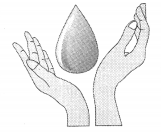
3. Water problems persist in many major cities and villages. In villages it results in drought like conditions. It also reflects into loss of agricultural produce. Therefore, the message about saving water or to make judicious use of water should be spread far and wide.
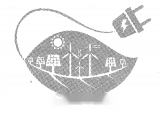
4. The solar energy is the renewable energy option which is very easily available in country like India. By using solar energy, we can replace the polluting and exhaustible fuels. Thereby, pollution will also be reduced.
Due to such symbols, important messages about environment conservation reach, us and we can change ourselves into more eeofriendly persons.
Project: (Do it your self)
Project 1.
Make a presentation on pollution of Gangci and Yamuna Rivers and effects of air pollution on Taimuhal.
Can you recall? (Text Book Page No. 36)
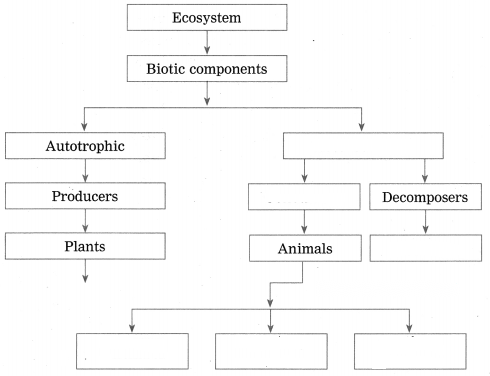
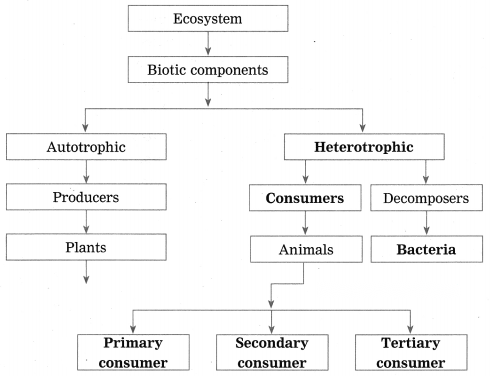
The different components in the ecosystem are as follows:
Abiotic components : Air, water, soil, sunlight, temperature, humidity, etc.
Biotic components: All the types of living organisms, like bacteria, fungi, plants and animals.
Think and Answer! (Text Book Page No. 36)

Use your brain power. (Text Book Page No. 40)
The young children and senior citizens are affected to greater extent by the pollution. If the air and water required for the survival of the people is affected, then exercising the pollution control is to be done immediately. Thus, it is said that pollution control is important.
Enlist and discuss (Text Book Page No. 43)



Observe and fill the information: (Text Book Page No. 8)

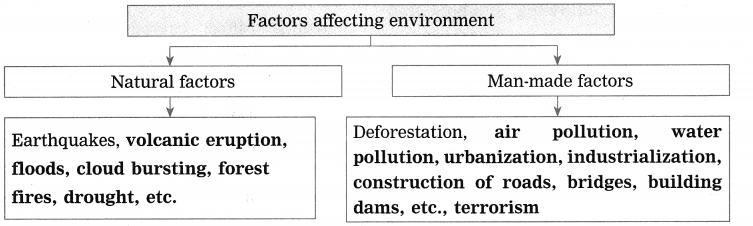
Complete the Chart: (Text Book Page No. 39)
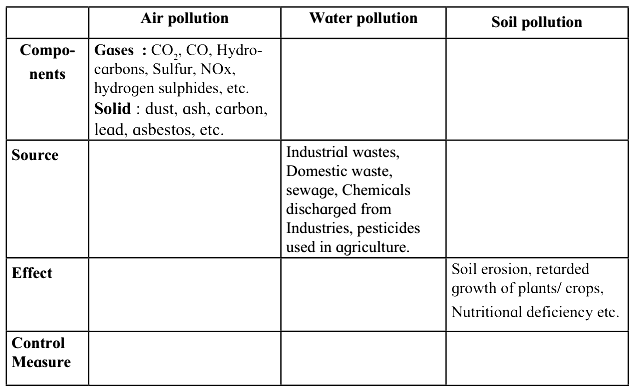
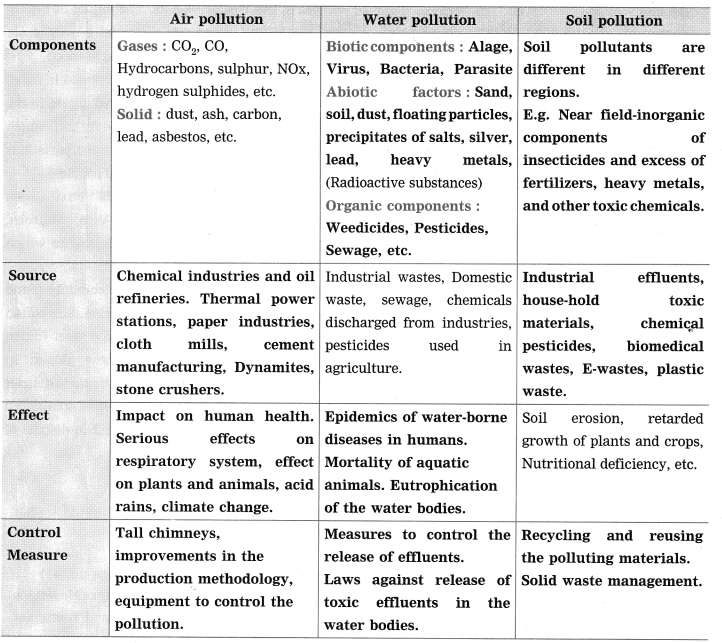
Complete the Chart: (Text Book Page No. 40)
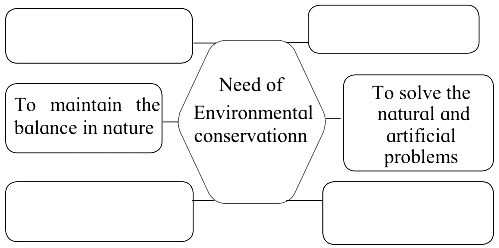
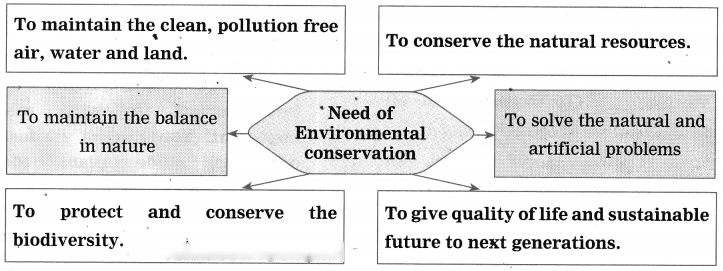
(Text Book Page No. 43)
In Maharashtra, sacred groves are found in tribal as well as non-tribal areas. The sacred groves in the western part are called Devrai or Devrahati, which means the abode of the gods. In eastern parts it is called Devegudi by the madiya tribal people.
In Maharashtra 2820 Devrais have been documented. Maruti, Vaghoba, Vira, Bhiroba, Khandoba and Shirkai are some deities to which sacred groves are dedicated.
In the sacred groves, the most commonly found plant species are Portia tree, Casuarina, Silk cotton tree, Indian laurel, Indian Elm, Bead tree, Indian butter tree, Turmeric and Japanese ginger. In Maharashtra, sacred groves are maximum in district of Sindhudurg, (More than 1500 out of total 2820) followed by Ratnagiri, then Pune and in district of Satara.
Choose the correct alternative and write that alphabet against the sub-question number:
Write whether the following statements are true or false, giving suitable explanation for the same:
Match the columns:
Column I | Column II |
(1) Physical, chemical and biological factors together form | (a) Biodiversity |
(2) The science of interactions between biotic and abiotic factors | (b) Ecosystem |
(c) Ecology | |
(d) Environment |
(1) Physical, chemical and biological factors together form – Environment.
(2) The science of interactions between biotic and abiotic factors – Ecology.
Question 2
Maharashtra Board Solution
Solution & Step-by-Step Answer:
(1) Basic functional unit in the environment – Ecosystem.
(2) Different types of living organisms – Biodiversity.
Question 3
Maharashtra Board Solution
|
Rules/Act | Year |
(1) Sound Pollution (Control and Prevention) Rule | (a) 1980 |
(2) Biomedical Waste (Management and Handling) Rule | (b) 2011 |
(c) 1998 | |
(d) 2000 |
(1) Sound Pollution (Control and Prevention) Rule – 2000.
(2) Biomedical Waste (Management and Handling) Rule – 1998.
Question 4
Maharashtra Board Solution
Solution & Step-by-Step Answer:
(1) Forest Conservation Act – 1980.
(2) Environmental Conservation Act – 1986.
Question 5
Maharashtra Board Solution
|
Species | Examples |
(1) Endangered | (a) Red panda, Musk deer. |
(2) Rare | (b) Tiger, Lion. |
(c) Lion tailed monkey, lesser florican. | |
(d) Monkey, squirrel |
(1) Endangered Species – Lion tailed monkey, lesser florican.
(2) Rare Species – Red panda, Musk deer.
Question 6
Maharashtra Board Solution
Solution & Step-by-Step Answer:
(1) Vulnerable Species – Tiger, Lion.
(2) Indeterminate Species – Giant squirrel (Shekhru). Find the odd one out:
Question 1
Maharashtra Board Solution
Ash, Carbon dioxide, Lead, Asbestos
Solution & Step-by-Step Answer:
Carbon dioxide. (All others are solid particulate pollutants.)
Question 2
Maharashtra Board Solution
Manas sanctuary, Sunderbans sanctuary, The Western Ghats, Tadoba National Park
Solution & Step-by-Step Answer:
Tadoba National Park. (All others are endangered heritage places of India.)
Question 3
Maharashtra Board Solution
Lion tailed monkey, White rats, Musk deer, Tiger
Solution & Step-by-Step Answer:
White rats. (All others are species that are threatened.)
Question 4
Maharashtra Board Solution
Conservation, Regulation, Pollution, Prohibition
Solution & Step-by-Step Answer:
Pollution. (All others are ways of environmental protection.)
Question 5
Maharashtra Board Solution
IPCC, UNEP, IUCN, BNHS
Solution & Step-by-Step Answer:
BNHS. (All others are international organizations. BNHS is Bombay Natural History Society.)
Find the correlation:
Question 1
Maharashtra Board Solution
Rare species : Musk deer : : ………… : Lesser florican.
Solution & Step-by-Step Answer:
Endangered species
Question 2
Maharashtra Board Solution
Red panda : Rare species : : Giant Squirrel : …………
Solution & Step-by-Step Answer:
Indeterminate species
Question 3
Maharashtra Board Solution
Nitrogen, Oxygen : Gaseous cycle : : Soil and Rocks : …………
Solution & Step-by-Step Answer:
Sedimentary cycle
Question 4
Maharashtra Board Solution
Manas : One horned Rhino : : Gir : ………..
Solution & Step-by-Step Answer:
Asiatic lion
Question 5
Maharashtra Board Solution
Mumbai : Bombay Natural History Society : : TehriGarhwal : ………….
Solution & Step-by-Step Answer:
Chipko centre.
Answer the following questions in detail:
Question 1
Maharashtra Board Solution
Answer the following questions: If frog population in paddy field declines all of a sudden, (a) What will be the effect on paddy crop?
Solution & Step-by-Step Answer:
If the population of frog declines, then there will be rise in the population of grasshoppers. The paddy fields will hence be infested with insect pests.
(b) Number of which consumers will decline and which will increase? (c) Name the Indian states where paddy is cultivated on a large scale.
Question 2
Maharashtra Board Solution
What is radioactive pollution? What are its effects?
Solution & Step-by-Step Answer:
(1) The radiations emitted either through the natural sources or through man-made sources cause radioactive pollution. (2) The natural radiations is in the form of ultra violet and infrared radiations. (3) Artificial or man-made radiations are X-rays and radiations from atomic energy plants. (4) All radiations are highly hazardous for the living organisms. The impact of radiation is also for a very long time. (5) It has brought about major accidental mishaps at Chernobyl, Windscale, qpd Three Miles Island. These disasters have affected thousands of people. (6) Some other effects of radiations are as follows – (i) Due to higher radiations of X-rays, cancerous ulceration occurs, (ii) Radiations destroy the body tissues, (iii) Radiations cause mutations and thus genetic changes occur, (iv) There is adverse effect on the vision.
Question 3
Maharashtra Board Solution
Give one word for “The forest conserved in the name of God.” (Board’s Model Activity Sheet)
Solution & Step-by-Step Answer:
Deorai.
Give scientific reasons:
Question 1
Maharashtra Board Solution
Certain scavenging caterpillars, termites and insects found in the dung are important.
Solution & Step-by-Step Answer:
Question 2
Maharashtra Board Solution
Destroying trees is to destroy everything.
Solution & Step-by-Step Answer:
Question 3
Maharashtra Board Solution
There is no definite information about indeterminate species.
Solution & Step-by-Step Answer:
Question 4
Maharashtra Board Solution
Tigers from Sunderbans and Rhinos from Manas are under threat.
Solution & Step-by-Step Answer:
Question 5
Maharashtra Board Solution
There are clusters of thick forests in the Western Ghats of India.
Solution & Step-by-Step Answer:
Question 6
Maharashtra Board Solution
We can see biodiversity on three levels.
Solution & Step-by-Step Answer:
Questions based on diagrams:
Question 1
Maharashtra Board Solution
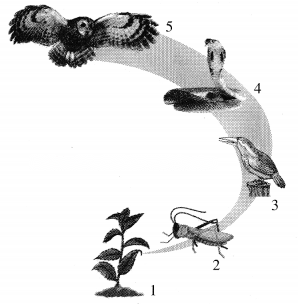
What is shown in the picture? Write name and trophic level of each component.
Solution & Step-by-Step Answer:
In this picture, food chain having rive trophic levels is shown. (1) Trophic level 1 = Producers : Green plant. (2) Trophic level 2 = Primary consumer (Herbivore): Grasshopper. (3) Trophic level 3 = Secondary consumer (Carnivore): Bird. (4) Trophic level 4 = Tertiary consumer (Carnivore) : Snake. (5) Trophic level 5 = Top or Apex consumer (Carnivore) : Owl.
Question 2
Maharashtra Board Solution
Explain the meaning of following symbols A and B and C. A.
Solution & Step-by-Step Answer:
The symbol show types of green energy such as solar energy and wind energy. It also expresses that people should use such sources of energy for their use.
B.
C.
WWF means World Wild Life Fund. Also known as World Wide Life Fund. This International Institute is looking after the welfare of wildlife through different conservation projects. WWF symbol shows Panda while BNHS symbol has Giant Hornbill.
Question 3
Maharashtra Board Solution
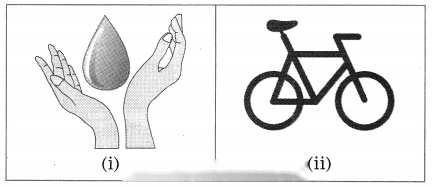
(a) Identify the following symbols and state their significance: (March 2019)
Solution & Step-by-Step Answer:
(i) This symbol is giving the message “Save water”. Sustainable use of water is necessary for our future. (ii) Use of bicycle means use of green energy. By riding on a bicycle we save on fuel and use our own muscular energy. It is the best ecofriendly, non polluting vehicle.
(b) How can biodiversity be conserved? Activity based questions:
Question 1
Maharashtra Board Solution
Questions based on the charts. Complete the flow chart: (July 2019)
Solution & Step-by-Step Answer:
Question 2
Maharashtra Board Solution
Collect more information about locations of these hotspots present in the world. (Textbook page no. 44)
Solution & Step-by-Step Answer:
Students should collect this information.
Question 3
Maharashtra Board Solution
Where are such sacred groves in Maharashtra? Make a list and visit with your teachers. (Textbook page no. 43)
Solution & Step-by-Step Answer:
Sacred groves: Sacred groves form an important landscape feature in the deforested hill ranges of the Western Ghats. The felling of timber and the killing of animals in sacred groves is not allowed by the locals. It is considered as taboo.
In Maharashtra, sacred groves are found in tribal as well as non-tribal areas. The sacred groves in the western part are called Devrai or Devrahati, which means the abode of the gods. In eastern parts it is called Devegudi by the madiya tribal people. In Maharashtra 2820 Devrais have been documented. Maruti, Vaghoba, Vira, Bhiroba, Khandoba and Shirkai are some deities to which sacred groves are dedicated. In the sacred groves, the most commonly found plant species are Portia tree, Casuarina, Silk cotton tree, Indian laurel, Indian Elm, Bead tree, Indian butter tree, Turmeric and Japanese ginger. In Maharashtra, sacred groves are maximum in district of Sindhudurg, (More than 1500 out of total 2820) followed by Ratnagiri, then Pune and in district of Satara. Projects: (Do it your self) Project 1. Project 2. Project 3. Project 4. Project 5. |