Maharashtra State Board Class 10 Science Solutions Part 1 Chapter 2 Periodic Classification of Elements
Periodic Classification Of Elements Question 1.
Rearrange the columns 2 and 3 so as to match with the column 1.
Column 1 | Column 2 | Column 3 |
i. Triad | a. Lightest and negatively charged particle in all the atoms | 1. Mendeleev |
ii. Octave | b. Concentrated mass and positive charge | 2. Thomson |
iii. Atomic number | c. Average of the first and the third atomic mass | 3. Newlands |
iv. Period | d. Properties of the eighth element similar to the first | 4. Rutherford |
v. Nucleus | e. Positive charge on the nucleus | 5. Dobereiner |
vi. Electron | f. Sequential change in molecular formulae | 6. Moseley |
Answer:
Column 1 | Column 2 | Column 3 |
i. Triad | Average of the first and the third atomic mass | Dobereiner |
ii. Octave | Properties of the eighth element similar to the first | Newlands |
iii. Atomic number | Positive charge on the nucleus | Moseley |
iv. Period | Sequential change in molecular formulae | Mendeleev |
v. Nucleus | Concentrated mass and positive charge | Rutherford |
vi. Electron | Lightest and negatively charged particle in all the atoms | Thomson |
Periodic Classification Of Elements Class 10 Maharashtra Board Question 2.
Choose the correct option and rewrite the statement:
(a) The number of electrons in the outermost shell of alkali metals is…….
(a) 1
(b) 2
(c) 3
(d) 7
Answer:
(a) 1
(b) Alkaline earth metals have valency 2. This means that their position in the modern periodic table is in…….
(a) Group 2
(b) Group 16
(c) Period 2
(d) d-block
Answer:
(a) Group 2
(c) Molecular formula of the chloride of an element X is XCl. This compound is a solid having high melting point. which of the following elements be present in the same group as X.
(a) Na
(b) Mg
(c) Al
(d) Si
Answer:
(a) Na
(d) In which block of the modem periodic table are the nonmetals found?
(a) s-block
(b) p-block
(c) d-block
(d) f-block
Answer:
(b) p-block
Class 10 Science Chapter 2 Periodic Classification Of Elements Notes Question 3.
An element has its electron configuration as 2, 8, 2. Now answer the following questions.
a. What is the atomic number of this element?
Answer:
The atomic number of this element is 12.
b. What is the group of this element?
Answer:
The group of this element is 2.
c. To which period does this element belong?
Answer:
This element belongs to period 3.
d. With which of the following elements would this element resemble? (Atomic numbers are given in the brackets)
N(7), Be(4), Ar(18), Cl(17)
Answer:
This element resembles Be(4).
Class 10 Science 1 Chapter 2 Periodic Classification Of Elements Question 4.
Write down the electronic configuration of the following elements from the given atomic numbers. Answer the following question with explanation.
a.3Li,14Si,2He,11Na,15P which of these elements belong to be period 3?
Answer:
Elements | Electronic configuration |
(i)3Li | 2,1 |
(ii)14Si | 2, 8,4 |
(iii)2He | 2 |
(iv)11Na | 2, 8, 1 |
(v)15P | 2, 8, 5 |
Elements belong to the 3rd period:14Si,11Na and15P.
b.1H,7N,20Ca,16S,4Be,18Ar. Which of these elements belong to the second group?
Answer:
Elements | Electronic configuration |
(i)1H | 1 |
(ii)7N | 2, 5 |
(iii)20Ca | 2, 8, 8, 2 |
(iv)16S | 2, 8, 6 |
(v)4Be | 2, 2 |
(iv)18Ar | 2, 8, 8 |
Elements belongs to the 2nd group:4Be and20Ca.
c.7N,6C,8O,5B,13Al Which is the most electronegative element among these?
Answer:
Elements | Electronic configuration |
(i)7N | 2,5 |
(ii)6C | 2,4 |
(iii)80 | 2,6 |
(iv)5B | 2,3 |
(v)13A1 | 2, 8,3 |
Among these,8O is the most electronegative element.
d.4Be,6C,8O,5B,13Al Which is the most electropositive element among these?
Answer:
Elements | Electronic configuration |
(i)4Be | 2, 2 |
(ii)6C | 2, 4 |
(iii)8O | 2, 6 |
(iv) B | 2, 3 |
(v)11Al | 2, 8, 3 |
Among these,13Al is the most electropositive element.
e.11Na,15P,17Cl,14Si,12Mg which of these has largest atoms?
Answer:
Elements | Electronic configuration |
(i)11Na | 2, 8, 1 |
(ii)15P | 2, 8, 3 |
(iii)17Cl | 2, 8, 7 |
(iv)14Si | 2, 8, 4 |
(v)12Mg | 2, 8, 2 |
11Na has the largest atomic size.
f.19K,3li,11Na,4Be Which of these atoms has smallest atomic radius?
Answer:
Elements | Electronic configuration |
(i)19K | 2, 8, 8, 1 |
(ii)3Li | 2, 1 |
(iii)11Na | 2, 8, 1 |
(iv)4Be | 2, 2 |
4Be has smallest atomic radius.
g.13Al,14Si,11Na,12Mg,16S Which of the above elements has the highest metallic character?
Answer:
Elements | Electronic configuration |
(i)13Al | 2, 8, 3 |
(ii)14Si | 2, 8, 4 |
(iii)11Na | 2, 8, 1 |
(iv)12Mg | 2, 8, 2 |
(v)16S | 2, 8, 6 |
11Na has the highest metallic character.
h.6C,3Li,9F,7N,8O Which of the above elements has the highest nonmetallic character?
Answer:
Elements | Electronic configuration |
(i)6C | 2, 4 |
(ii)3Li | 2, 1 |
(iii)9F | 2, 7 |
(iv)7N | 2, 5 |
(v)8O | 2, 6 |
9F has the highest non metallic character.
Science 1 Chapter 2 Class 10 Maharashtra Board Question 5.
write the name and symbol of the element from the description.
a. The atom having the smallest size.
Answer:
Helium(He).
b. The atom having the smallest atomic mass.
Answer:
Hydrogen(H2).
c. The most electronegative atom.
Answer:
Fluorine(F2).
d. The noble gas with the smallest atomic radius.
Answer:
Helium(He).
e. The most reactive nonmetal.
Answer:
Fluorine(F2).
Class 10 Science Chapter 2 Periodic Classification Of Elements Question 6.
Write short notes.
a. Mendeleev’s periodic law.
Answer:
when the elements are arranged in the order of their increasing atomic masses, Mendeleev found that the elements with similar physical and chemical properties repeat after a definite interval. On the basis of these finding Mendeleev stated the periodic law. The physical and chemical properties of elements are a periodic function of their atomic masses.
b. Structure of the modern periodic table.
Answer:
(1) In the modern periodic table, the elements are arranged in the order of their increasing atomic number. In the modern periodic table there are seven horizontal rows called periods and eighteen vertical columns (1 to 18) called groups. The arrangement or the periods and groups results into formation of boxes. Atomic numbers are serially indicated in the upper part of these boxes.
(2) Each box represents the place for one element. Apart from these seven rows, there are two rows of elements placed separately at the bottom of the periodic table. They are lanthanides and actinides series. There are 118 boxes in the periodic table including the two series that means there are 118 places for elements in the modern periodic table.
The formation of a few elements was established experimentally very recently and thereby the modern periodic table is now completely filled with 118 elements.
(3) On the basis of the electronic configuration, the elements in the modern periodic table are divided into four blocks, viz. s-block, p-block, d-block and f-block. The s-block constitute groups 1 and 2. The groups 13 to 18 constitute the p-block. Groups 3 to 12 constitute the d-block, while the lanthanide and actinide series at the bottom form the f-block. The d-bloclçelements are called transition elements.
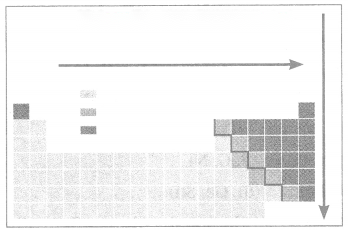
A zig-zag line shown in the p-block of the periodic table. This zig-zag line shows the three traditional types of elements, i.e. metals, nonmetals and metalloids. The metalloid elements lie along the border of zig-zag line. All the metals lie on the left side of the zig-zag line while all the nonmetals lie on the right side.
c. Position of isotopes in the Mendeleev’s and the modern periodic table.
Answer:
Isotopes were discovered long time after Mendeleev put forth the periodic table. A challenge was posed in placing isotopes in Mendeleev’s periodic table, as isotopes have the same chemical properties but different atomic masses. Isotopes do not find separate places in this table.
Moseley found out that atomic number is a fundamental property of an element rather than its atomic mass. The atomic number of any element is increased by one unit (number) from the atomic number or subsequent element. In the modern periodic table, the elements are arranged in the order of their increasing atomic numbers, that time the problem or discrepancy in the pairs or isotopes of elements observed in Mendeleev’s periodic table was solved. The isotopes or17Cl35and17Cl37were placed in the same group as both have the same atomic number.
Periodic Classification Of Elements Class 10 State Board Question 7.
Write scientific reasons.
a. Atomic radius goes on decreasing while going from left to right in a period.
Answer:
(1) In a period while going from left to right, atomic radius goes on decreasing and the atomic number increases one by one, that means positive charge on the nucleus increases by one unit at a time.
(2) However, the additional electron is added to the same outermost shell. Due to the increased nuclear charge the electrons are pulled towards the nucleus to a greater extent, as a result the size of atom decreases i.e., atomic radius decreases.
b. Metallic character goes on decreasing while going from left to right in a period.
Answer:
(1) Metals have a tendency to lose the valence electrons to form cations. This tendency of an element is called the metallic character of the element.
(2) while going from left to right within a period the outermost shell remains the same and electrons are added to the same shell. However, the positive charge on the nucleus goes on Increasing while the atomic radius goes on decreasing and thus the effective nuclear charge goes on increasing. As a result of this the tendency of atom to lose electrons decreases, i.e., electropositivity decreases. Thus, metallic character goes on decreasing within a period from left to right.
c. Atomic radius goes on increasing down a group.
Answer:
The size of an atom is indicated by its radius. while going down a group a new shell is added. Therefore, the distance between the outermost electron and the nucleus goes on increasing. These electrons experience lesser pull from the nucleus. Thus, atomic radius goes on increasing down a group.
d. Elements belonging to the same group have the same valency.
Answer:
(1) The valency of an element is determined by the number of valence electron in the outermost shell of an atom of an element.
(2) All the elements in a group have the same number of valence electrons. Therefore, elements in the same group should have the same valency. For example, the elements of group I contain only one valence electron: the valency of elements of group I is one. Similarly for group II, the valency is two.
e. The third period contains only eight elements even through the electron capacity of the third shell is 18.
Answer:
(1) In the modern periodic table, there are seven horizontal rows called periods. In a periods elements are arranged in an increasing order of their atomic numbers. The third row contains 8 elements and the electron capacity of the third shell is 18.
(2) In the third period, while moving from left to right, atomic number increases, number of electrons increases in the shell. The number of elements present in 3rdperiod is decided on the basis of electronic configuration and octet rule.
Atomic number | 11 | 12 | 13 | 14 | 15 | 16 | 17 | 18 |
Elements | Na | Mg | Al | Si | P | S | Cl | Ar |
Argon (Ar) is the last element of the third period and has a capacity of maximum 18 electrons. Its octet of electrons is completed and as argon belongs to zero group, the third shell contains 18 electrons.
Periodic Classification Of Elements Exercise Question 8.
Write the names from the description.
a. The period with electrons in the shells, K, L and M.
Answer:
Third period.
b. The group with valency zero.
Answer:
Group 18.
c. The family of nonmetals having valency one.
Answer:
Halogen family.
d. The family of metals having valency one.
Answer:
Group 1.
e. The family of metals having valency two.
Answer:
Group 2.
f. The metalloids in the second and third periods.
Answer:
Boron, Silicon.
g. Nonmetals in the third period.
Answer:
Phosphorous, sulfur and chlorine and argon.
h. Two elements having valency 4.
Answer:
Carbon, silicon.
Project:
Do it your self.
1. Find out the applications of all the inert gases, prepare a chart and display it in the class.
2. Find out the properties and uses of group 1 and group 2 elements.
3. Find out the properties and uses of period 2 and period 3 elements.
Can you recall? (Text Book Page No. 16)
Science 1 Chapter 2 Periodic Classification Of Elements Question 1.
What are the types of matter?
Answer:
The types of matter are solid, liquid, gas and plasma.
Class 10 Science Chapter 2 Periodic Classification Of Elements Exercise Question 2.
what are the types of elements?
Answer:
The types of elements are metals, nonmetals and metalloids.
Periodic Classification Of Elements Class 10 Solutions Question 3.
What are the smallest particles of matter called?
Answer:
The smallest particles are called atoms.
Periodic Classification Of Elements Question 4.
what is the difference between the molecules of elements and compounds?
Answer:
Can you tell? (Text Book Page No.16)
Identify Dobereiner’s triads from the following groups of elements having similar chemical properties:
(i) Mg (24.3), Ca (40.1), Sr (87.6)
(ii) S (32.1), Se (79.0), Te (127.6)
(iii) Be (9.0), Mg (24.3), Ca (40.1)
Answer:
Dobereiner’s triads
(i) S (32.1), Se (79.0), Te (127.6)
(ii) Be (9.0), Mg (24.3), Ca (40.1)
Use your brain power! (Text Book Page No. 20)
Class 10 Periodic Classification Of Elements Solutions Question 1.
write the molecular formulae of oxides of the following elements by referring to the Mendeleev’s periodic table. Na, Si, C, Rb, P, Ba, Cl, Sn.
Answer:
Elements | Oxides of Elements |
Na | Na2O Sodium oxide |
Si | SiO2Silicon oxide |
C | CO2Carbon dioxide |
Rb | Rb2O Rubidium oxide(yellow solid) |
P | P2O5Phosphorous pentaoxide |
Ba | BaO Barium oxide |
Cl | Cl2O Chlorine monoxide |
Sn | SnO2Tin oxide(stannic oxide) |
Periodic Classification Of Elements Class 10 Question 2.
Write the molecular formulae of the compounds of the following elements with hydrogen by referring to the Mendeleev’s periodic table. C, S, Br, AS, F, O, N, Cl.
Answer:
Elements | Compounds (with hydrogen) |
C | CH4Methane |
S | H2S Hydrogen sulphide |
Br | HBr Hydrogen bromide |
As | AsH3Arsine |
F | HF Hydrogen fluoride |
O | H2O Water |
N | NH3Ammonia |
Cl | HCl Hydrogen chloride |
Can you tell? (Text Book Page No. 22)
Periodic Classification Of Elements Class 10 Question And Answers Question 1.
Go through the modern periodic table and write the names one below the other of the elements of group 1.
Answer:
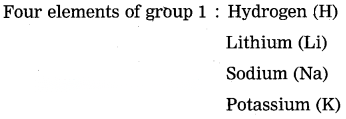
Periodic Classification Of Elements Class 10 Short Notes Question 2.
Write the electronic configuration of first four elements in this group.
Answer:
Elements | Electronic configuration |
Hydrogen | 1 |
Lithium | 2, 1 |
Sodium | 2, 8, 1 |
Potassium | 2, 8, 8, 1 |
Periodic Classification Of Elements Solutions Question 3.
Which similarity do you find in their configuration?
Answer:
The similarity is observed in valence electrons of these elements. The valence electron in these elements is one.
10th Science Part 1 Chapter 2 Periodic Classification Of Elements Question 4.
How many valence electrons are there in each of these elements?
Answer:
There is one valence electron in all these elements.
Can you tell? (Text Book Page No. 23)
Elements | Electronic configuration |
Li | 2, 1 |
Be | 2, 2 |
B | 2, 3 |
C | 2, 4 |
N | 2, 5 |
O | 2, 6 |
F | 2, 7 |
Ne | 2, 8 |
Can you tell? (Text Book Page No. 24)
Elements | K Shell | L Shell | M Shell | Electronic configuration |
Na | 2 | 8 | 1 | 2, 8, 1 |
Mg | 2 | 8 | 2 | 2, 8, 2 |
Al | 2 | 8 | 3 | 2, 8, 3 |
Si | 2 | 8 | 4 | 2, 8, 4 |
P | 2 | 8 | 5 | 2, 8, 5 |
S | 2 | 8 | 6 | 2, 8, 6 |
Cl | 2 | 8 | 7 | 2, 8, 7 |
Ar | 2 | 8 | 8 | 2, 8, 8 |
(Think about it) (Text Book Page No.19)
Atomic mass | Group | Period |
44 | III | 4 |
72 | IV | 5 |
100 | VII | 6 |
Use your brain power! (Text Book Page No. 19)
Use your brain power! (Text Book Page No.21)
Isotopes and occupy the same position in the modern periodic table. Both isotopes have the same atomic number.
In the modern periodic table, the elements are arranged in the order of their increasing atomic numbers, that the problem of discrepancy in the pairs of isotopes elements observed in Mendeleev’s periodic table was solved. The isotopes of and were placed in the same group as both have the same atomic number.
(2) On the other hand, hydrogen easily donates the electron and forms a stable cation (H+), but it does not easily form a stable anion (H–), hydride ion. Hence, it is better placed in group 1 rather than in group 17 in the modern periodic table.
Use your brain power! (Text Book Page No. 24)
Element | Electronic configuration | |
K shell | L shell | |
Li | 2 | 1 |
Be | 2 | 2 |
B | 2 | 3 |
C | 2 | 4 |
N | 2 | 5 |
O | 2 | 6 |
F | 2 | 7 |
Ne | 2 | 8 Octet complete |
Elements | K Shell | L Shell | M Shell | Electronic configuration |
Na | 2 | 8 | 1 | 2, 8, 1 |
Mg | 2 | 8 | 2 | 2, 8, 2 |
Al | 2 | 8 | 3 | 2, 8, 3 |
Si | 2 | 8 | 4 | 2, 8, 4 |
P | 2 | 8 | 5 | 2, 8, 5 |
S | 2 | 8 | 6 | 2, 8, 6 |
Cl | 2 | 8 | 7 | 2, 8, 7 |
Ar | 2 | 8 | 8 | 2, 8, 8 |
Think about it (Text Book Page No. 24)
Element | Atomic number | Electronic configuration | Valency |
Beryllium | 4 | 2, 2 | 2 |
Oxygen | 8 | 2, 6 | 2 |
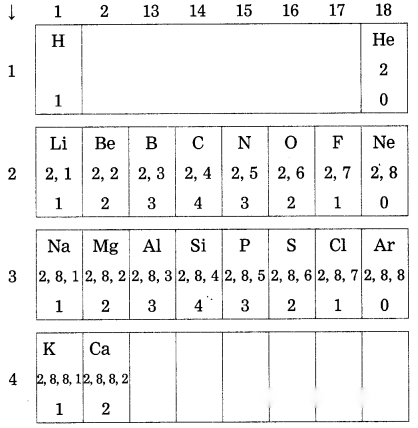

Elements | Li | Be | B | C | N | O | F | Ne |
Valancy | 1 | 2 | 3 | 4 | 3 | 2 | 1 | 0 |
Elements | Na | Mg | Al | Si | P | S | Cl | Ar |
Valancy | 1 | 2 | 3 | 4 | 3 | 2 | 1 | 0 |
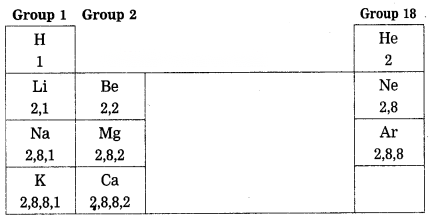
(2) All the elements in a group have the same number of valence elements. Therefore, elements in the same group should have the same valency. For example, the elements of group 1 (H, Li, Na, K etc.) contain only one valence electron. the valency of elements of group 1 is one. Similarly for group 2, (Be, Mg, Ca) contain two valence electrons, the valency of elements of group 2 is two.
(3) The elements of group 18 1 (Ne, Ar) contain 8 electrons (exception, Helium contain 2 electrons). Since the octet is completed their valency is zero.
Use your brain power! (Text Book Page No. 25)
Element | K | Na | Rb | Cs | Li |
Atomic radius (pm) | 231 | 186 | 244 | 264 | 152 |
Li | Na | K | Rb | Cs |
152 | 186 | 231 | 244 | 262 |
Use your brain power! (Text Book Page No. 26)
(Use your brain power !) (Text Book Page No. 27)
Full in the blanks:

Choose the correct option and rewrite the statement:
State whether the following statements are True or False. Rewrite the correct statement:
By observing the correlation in the first pair, complete the second pair:
Find the odd one out and give reasons:
Match the columns:
Column I | Column II |
(1) Modern periodic table | (a) Group 17 |
(2) Vertical columns | (b) Period 2 |
(3) Halogen | (c) Atomic number |
(4) Smallest period | (d) Group |
(e) Period 3 |
(1) Modern periodic table – Atomic number
(2) Vertical columns Group
(3) Halogen – Group 17
(4) Smallest period – Period 2.
Question 2
Maharashtra Board Solution
Solution & Step-by-Step Answer:
(1) Dobereiner – Triads
(2) Newlands – Octaves (3) Moseley – Atomic number (4) Mendeleev – Atomic mass.
Question 3
Maharashtra Board Solution
|
Column I | Column II |
(1) Eka-silicon | (a) Scandium |
(2) Eka-boron | (b) Gallium |
(3) Eka-aluminum | (c) Germanium |
(d) Cesium |
(1) Eka-silicon – Germanium
(2) Eka-boron – Scandium
(3) Eka-aluminium – Gallium.
Question 4
Maharashtra Board Solution
Solution & Step-by-Step Answer:
(1) Noble gas – Helium
(2) First period – Two elements (3) Second period – Eight elements (4) 3rdperiod – 18 elements.
Question 5
Maharashtra Board Solution
|
Column I | Column II |
(1) s-block elements | (a) Lanthanides and actinides |
(2) p-block elements | (b) Groups 1, 2 |
(3) d-block elements | (c) Groups IIIA to VIIA and zero group |
(4) f-block elements | (d) Groups 3 to 12 |
(e) Zero group elements | |
(f) Groups 13 to 18 |
(1) s-block elements – Groups 1, 2
(2) p-block elements – Groups 13 to 18
(3) d-block elements – Groups 3 to 12
(4) f-block elements – Lanthanides and actinides.
Question 6
Maharashtra Board Solution
Solution & Step-by-Step Answer:
(1) Helium – Zero group
(2) Horizontal row – Period (3) Group I – Alkali metal (4) Group II – Alkaline earth metal. Write the names from the description:
Question 1
Maharashtra Board Solution
The period with electrons In the shells K, L and M.
Solution & Step-by-Step Answer:
Third period.
Question 2
Maharashtra Board Solution
The group with valency zero.
Solution & Step-by-Step Answer:
Group 18.
Question 3
Maharashtra Board Solution
The family of nonmetals having valency One.
Solution & Step-by-Step Answer:
Halogen family.
Question 4
Maharashtra Board Solution
The family of metals having valency two.
Solution & Step-by-Step Answer:
Group 2.
Question 5
Maharashtra Board Solution
The metalloids in the second and third period.
Solution & Step-by-Step Answer:
Boron, silicon.
Question 6
Maharashtra Board Solution
The family of metals having valency one.
Solution & Step-by-Step Answer:
Group 1.
Question 7
Maharashtra Board Solution
Nonmetals In the third period.
Solution & Step-by-Step Answer:
Phosphorus, sulfur and chlorine, and argon.
Question 8
Maharashtra Board Solution
Two elements having valency 4.
Solution & Step-by-Step Answer:
Carbon. silicon.
Question 9
Maharashtra Board Solution
First three noble gases.
Solution & Step-by-Step Answer:
Helium, neon, and argon.
Name the following:
Question 1
Maharashtra Board Solution
Horizontal rows In modern periodic table.
Solution & Step-by-Step Answer:
Periods.
Question 2
Maharashtra Board Solution
Two elements having a single electron in their outermost shell.
Solution & Step-by-Step Answer:
Hydrogen, sodium.
Question 3
Maharashtra Board Solution
Three elements with filled outermost shell.
Solution & Step-by-Step Answer:
Question 4
Maharashtra Board Solution
Three elements having 7 electrons in their outermost shell.
Solution & Step-by-Step Answer:
Question 5
Maharashtra Board Solution
An alkali metal in period 2.
Solution & Step-by-Step Answer:
Lithium.
Question 6
Maharashtra Board Solution
An alkaline earth metal in period 3.
Solution & Step-by-Step Answer:
Magnesium.
Question 7
Maharashtra Board Solution
Halogen in period 3.
Solution & Step-by-Step Answer:
Chlorine.
Question 8
Maharashtra Board Solution
Three nonmetallic elements in period 2.
Solution & Step-by-Step Answer:
Question 9
Maharashtra Board Solution
The element with electronic configuration (2, 7).
Solution & Step-by-Step Answer:
Fluorine.
Question 10
Maharashtra Board Solution
The elements in periods 2 and 3 having stable electronic configuration.
Solution & Step-by-Step Answer:
Question 11
Maharashtra Board Solution
The three metals in the third period of the modern periodic table.
Solution & Step-by-Step Answer:
Answer the following questions: (Practice Activity Sheet – 3)
Question 1
Maharashtra Board Solution
What is the atomic number of this element?
Solution & Step-by-Step Answer:
The atomic number of this element is 20.
Question 2
Maharashtra Board Solution
what is the group of this element?
Solution & Step-by-Step Answer:
The group of this element is 2.
Question 3
Maharashtra Board Solution
To which period does this element belong?
Solution & Step-by-Step Answer:
The element belongs to period 4.
Answer the following questions in one sentence each:
Question 1
Maharashtra Board Solution
In Dobereiner’s triad containing L, Na, K, if atomic masses of 1ithium and potassium are 6.9 and 39.1, then what will be the atomic mass of sodium? (Practice Activity Sheet – 3) (March 2019)
Solution & Step-by-Step Answer:
The atomic mass of sodium is the average of the atomic masses or Li and K i.e., = 23.
Question 2
Maharashtra Board Solution
who was the first scientist to prepare the periodic table?
Solution & Step-by-Step Answer:
Mendeleev was the first scientist to prepare the periodic table.
Question 3
Maharashtra Board Solution
State the number of groups and periods in the modern periodic table.
Solution & Step-by-Step Answer:
There are 18 groups and 7 periods in the modern periodic table.
Question 4
Maharashtra Board Solution
How many elements are there in the second and the third periods of the periodic table?
Solution & Step-by-Step Answer:
There are eight elements in the second and the third periods of the periodic table.
Question 5
Maharashtra Board Solution
State the number of elements in the shortest period.
Solution & Step-by-Step Answer:
There are two elements in the shortest (first period) period.
Question 6
Maharashtra Board Solution
State the number of elements in the modern periodic table.
Solution & Step-by-Step Answer:
There are 118 elements in the modern periodic table.
Question 7
Maharashtra Board Solution
which column is known as the zero group in the modern periodic table?
Solution & Step-by-Step Answer:
The last column, i.e. 18th column on the right side of the modern periodic table is known as the zero group in the modern periodic table.
Question 8
Maharashtra Board Solution
which group elements have seven electrons in the outermost shell?
Solution & Step-by-Step Answer:
Group 17 elements have seven electrons in the outermost shell.
Question 9
Maharashtra Board Solution
How many electrons are there in the outermost shell of group 2 elements?
Solution & Step-by-Step Answer:
There are 2 electrons in the outermost shell of group 2 elements.
Question 10
Maharashtra Board Solution
How many electrons are there in the outermost shell of group 18 elements?
Solution & Step-by-Step Answer:
There are 8 electrons mn the outermost shell or group 18 elements, except He, which has 2 electrons.
Question 11
Maharashtra Board Solution
which block or the modern periodic table separates metals and nonmetals with the help of zig-zag line?
Solution & Step-by-Step Answer:
p-block of the modern periodic table separates metals and nonmetals with the help of zig-zag line.
Question 12
Maharashtra Board Solution
Name an alkali metal in the second period.
Solution & Step-by-Step Answer:
Lithium is an alkali metal in the second period.
Question 13
Maharashtra Board Solution
Name the halogen in the second period.
Solution & Step-by-Step Answer:
Fluorine is the halogen in the second period.
Question 14
Maharashtra Board Solution
Name a metalloid in the third period.
Solution & Step-by-Step Answer:
Silicon is a metalloid in the third period.
Question 15
Maharashtra Board Solution
Name the group to which sodium and lithium belong.
Solution & Step-by-Step Answer:
Sodium and 1ithium belong to group IA or the periodic table.
Question 16
Maharashtra Board Solution
Name the group to which magnesium and calcium belong.
Solution & Step-by-Step Answer:
Magnesium and calcium belong to group IIA of the periodic table.
Question 17
Maharashtra Board Solution
Name the group to which the most reactive metals belong.
Solution & Step-by-Step Answer:
The most reactive metals belong to group IA.
Question 18
Maharashtra Board Solution
Name the element having one shell and one valence electron.
Solution & Step-by-Step Answer:
Hydrogen has one shell and one valence electron.
Question 19
Maharashtra Board Solution
How many valence electrons are there in the outermost shell of silicon?
Solution & Step-by-Step Answer:
There are four valence electrons present in the outermost shell of silicon.
Question 20
Maharashtra Board Solution
State the electronic configuration of nitrogen and phosphorus.
Solution & Step-by-Step Answer:
Electronic configuration of nitrogen (N) : 2, 5. Electronic configuration of phosphorus (P) : 2, 8, 5.
Question 21
Maharashtra Board Solution
write the electronic configuration: 13Al (Practice Activity Sheet – 1)
Solution & Step-by-Step Answer:
Electronic configuration of 13Al : 2, 8, 3
Question 22
Maharashtra Board Solution
Name the group containing highly reactive nonmetals only.
Solution & Step-by-Step Answer:
Group 17 contains highly reactive non-metals, namely, fluorine, chlorine, bromine, and iodine.
Question 23
Maharashtra Board Solution
Name the last three elements of the second period in increasing order of atomic number.
Solution & Step-by-Step Answer:
The last three elements of the second period in increasing order of atomic number are oxygen, fluorine, and neon.
Question 24
Maharashtra Board Solution
Name the three nonmetals in the second period of the modern periodic table.
Solution & Step-by-Step Answer:
The three nonmetals in the second period of the modern periodic table are nitrogen, oxygen, and fluorine.
Answer the following questions:
Question 1
Maharashtra Board Solution
State Doberelner’s law of triads giving one example.
Solution & Step-by-Step Answer:
Dobereiner made groups of three elements each, having similar chemical properties and called them triads. He arranged the three elements in a triad in an increasing order of atomic mass and showed that the atomic mass of the middle element was approximately equal to the mean or the atomic masses of the other two elements. Examples : Lithium (Li), Sodiun (Na), Potassium (K) form Dobereiner’s triad.
Question 2
Maharashtra Board Solution
Give a suitable illustration of Dobereiner’s law of triads.
Solution & Step-by-Step Answer:
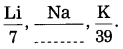
(1) Lithium, sodium, and potassium form Doberemer’s triad. They show similar chemical properties. Their atomic masses are as follows:
According to Dobereiner’s law or triads, the atomic mass of the middle element is approximately the arithmetic mean of the atomic masses of the other two elements. (2) Another triad of elements: Calcium (40.1), strontium (87.6) and barium (137.3).
Question 3
Maharashtra Board Solution
(A, B, C) is a Dobereiner’s triad. complete the following chart and give reason for the
Solution & Step-by-Step Answer:
Answer:
Let the atomic mass of C be x. As (A, B, C) is a Dobereiner’s triad, = 12.01
Question 4
Maharashtra Board Solution
From the following set of the elements and their atomic masses obtain Dobereiner’s triad: |
Element | Br | K | I | Cl |
Atomic mass | 35.5 | 79.9 | 126.9 | 35.5 |
Among the given four elements, the three elements in the increasing order of atomic masses and having similar properties are
Element | Br | K | I | ||||||||||||||||||||||||||||||||||||||||||||||||||||||||||
Atomic mass | 35.5 | 79.9 | 126.9 Hence, the above three elements represent Dobereiner’s triad.
Question 5
Maharashtra Board Solution
State the limitations of Dobereiner’s law of triads.
Solution & Step-by-Step Answer:
Question 6
Maharashtra Board Solution
State Newlands’ law of octaves.
Solution & Step-by-Step Answer:
When the elements are arranged in an increasing order of their atomic masses, the properties of the eighth element are similar to those of the first. It is found that Na is the eighth element from Li and both of them have similar properties.
Question 7
Maharashtra Board Solution
Illustrate Newlands’ law of octaves with a suitable example.
Solution & Step-by-Step Answer:
(1) Newlands’ law of octaves states that when the elements are arranged in the order of their increasing atomic masses, every eighth element has properties similar to those of the first.
(2) Illustration: If the first 21 elements, except inert gases, are arranged in the order of their increasing atomic masses we have octaves as given below:
It is found that Na is the eighth element from Li and both of them have similar properties. Similarly, the elements, in the following pairs show similar properties: C and Si, Na and K, Mg and Ca, F and Cl.
Question 8
Maharashtra Board Solution
Explain the limitations of Newlands’ law of octaves.
Solution & Step-by-Step Answer:
(1) Newlands’ law of octaves i.e. applicable to only the first few elements i.e., only up to calcium out of total 56 elements known at that time.
(2) Newlands placed two elements each in some boxes to accommodate all known elements e.g. CO and Ni, Ce and La. He placed some elements with different properties under the same note in the octave. For example, Co and Ni under the note Do along with halogens, while Fe having similarity with CO and Ni away from them along with the nonmetals O and S under the note Ti. (3) Newland’s octaves did not have provision to accommodate the newly discovered elements.
Question 9
Maharashtra Board Solution
Describe the merits of Mendeleev’s periodic table. (March 2019)
Solution & Step-by-Step Answer:
(1) To give the proper place in the periodic table, atomic masses of some elements were revised in accordance with their properties. For example, the previously determined atomic mass or beryllium, 14.09, was changed to the correct value 9.4, and beryllium was placed before boron.
(2) Mendeleev had kept some vacant places in the periodic table for elements that were yet to be discovered. Three of these unknown elements were given the names eka-boron, eka-aluminum and eka-silicon from the known neighbors and their atomic masses were indicated as 44, 68 and 72, respectively. Their properties were also predicted. Later on, these elements were discovered subsequently and were named as scandium (SC), gallium (Ga) and germanium (Ge) respectively. The properties of these elements matched well with those predicted by Mendeleev. Due to this success all were convinced about the importance of Mendeleev’s periodic table. (3) There was no place reserved for noble gases in Mendeleev’s original periodic table. when noble gases such as helium, neon and argon were discovered, Mendeleev created the ‘zero group’ without disturbing the original periodic table in which the noble gases were placed very well.
Question 10
Maharashtra Board Solution
What are the demerits of Mendeleev’s periodic table?
Solution & Step-by-Step Answer:
(1) The elements cobalt (CO) and nickel (Ni) have the same whole number atomic mass. As a remit there was an ambiguity regarding their sequence in Mendeleev’s periddic table.
(2) Isotopes were discovered long time after Mendeleev put forth the periodic table. A challenge was posed in placing isotopes in Mendeleev’s periodic table as isotopes have the same chemical properties but different atomic masses. (3) The rise in atomic mass does not appear to be uniform when elements are arranged in an increasing order of atomic masses. It was not possible, therefore, to predict how many elements could be discovered between two heavy elements. (4) Position of hydrogen: Hydrogen shows similarity with halogens (group VII). For example, the molecular formula of hydrogen is H2while the molecular formulae of fluorine and chlorine are F2and Cl2, respectively. In the same way, there is a similarity in the chemical properties of hydrogen and alkali metals (group I). There is a similarity in the molecular formulae of the compounds of hydrogen alkali metals (Na, K, etc.) formed with chlorine and oxygen. On considering the above properties it is difficult to decide the correct position of hydrogen whether it is in the group of alkali metals (group I) or in the group of halogens (group VII).
Similarly in hydrogen and alkali metals.
Question 11
Maharashtra Board Solution
write a short note on: Moseley’s contribution and the modern periodic table.
Solution & Step-by-Step Answer:
The English scientist Henry Moseley demonstrated, with the help of the experiments done using X-ray tube, that the atomic number (Z) of an element corresponds to the positive charge on the nucleus or the number of the protons in the nucleus of the atom or that element. He suggested that ‘atomic number’ is more. fundamental property of an element rather than its atomic mass. On the basis of this research, elements were arranged in the order of their increasing atomic numbers in a more systematic way. Accordingly, the statement of the modern periodic law was stated.
Question 12
Maharashtra Board Solution
State the modern periodic law.
Solution & Step-by-Step Answer:
The chemical and physical properties of elements are a periodic function of their atomic numbers.
Question 13
Maharashtra Board Solution
what is meant by modern periodic table?
Solution & Step-by-Step Answer:
The classification of elements resulting from an arrangement of the elements in an increasing order of their atomic numbers (Z) is the modern periodic table.
Question 14
Maharashtra Board Solution
write the answers to the questions with reference to the structure of the periodic table. (a) Which points are considered for the modern periodic table? (b) How are blocks indicated? (c) Which elements are present near the zig-zag line? (d) Draw the electronic configuration of the second-row elements of first group in the periodic table. (e) In a periodic table while going from left to right atomic radius decreases. Explain. (Practice Activity Sheet – 1)
Solution & Step-by-Step Answer:
(a) In the modern periodic table, the elements are arranged in the order of their increasing atomic number. In the modern periodic table there are seven horizontal rows called periods and eighteen vertical columns (1to 18) called groups. The arrangement of the periods and groups results into formation of boxes. Atomic numbers are serially indicated in the upper part of these boxes.
(b) On the basis of the electronic configuration, the elements in the modern periodic table are divided into four blocks, viz. s-block, p-block and f-clock, The s-block constitutes the groups 1 and 2. Groups 13 to 18 constitute the p-block. Groups 3 to 12 constitute the d-block, while the lanthanide and actinide series at the bottom form the f-block. The d-block elements are called transition elements. A zig-zag line is shown in the p-block of the periodic table. (c) The zig-zag line shows the three traditional types of elements, i.e. metals, nonmetals and metalloids. The metalloid elements lie along the border of the zig-zag line. All the metals lie on the left side of the zig-zag line while all the nonmetals lie on the right side. (d) The electronic configuration of the second row elements of the first group in the periodic table is shown below:
(e) (1) In a period while going from left to right, atomic radius goes on decreasing and the atomic number goes on increasing one by one. It means the positive charge on the nucleus increases by one unit at a time. (2) However, the additional electron gets added to the same outermost shell. Due to the increased nuclear charge the electrons are pulled towards the nucleus to a greater extent. As a result, the size of the atom decreases i.e. the atomic radius decreases.
Question 15
Maharashtra Board Solution
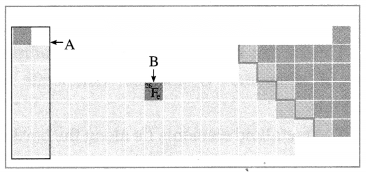
Observe the figure and answer the following questions. (a) Identify the block shown by box A and write an electronic configuration of any one element of this block. (b) Identify the block of element denoted by letter B and write its period number. (Practice Activity Sheer – 3)
Solution & Step-by-Step Answer:
(a) The block shown by box A is the s-block. Electronic configuration of Mg: 2, 8, 2.
(b) The block of element denoted by letter B is the d-block and its period number is 4.
Question 16
Maharashtra Board Solution
Give two examples of metalloids.
Solution & Step-by-Step Answer:
Metalloids: Boron (B) and Silicon (Si).
Question 17
Maharashtra Board Solution
write a short note on the zig-zag line in the modern periodic table.
Solution & Step-by-Step Answer:
Question 18
Maharashtra Board Solution
Classify the following elements into group 1, 16 and 17 : Chlorine, Hydrogen, Oxygen: Bromine.
Solution & Step-by-Step Answer:
Group 1 : Hydrogen. Group 16 : Oxygen. Group 17 : Chlorine and Bromine.
Question 19
Maharashtra Board Solution
Classify the following elements into Alkali metals, Halogens, Alkaline earth metals: (Cl– Br– I–), (Ca, Sr, Mg), (Li, Na, K).
Solution & Step-by-Step Answer:
Alkali metals : (Li, Na, K) Halogens : (Cl– Br– I–). Alkaline earth metals : (Ca, Sr, Mg).
Question 20
Maharashtra Board Solution
Classify the following elements into Metals, Nonmetals, Metalloids : (P, C, N), (Ca, Fe, Al), (Si, Ge, Sn), (K. Mg, Na).
Solution & Step-by-Step Answer:
Metals : (Ca, Fe, Al), (K, Mg, Na). Nonrnetals : (P, C, N). Metalloids : (Si, Ge, Sn).
Question 21
Maharashtra Board Solution
Identiry the electronic configuration of the Inert gas elements, third row elements, seventeen group elements, second group elements: (i) (2, 8, 2), (ii) (2, 8, 8), (iii) (2, 8, 1), (iv) (2, 7), (v) (2, 2), (vi) (2, 8), (vii) (2, 8, 7).
Solution & Step-by-Step Answer:
Inert gas elements : (2, 8, 8), (2, 8). Third row elements : (2, 8, 2), (2, 8, 7), (2, 8, 8). Second group elements : (2, 8, 2), (2, 2). Seventeen group elements : (2, 7), (2, 8, 7).
[Note: (1) The outermost shell of all noble gases contain 8 electrons (except He). (2) Atoms or all 3rdrow elements contain 3 shells. Out of which first shell contains 2 and 2ndshell contains 8 electrons. (3) The elements of group 17 contains 7 electrons in the outermost shell. (4) The elements or group 2 contains 2 electrons in the outermost shell.]
Question 22
Maharashtra Board Solution
Define : (i) Group (ii) Period.
Solution & Step-by-Step Answer:
(i) Group : The vertical column of elements in the periodic table or elements is called a group. (ii) Period : The horizontal row bf the elements in the periodic able of the elements is called a period.
Question 23
Maharashtra Board Solution
write the numbers of vertical columns (groups) and horizontal rows (periods) in the long form of the periodic table.
Solution & Step-by-Step Answer:
There are 18 vertical columns or groups and seven horizontal rows or periods of the elements in the long form of the periodic table.
Question 24
Maharashtra Board Solution
Depending on electronic configuration the properties of the elements vary in different groups. Explain why?
Solution & Step-by-Step Answer:
(1) There are 18 vertical columns in the modern periodic table and are called groups. These groups are 1 and 2, 13 to 18 and 3 to 12.
(2) The number of valence electrons in all these elements from the group 1, i.e., the family of alkali metals, is the same. Similarly, the elements from any other group, the number of their valence electrons to be the same. For example, the elements beryllium (Be), magnesium (Mg) and calcium (Ca) belong to the group 2, i.e. the family of alkaline earth metals. There are two electrons in their outermost shell the number of valence electrons are 2. Similarly, there are seven electrons in the outermost shell of the elements such as fluorine (F) and chlorine (Cl) from the group 17, i.e. the family of halogens the number of valence electron is 1. As a result, all elements belonging to the same group have the same valence electrons and show similar chemical properties. (3) while going from top to bottom within any group, one electronic shell is added at a time. Atomic radius and atomic size increases and hence shows gradation of properties of the elements down the group. From this, the electronic configuration of the outermost shell is characteristic of a particular group.
Question 25
Maharashtra Board Solution
Depending on electronic configuration the properties of elements vary in different periods. Explain why?
Solution & Step-by-Step Answer:
(1) In the modern periodic table, there are seven horizontal rows called periods.
(2) In a period, change in valency of an elements varies electronic configuration. (3) The number of valence electrons is different in these elements. However, the number of shells is the same. In a period, while going from left to right, the atomic number increases by one at a time and the number of valence electrons also increases by one at a time. In a period, there is gradation in properties of elements. (4) The elements with the same number of shells occupied by electrons belong to the same period. The elements in the second period, namely, Li, Be, B, C, N, O, F and Ne have electrons in the two shells, K and L. The elements in the third period, namely, Na, Mg, Al, Si, P, S, Cl, and Ar have electrons in the three shell6: K, L and M. (5) The chemical reactivity of an element is determined by the number of valence electrons in it and the shell number of the valence shell. In a period, while going from left to right, the atomic number increases by one at a time as a result atomic radius gradually decreases. Hence, atomic size decreases.
Question 26
Maharashtra Board Solution
What is meant by periodic trends in the modern periodic table?
Solution & Step-by-Step Answer:
when the properties of elements in a period or a group of the modern periodic table are compared, certain regularity is observed in their variations. it is called the periodic trends in the modern periodic table. The periodic trends are observed in properties of elements, namely, valency, atomic size and metallic-nonmetallic character.
Question 27
Maharashtra Board Solution
What is meant by valency?
Solution & Step-by-Step Answer:
The valency of an element is determined the number of electrons present in the outermost shell of its atoms, i.e. valence electrons.
Question 28
Maharashtra Board Solution
Define atomic size. How does it vary in a period and a group?
Solution & Step-by-Step Answer:
(1) The distance between the centre of the atom and the outermost shell of the atom is called the atomic radius. The size of an atom is indicated by its radius. Atomic radius is expressed in unit picometre (pm). (1 pm = 10-12 m). The size or atom depends on number of shells, more the number of shells larger is the atomic size.
(2) In a group, while going down a group the atomic size goes on increasing because while going down a group newer shells are successively added. This increases the distance between the outermost electron and the nucleus. Hence, the nuclear attraction on these electrons goes on decreasing. Thus in a group atomic size increases. (3) while going from left to right within a period, atomic radius goes on decreasing and the atomic number goes on increasing one by one. The positive charge on the nucleus increases by one unit at a time. However, the additional electron gets added to the same outermost shell. Due to the increased nuclear charge, the electrons are pulled towards the nucleus to a greater extent, as a result, the size of the atom decreases.
Question 29
Maharashtra Board Solution
Discuss the trends in the variation of metallic and nonmetallic properties In a period and in a group.
Solution & Step-by-Step Answer:
(1) Metals have a tendency to loose the valence electrons to form cations having a stable noble gas configuration. This tendency of an element is called electropositivity is the metallic character of that element.
(2) Nonmetals have a tendency to accept the valence electrons to form anions having a stable noble gas configuration. This tendency of an element is called electronegativity is the nonmetallic character of that element. (3) In a group, while going down a group a new shell is added, resulting in an increase in the distance between the nucleus and the valence electrons. This results in lowering the effective nuclear charge and thereby lowering the attractive force on the valence electrons. As a result of this the tendency of the atom to lose electrons increases. Also, the penultimate shell becomes the outermost shell on losing valence electrons. The penultimate shell is a complete octet. Therefore, the resulting cation attains special stability. The metallic character of an atom is its tendency to lose electrons. Therefore, the following trend is observed: The metallic character of elements increases while going down the group. (4) while going from left to right within a period the outermost shell remains the same. However, the positive charge on the nucleus goes on increasing while the atomic radius goes on decreasing and thus the effective nuclear charge goes on increasing. Therefore, valence electrons are held with greater attractive force. This is called electronegativity. As a result of this the tendency of atom to lose valence electrons decreases within a period from left to right, i.e., electronegativity increases. Thus, non-metallic character of elements increases within a period from left to right.
Question 30
Maharashtra Board Solution
Name the elements, group, formulae and physical state belonging to the halogen family.
Solution & Step-by-Step Answer:
Question 31
Maharashtra Board Solution
Considering the elements of period 3 in the moderm periodic table, answer the following questions: (a) Name the ‘element’ in which all the shells are completely filled with electrons.
Solution & Step-by-Step Answer:
Answer: The element in which all the shells are completely filled with electrons is argon. (2, 8, 8).
(b) Name the element which has one electron in the outermost shell. (c) State the most electronegative element in this period.
Question 32
Maharashtra Board Solution
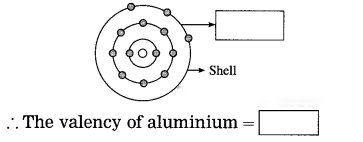
The atomic number of aluminium is 13. With the help of diagram, write the electronic configuration and valency.
Solution & Step-by-Step Answer:
The electronic configuration aluminium = 2, 8, 3 The valency of aluminium = 3
Question 33
Maharashtra Board Solution
Observe the following diagram and answer the following questions: |

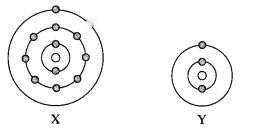
(i) Identify elements X and Y.
An element X is Sodium (Na).
An element Y is Lithium (Li).
(ii) Do these elements belong to the same group? Explain.
Answer:
Yes, these elements belong to the same group as they have the same number of valence electrons.
(iii) which element is more electropositive in nature? Why?
Answer:
Element X is more electropositive than Y. This is because while going down the group, electropositivity increases with increase in atomic size.
Taking into consideration the period of the elements given below, answer the following questions:(March 2019)
Element | O | B | C | N | Be | Li | ||||||||||||
Atomic radius (pm) | 66 | 68 | 77 | 74 | 111 | 152
Question 1
Maharashtra Board Solution
Arrange the above elements in decreasing order of their atomic radii.
Solution & Step-by-Step Answer:
The above elements are arranged in decreasing order of their atomic radii:
Question 2
Maharashtra Board Solution
State the period to which the above elements belong.
Solution & Step-by-Step Answer:
The above elements belong to period 2.
Question 3
Maharashtra Board Solution
why this arrangement of elements is similar to the above period of the modern periodic table?
Solution & Step-by-Step Answer:
As we move from left to right within a period, the atomic number increases one by one means the position charge on the nucleus increases by one unit at a time, but the electrons are added to the same orbit thereby increasing the pull towards the nucleus which decreases the size of the atom.
Question 4
Maharashtra Board Solution
Which of the above elements have the biggest and the smallest atom?
Solution & Step-by-Step Answer:
The biggest atom: Lithium (Li) The smallest atom: Oxygen (O)
Question 5
Maharashtra Board Solution
What is the periodic trend observed in the variation of atomic radius while going from left to right within a period?
Solution & Step-by-Step Answer:
while going from left to right in a period, the atomic number increases, atomic radius decreases. Therefore, atomic size gradually decreases.
Write scientific reasons:
Question 1
Maharashtra Board Solution
Zero group elements (inert gases) are called noble gases.
Solution & Step-by-Step Answer:
(1) In the atoms of the inert gas elements (zero group elements), all the electronic shells, including the outermost shell, are completely filled.
(2) The electronic configuration is stable, and these elements do not lose or accept electrons. These elements do not take part in chemical reactions. These elements are gases. Hence, they are called noble gases.
Question 2
Maharashtra Board Solution
while going down the second group, the reactivity of the alkaline earth metals increases.
Solution & Step-by-Step Answer:
The reaction of alkaline earth metal with water is M + 2H2O → M(OH)2 + H2. while going down the second group as Be → Mg → Ca → Sr → Ba, the gradation in this chemical property or the alkaline earth metals is seen. while going down the second group the reactivity of the alkaline earth metals goes on increasing thereby the ease with which this reaction takes place also goes on increasing.
Thus, Beryllium (Be) does not react with water. Mg (Magnesium) reacts with steam. whereas calcium (Ca), strontium (Sr) and barimm (Ba) reacts with water at room temperature with increasing rates.
Question 3
Maharashtra Board Solution
Fluorine is the most reactive among the halogens.
Solution & Step-by-Step Answer:
Question 4
Maharashtra Board Solution
Sodium is more metallic than aluminium.
Solution & Step-by-Step Answer:
Distinguish between the following: Question.1 Modern periodic table:
Question 2
Maharashtra Board Solution
Groups and periods
Solution & Step-by-Step Answer:
Groups:
periods:
Question 3
Maharashtra Board Solution
s-block elements and p-block elements
Solution & Step-by-Step Answer:
s-block elements:
p-block elements : |