Practice Set 3.1 Algebra 10th Std Maths Part 1 Answers Chapter 3 Arithmetic Progression
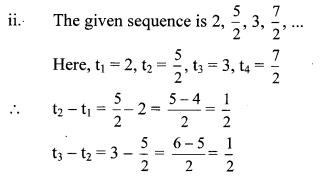
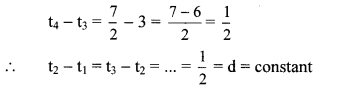
The difference between two consecutive terms is constant.
∴ The given sequence is an A.P. and common difference (d) = .
iii. The given sequence is -10, -6, -2, 2,…
Here, t1= -10, t2= – 6, t3= -2, t4= 2
∴ t2– t1= -6 – (-10) = -6 + 10 = 4
t3– t2= -2 -(-6) = -2 + 6 = 4
t4– t3= 2 – (-2) = 2 + 2 = 4
∴ t2– t1= t3– t2= … = 4 = d = constant
The difference between two consecutive terms is constant.
∴ The given sequence is an A.P. and common difference (d) = 4.
iv. The given sequence is 0.3, 0.33, 0.333,…
Here, t1= 0.3, t2= 0.33, t3= 0.333
∴ t2-t1= 0.33 – 0.3 = 0.03
t3– t2= 0.333 – 0.33 = 0.003
∴ t2– t1≠ t3– t2
The difference between two consecutive terms is not constant.
∴ The given sequence is not an A.P.
v. The given sequence is 0, -4, -8, -12,…
Here, t1= 0, t2= -4, t3= -8, t4= -12
∴ t2– t1= -4 – 0 = -4
t3– t2= -8 – (-4) = -8 + 4 = -4
t4– t3= -12 – (-8) = -12 + 8 = -4
∴ t2– t1= t3– t2= … = —4 = d = constant
The difference between two consecutive terms is constant.
∴ The given sequence is an A.P. and common difference (d) = -4.
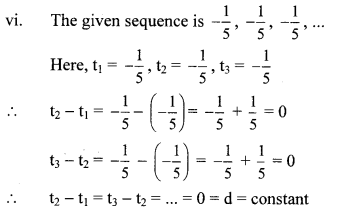
The difference between two consecutive terms is constant.
∴ The given sequence is an A.P. and common difference (d) = 0.
The difference between two consecutive terms is constant.
∴ The given sequence is an A.P. and common difference (d) = √2.
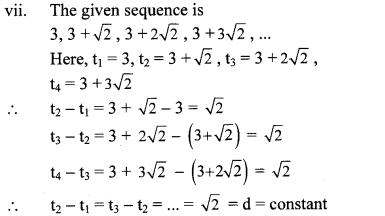
viii. The given sequence is 127, 132, 137,…
Here, t1= 127, t2= 132, t3= 137
∴ t2– t1= 132 – 127 = 5
t3– t2= 137 – 132 = 5
∴ t2– t1= t3– t2= … = 5 = d = constant
The difference between two consecutive terms is constant.
∴ The given sequence is an A.P. and common difference (d) = 5.
ii. a = -3, d = 0 …[Given]
∴ t1= a = -3
t2= t1+ d = -3 + 0 = -3
t3= t2+ d = -3 + 0 = -3
t4= t3+ d = -3 + 0 = -3
∴ The required A.P. is -3, -3, -3, -3,…
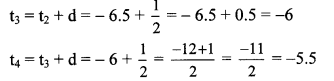
∴ The required A.P. is -7, – 6.5, – 6, – 5.5,
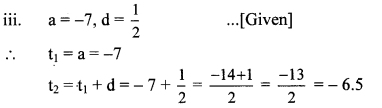
iv. a = -1.25, d = 3 …[Given]
t1= a = -1.25
t2= t1+ d = – 1.25 + 3 = 1.75
t3= t2+ d = 1.75 + 3 =.4.75
t4= t3+ d = 4.75 + 3 = 7.75
∴ The required A.P. is -1.25, 1.75, 4.75, 7.75,…
v. a = 6, d = -3 …[Given]
∴ t1= a = 6
t2= t1+ d = 6 – 3 = 3
t3= t2+ d = 3 – 3 = 0
t4= t3+ d = 0- 3 = -3
∴ The required A.P. is 6, 3, 0, -3,…
vi. a = -19, d = -4 …[Given]
t1= a = -19
t2= t1+ d = -19 – 4 = -23
t3= t2+ d = -23 – 4 = -27
t4= t3+ d = -27 – 4 = -31
∴ The required A.P. is -19, -23, -27, -31,…
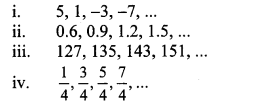
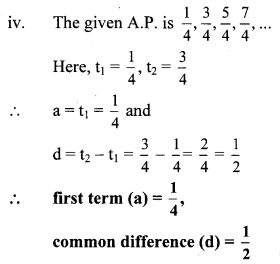
ii. The given A.P. is 0.6, 0.9, 1.2, 1.5,…
Here, t1= 0.6, t2= 0.9
∴ a = t1= 0.6 and
d = t2– t1= 0.9 – 0.6 = 0.3
∴ first term (a) = 0.6,
common difference (d) = 0.3
iii. The given A.P. is 127, 135, 143, 151,…
Here, t1= 127, t2= 135
∴ a = t1= 127 and
d = t2– t1= 135 – 127 = 8
∴ first term (a) = 127,
common difference (d) = 8

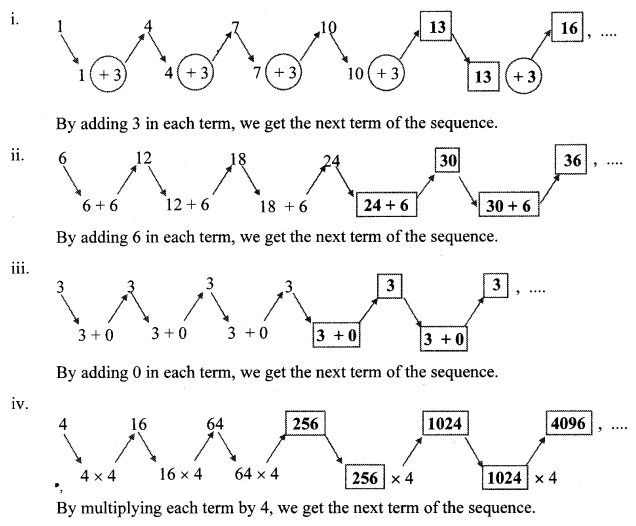
Note : A Geometric Progression is a sequence in which the ratio of any two consecutive terms is a constant,
Sequence iv. is a geometric progression.
