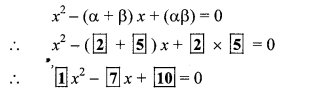
Practice Set 2.5 Algebra 10th Std Maths Part 1 Answers Chapter 2 Quadratic Equations
Solution & Step-by-Step Answer:
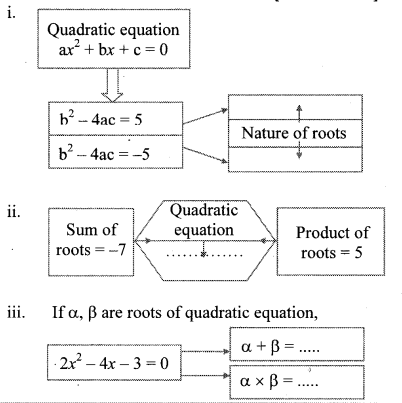
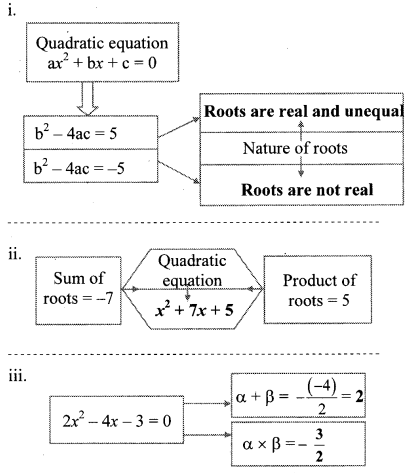
Solution & Step-by-Step Answer:
i. x2 +7 x – 1 = 0 Comparing the above equation with ax2 + bx + c = 0, we get a = 1, b = 7, c = -1 ∴ b2– 4ac = (7)2 – 4 × 1 × (-1) = 49 + 4 ∴ b2 – 4ac = 53
ii. 2y2– 5y + 10 = 0
Comparing the above equation with
ay2+ by + c = 0, we get
a = 2, b = -5, c = 10
∴ b2– 4ac = (-5)2 -4 × 2 × 10
= 25 – 80
∴ b2– 4ac = -55
iii. √2 x2+ 4x + 2√2 = 0
Comparing the above equation with
ax + bx + c = 0, we get
a = √2,b = 4, c = 2√2
∴ b2– 4ac = (4)2 – 4 × √2 × 2√2
= 16 – 16
∴ b2– 4ac =0
Solution & Step-by-Step Answer:
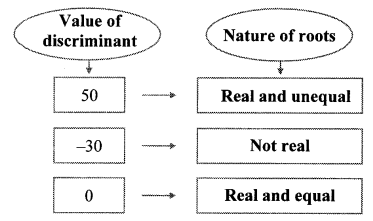
i. x2 – 4x + 4= 0 Comparing the above equation with ax2 + bx + c = 0, we get a = 1,b = -4, c = 4 ∴ ∆ = b2 – 4ac = (- 4)2 – 4 × 1 × 4 = 16 – 16 ∴ ∆ = 0 ∴ Roots of the given quadratic equation are real and equal.
ii. 2y2– 7y + 2 = 0
Comparing the above equation with
ay2+ by + c = 0, we get
a = 2, b = -7, c = 2
∴ ∆ = b2– 4ac
= (- 7)2– 4 × 2 × 2
= 49 – 16
∴ ∆ = 33
∴ ∆ > 0
∴ Roots of the given quadratic equation are real and unequal.
iii. m2+ 2m + 9 = 0
Comparing the above equation with
am2+ bm + c = 0, we get
a = 1,b = 2, c = 9
∴ ∆ = b2– 4ac
= (2)2– 4 × 1 × 9
= 4 – 36
∴ ∆ = -32
∴ ∆ < 0
∴ Roots of the given quadratic equation are not real.
Solution & Step-by-Step Answer:
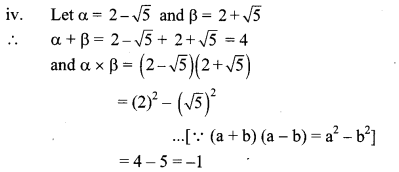
i. Let a = 0 and β = 4 ∴ α + β = 0 + 4 = 4 and α × β = 0 × 4 = 0 ∴ The required quadratic equation is x2 – (α + β) x + αβ = 0 ∴ x2 – 4x + 0 = 0 ∴ x2 – 4x = 0
ii. Let α = 3 and β = -10
∴ α + β = 3 – 10 = -7
and α × β = 3 × -10 = -30
∴ The required quadratic equation is
x2– (α + β)x + αβ = 0
∴ x2– (-7) x + (-30) = 0
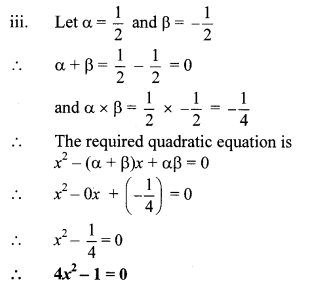
∴ The required quadratic equation is
x2– (α + β)x + αβ = 0
∴ x2– 4x – 1 = 0
Solution & Step-by-Step Answer:
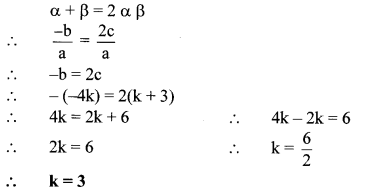
x2 – 4kx + k + 3 = 0 Comparing the above equation with ax2 + bx + c = 0, we get a = 1, b = – 4k, c = k + 3 Let α and β be the roots of the given quadratic equation. Then, α + β = and αβ = According to the given condition,
Solution & Step-by-Step Answer:
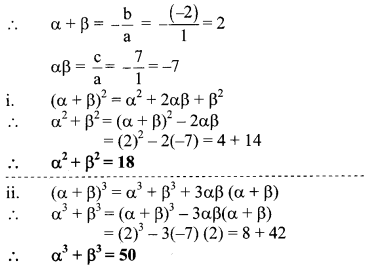
y2 – 2y – 7 = 0 Comparing the above equation with ay2 + by + c = 0, we get a = 1, b = -2, c = -7
Solution & Step-by-Step Answer:
i. 3y2 + kg + 12 = 0 Comparing the above equation with ay2 + by + c = 0, we get a = 3, b = k, c = 12 ∴ ∆ = b2 – 4ac = (k)2 – 4 × 3 × 12 = k2 – 144 = k2 – (12)2 ∴ ∆ = (k + 12) (k – 12) …[∵ a2 – b2 = (a + b) (a – b)] Since, the roots are real and equal. ∴ ∆ = 0 ∴ (k + 12) (k – 12) = 0 ∴ k + 12 = 0 or k – 12 = 0 ∴ k = -12 or k = 12
ii. kx (x – 2) + 6 = 0
∴ kx2– 2kx + 6 = 0
Comparing the above equation with
ax2+ bx + c = 0, we get
a = k, b = -2k, c = 6
∴ ∆ = b2– 4ac
= (-2k)2– 4 × k × 6
= 4k2– 24k
∴ ∆ = 4k (k – 6)
Since, the roots are real and equal.
∴ ∆ = 0
∴ 4k (k – 6) = 0
∴ k(k – 6) = 0
∴ k = 0 or k – 6 = 0
But, if k = 0 then quadratic coefficient becomes zero.
∴ k ≠ 0
∴ k = 6
Solution & Step-by-Step Answer:
Solution & Step-by-Step Answer:
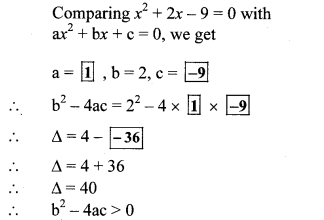
∴ The roots of the given equation are real and unequal.
Solution & Step-by-Step Answer:
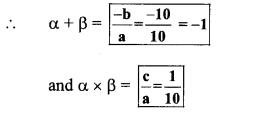
10x2 + 10x + 1 = 0 Comparing the above equation with ax2 + bx + c = 0, we get a = 10, b = 10, c = 1
Solution & Step-by-Step Answer:

Solution & Step-by-Step Answer: