Practice Set 2.1 Algebra 10th Std Maths Part 1 Answers Chapter 2 Quadratic Equations
ii. The given equation is
y2= 5y – 10
∴ y2– 5y + 10 = 0
Here, y is the only variable and maximum index of the variable is 2.
a = 1, b = -5, c = 10 are real numbers and a ≠ 0.
∴ The given equation is a quadratic equation.
iii. The given equation is
y2+ = 2
∴ y3+ 1 = 2y …[Multiplying both sides by y]
∴ y3– 2y + 1 = 0
Here, y is the only variable and maximum index of the variable is not 2.
∴ The given equation is not a quadratic equation.
iv. The given equation is
x + = -2
∴ x2+ 1 = -2x …[Multiplying both sides by x]
∴ x2+ 2x+ 1 = 0
Here, x is the only variable and maximum index of the variable is 2.
a = 1, b = 2, c = 1 are real numbers and a ≠ 0.
∴ The given equation is a quadratic equation.
v. The given equation is
(m + 2) (m – 5) = 0
∴ m(m – 5) + 2(m – 5) = 0
∴ m2– 5m + 2m – 10 = 0
∴ m2– 3m – 10 = 0
Here, m is the only variable and maximum index of the variable is 2.
a = 1, b = -3, c = -10 are real numbers and a ≠ 0.
∴ The given equation is a quadratic equation.
vi. The given equation is
m3+ 3m2– 2 = 3m3
∴ 3m3– m3– 3m2+ 2 = 0
∴ 2m3– 3m2+ 2 = 0
Here, m is the only variable and maximum
index of the variable is not 2.
∴ The given equation is not a quadratic equation.
ii. (x – 1)2= 2x + 3
∴ x2– 2x + 12x + 3
x2– 2x + 1 – 2x – 30
∴ x2– 4x – 2 = 0
Comparing the above equation with
ax2+ bx + c = 0, we get
a = 1, b = -4, c = -2
iii. x2+ 5x = – (3 – x)
∴ x2+ 5x = -3 + x
∴ x2+ 5x – x + 3 = 0
∴ x2+ 4x + 3 = 0
Comparing the above equation with
ax2+ bx + c = 0, we get
a = 1, b = 4, c = 3
iv. 3m2= 2m2– 9
∴ 3m2– 2m2+ 9 = 0
∴ m2+ 9 = 0
∴ m2+ 0m + 9 = 0
Comparing the above equation with
am2+ bm + c = 0, we get
a = 1, b = 0, c = 9
v. p (3 + 6p) = – 5
∴ 3p + 6p2= -5
∴ 6p2+ 3p + 5 = 0
Comparing the above equation with
ap2+ bp + c = 0, we get
a = 6, b = 3, c = 5
vi. x2– 9 = 13
∴ x2– 9 – 13 = 0
∴ x2– 22 = 0
∴ x2+ 0x – 22 = 0
Comparing the above equation with
ax2+ bx + c = 0, we get
a = 1, b = 0, c = -22
ii. The given equation is
2m2– 5m = 0 …(i)
Putting m = 2 in L.H.S. of equation (i), we get
L.H.S. = 2(2)2– 5(2) = 2(4) -10 = 8 – 10 = -2
∴ L.H.S. ≠ R.H.S.
∴ m = 2 is not the root of the given quadratic equation.
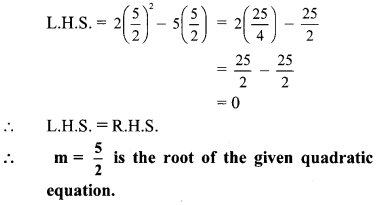
Putting m = in L.H.S. of equation (i), we get
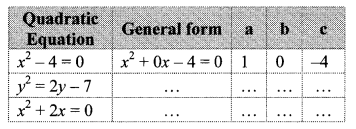
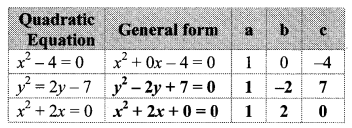
ii. In the equation m3– 5m2+ 4 = 0, [m] is the only variable and maximum index of the variable is not 2.
∴ It [is not] a quadratic equation.
iii. (l + 2)(l – 5) = 0
∴ l(l – 5) + 2(l – 5) = 0
∴ l2– 5l + 2l – 10 = 0
∴ l2– 3l – 10 = 0.
In this equation [l] is the only variable and maximum index of the variable is [2]
∴ it [is] a quadratic equation.