Maharashtra State Board Class 10 Geography Solutions Chapter 6 Population
Class 10 Geography Chapter 6 Population Textbook Questions and Answers
1. Are the following sentences right or wrong? Correct the wrong ones.
Question a.
Literacy rate is higher in Brazil than India.
Answer:
Right.
Question b.
In Brazil, people prefer living in the south east as compared to the north east.
Answer:
Right.
Question c.
The life expectancy of Indians is decreasing.
Answer:
Wrong.
Question d.
The north-western part of India is densely populated.
Answer:
Wrong.
Question e.
The western part of Brazil is densely populated.
Answer:
Wrong
2. Answer the following questions as per the instructions:
Question a.
Arrange the following states of India in descending order of their population. Himachal Pradesh, Uttar Pradesh, Arunachal Pradesh, Madhya Pradesh, Andhra Pradesh.
Answer:
Descending order: Uttar Pradesh, Madhya Pradesh, Andhra Pradesh, Himachal Pradesh, Arunachal Pradesh.
Question b.
Arrange the states of Brazil in ascending order of their population: Amazonas, Rio de Janeiro,
Alagoas, Sao Paulo, Parana.
Answer:
States of Brazil: Alagoas, Amazonas, Parana, Rio de Janeiro, Sao Paulo.
Question c.
Classify the factors affecting the distribution of population into favourable and unfavourable.
Answer:
Favourable Factors | Unfavourable Factors |
(1) Nearness to Sea | Lack of roads |
(2) Temperate Climate | Lack of Industries |
(3) New cities and towns | Tropical moist forests |
(4) Minerals | Semi arid climate |
(5) Cultivable land |
3. Answer the following questions:
Question a.
Explain the similarities and differences between the population distribution in Brazil and India.
Answer:
(a) Similarities in population distribution in Brazil and India:
(b) Differences between population distribution in Brazil and India.
Question b.
Giving examples, correlated to, climate and population distribution
Answer:
Climate and population distribution are closely interreleted. Temperature and rainfall, the two elements of climate greatly influence the population concentration.
(i) Dense population is found in regions with mild climate and moderate rainfall.
E.g. the coastal plains of Brazil, the northern plain as well as the coastal plains of India
(ii) Places with heavy rainfall, inaccessibility and dense forests have low population.
E.g. the interiors of the Amazon Basin in Brazil, north eastern states in India.
(iii) The snow covered regions due to extremely cold climatic conditions have less population.
E.g. the northernmost part of Jammu & Kashmir.
(iv) In certain regions, due to less rainfall and extreme climatic conditions population is sparse.
E.g. Thar desert of Rajasthan and the Drought Quadrilateral region of Brazil.
4. Give geographical reasons:
Question a.
Population is an important resource.
Answer:
Question b.
Brazil’s population density is very less.
Answer:
Question c.
India’s population density is high.
Answer:
Question d.
The density of population is sparse in the Amazon Basin.
Answer:
Question e.
Population density is high in the Ganga plains.
Answer:
5. Observe the following diagram and answer the following questions:

Males | 800 | 1000 |
Females | 1000 | ? |
Number of females =
= 1250
Sex Ratio is 1250 females per 1000 males.
S.No. | Population Density (per sq.km.) | Name of the States / Union Territories |
(1) | less than 100 | Arunachal Pradesh, Mizoram, Jammu and Kashmir, Himachal Pradesh, Uttarakhand, Sikkim. |
(2) | 101 to 250 | Meghalaya, Manipur, Nagaland, Rajasthan, Madhya Pradesh, Chattisgarh. |
(3) | 251 to 500 | Gujarat, Maharashtra, Goa, Karnataka, Andhra Pradesh, Telangana, Odisha, Jharkhand, Assam, Tripura. |
(4) | more than 501 | West Bengal, Bihar, Punjab, Haryana, Uttar Pradesh,Kerala and Tamil Nadu, Delhi, Chandigarh, Puducherry, Diu, Daman, Dadra Nagar, Haveli, Andaman and Nicobar Islands. |
Class 10 Geography Chapter 6 Population Intext Questions and Answers
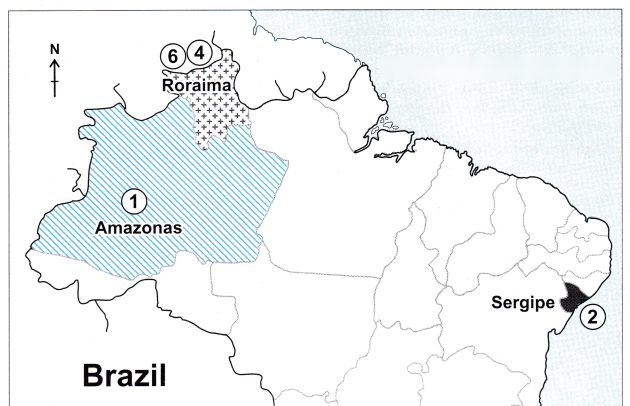
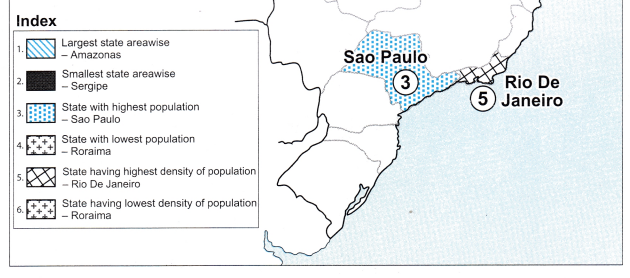
Study the maps and answer the following questions
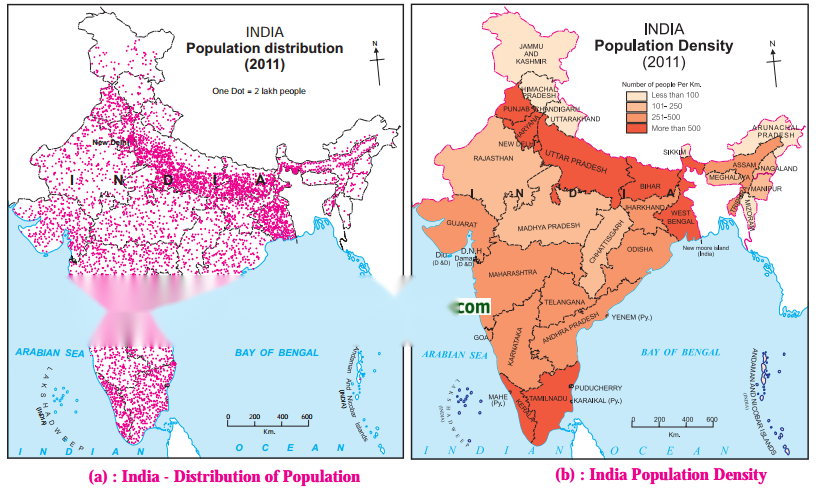
S.No. | Population Density (per sq.km.) | Name of the States / Union Territories |
(1) | less than 100 | Arunachal Pradesh, Mizoram, Jammu and Kashmir, Himachal Pradesh, Uttarakhand, Sikkim. |
(2) | 101 to 250 | Meghalaya, Manipur, Nagaland, Rajasthan, Madhya Pradesh, Chattisgarh. |
(3) | 251 to 500 | Gujarat, Maharashtra, Goa, Karnataka, Andhra Pradesh, Telangana, Odisha, Jharkhand, Assam, Tripura. |
(4) | more than 501 | West Bengal, Bihar, Punjab, Haryana, Uttar Pradesh, Kerala and Tamil Nadu, Delhi, Chandigarh, Puducherry, Diu, Daman, Dadra Nagar, Haveli, Andaman and Nicobar Islands. |
(ii) Temperature and rainfall are the two elements of climate which greatly influence the population distribution.
(iii) Dense population is found in regions with mild climate and moderate rainfall.
E.g. the northern plain as well as the coastal plains of India
(iv) Places with heavy rainfall, inaccessibility and dense forests have low population.
E.g. northeastern states in India.
(v) The snow-covered regions due to extremely cold climatic conditions have less population.
E.g. the northernmost part of Jammu and Kashmir.
(vi) In certain regions, due to less rainfall and extreme climatic conditions population is sparse.
E.g. Westernmost part of India in the Thar desert, Rajasthan.
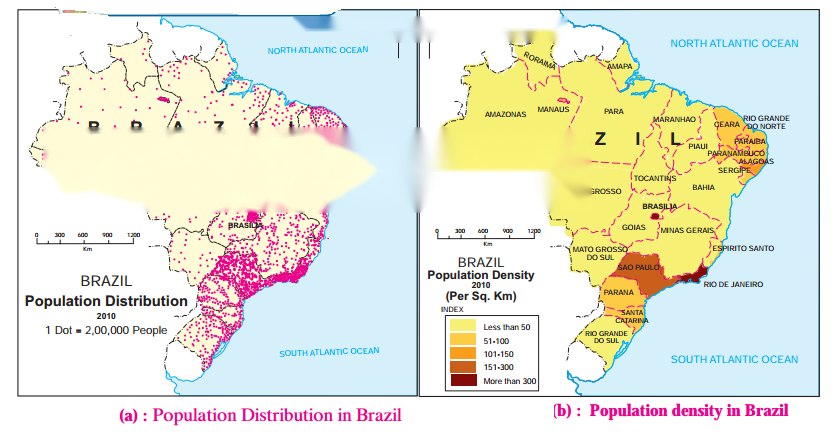
S. No. | Population Density | Names of the places |
(1) | Less than 50 | Acre, Amazonas, Roraima, Rondonia, Para, Amapa, Mata Grasso, Mato Grasso Do Sul, Goias, Tocantins, Maranhao, Piaui, Bahia, Minas Gerais, Rio Gande Do Sul |
(2) | 51 -100 | Paraiba, Pamambuco, Parana, Santa Catarina, Sergipe, Rio Grande Do Norte, Ceara |
(3) | 101 -150 | Alagoas |
(4) | 151 – 300 | Sao Paulo |
(5) | More than 300 | Rio de Janerio, Brasilia |
USE YOUR BRAIN POWER
Question 1
Maharashtra Board Solution
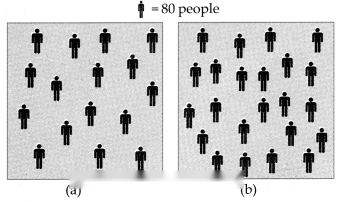
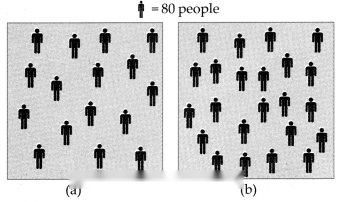
Calculate the population density of the area shown in 1 sq.km, of square in ‘a’ and ‘b’ each
Solution & Step-by-Step Answer:
block bg-white dark:bg-slate-900/80 border-l-4 border-emerald-500 rounded-r-xl p-5 my-3 shadow-xs border border-slate-200/60 dark:border-slate-800">
Solution & Step-by-Step Answer:
(a) In fig. (a) there are 16 Each = 80 people Total number of people = 16 x 80 = 1280 Fig. (a) has a population density of 1280 people per sq. km.
(b) In fig. (b) there are 23
GIVE IT A TRY
Question 1
Maharashtra Board Solution
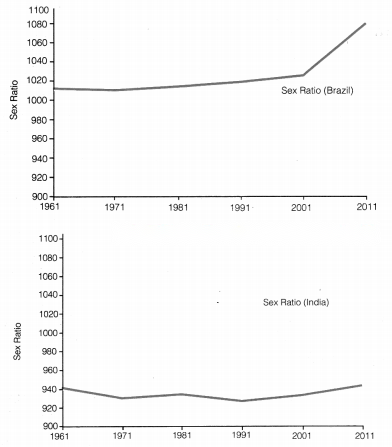
What could be the reasons of lower sex ratio in any region?
Solution & Step-by-Step Answer:
With reference to both the countries, the characteristics of population are prominently notable.
Question 2
Maharashtra Board Solution
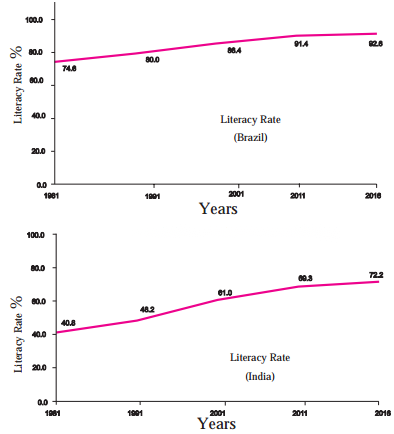
Write a similar conversation using the graph
Solution & Step-by-Step Answer:
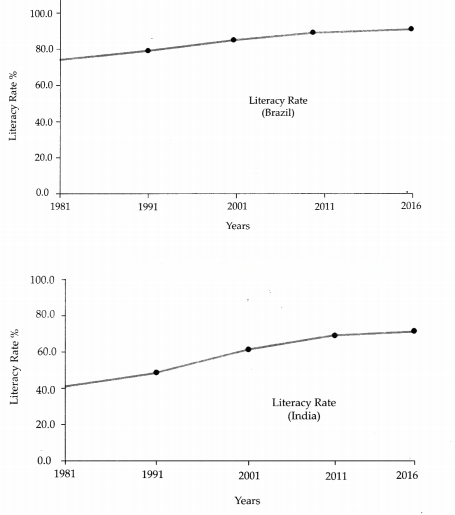
A: What do these graphs show?
B: These graphs show the literacy rate of India and Brazil. A: What do you mean by literacy rate? B: It means the total percentage of the population of an area at a particular time aged seven years or above ‘ who can read and write with understanding. A: It means that, as on today’s date, the literacy rate of our country is 72.2%. B: But, Brazil had an even higher literacy rate decades back in 1981, i.e. 74.6% and it has touched 92.6 as of today (2018), which is quite commendable. A: Yes, definitely But, we have also seen a steady growth in the literacy rate of the country, especially, during the period between 1991 and 2011. B: Still, though we are growing, we are way behind Brazil today with 72.2% because they have a much higher literacy percentage of 92.6. A: What measures can be adopted to increase the literacy rate of our country? B: We can make people aware of the need and importance of education, help in teaching them, introducing various literacy campaigns by making use of free calls, free sms services, etc.
Question 3
Maharashtra Board Solution
Study the indices of density maps of both the countries. What difference do you find? What conclusions can you draw?
Solution & Step-by-Step Answer:
(i) India’s density of population is proportionately catered while Brazil’s density of population is concentrated only on the eastern coast. (ii) After studying the indices of the density maps of both the countries, we can conclude that India’s population density is much higher than that of Brazil. (iii) The lowest value on the map of India indicates less than 100 whereas on the Brazil map it is less than 50. (iv) Places in Brazil which are highest in density is grouped in the category of more than 300 people’ per sq. km. whereas in India it is more than 500 persons per sq. km.
Question 4
Maharashtra Board Solution
Considering the above discussion, what should be done so that our manpower is utilized properly, sex ratio improves and population growth is controlled? Write two to three sentences on each.
Solution & Step-by-Step Answer:
(i) Measures to utilise man power properly:
(ii) Measures to improve sex ratio: (iii) Measures to control population growth: TRY THIS Age and Sex Pyramid:
Question 1
Maharashtra Board Solution
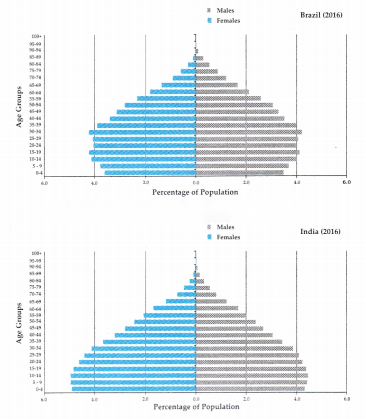
What is this figure called? What is it always known as?
Solution & Step-by-Step Answer:
The figure is called the Age-Sex Pyramid. It is also known as Population Pyramid.
Question 2
Maharashtra Board Solution
What does the graph depict?
Solution & Step-by-Step Answer:
The graph depicts the percentage of male and female population of various age groups in Brazil & India for the year 2016.
Question 3
Maharashtra Board Solution
In which country is the proportion of adults more?
Solution & Step-by-Step Answer:
The proportion of adults is comparatively more in India.
Question 4
Maharashtra Board Solution
‘This country’s population is getting slowly older’. Which country is being referred to? Why?
Solution & Step-by-Step Answer:
‘This country’s population is getting slowly older – The country being referred to is Brazil. As compared to India, a larger percentage of Brazil’s population falls in the above 60 years age group. So it is said that Brazil’s population is getting slowly older.
Question 5
Maharashtra Board Solution
In which country are the number of children comparatively more?
Solution & Step-by-Step Answer:
The proportion of children is comparatively more in India.
Question 6
Maharashtra Board Solution
While comparing the age-sex pyramids, which pyramid has a broader base?
Solution & Step-by-Step Answer:
While comparing the age-sex pyramids, India’s pyramid has a broader base.
USE YOUR BRAIN POWER
Question 1
Maharashtra Board Solution
Is there a relationship between increase in life expectancy and growth of population ? How?
Solution & Step-by-Step Answer:
(i) Yes, there is a relationship between increase in life expectancy and growth of population. (ii) Increased life expectancy means there are more people who live longer, which means healthier and better quality of life. (iii) This kind of population generally prefers fewer children which leads to decreased birth rates.
Question 2
Maharashtra Board Solution
If the proportion of dependent age groups increases in the composition of population, how will it affect the economy of a country? Ans. (i) If the proportion of dependent age groups increases in the composition of population, it will have an adverse effect on the economy of a country. (ii) The reason is if the working population is less, the economic activities will reduce and will have a direct impact on the economic growth and development of that nation. (iii) The production will decrease in comparison to consumption leading to inflation also the per capita income and GDP will decrease. (iv) Export will reduce and imports will increase. (v) The proportion of the working population will increase, slowing down the pace of development. |


Class 10 Geography Chapter 6 Population Additional Important Questions and Answers
Choose the correct option and rewrite the statements:
Question 1
Maharashtra Board Solution
The ______ aspects of a population are important for a nation’s economic and social progress. (a) quantitative (b) qualitative (c) measurable (d) calculable
Solution & Step-by-Step Answer:
block bg-white dark:bg-slate-900/80 border-l-4 border-emerald-500 rounded-r-xl p-5 my-3 shadow-xs border border-slate-200/60 dark:border-slate-800">
Solution & Step-by-Step Answer:
(b) qualitative
Question 2
Maharashtra Board Solution
India is the ________ most populous country in the world. (a) second (b) fifth (c) seventh (d) sixth
Solution & Step-by-Step Answer:
(a) second
Question 3
Maharashtra Board Solution
Due to farming, industries and trade, the proportion of the population got in _____ a few places. (a) distributed (b) sparse (c) concentrated (d) equal
Solution & Step-by-Step Answer:
(c) concentrated
Question 4
Maharashtra Board Solution
In mountainous / hilly regions, dry desert areas and densely forested areas, population density is __________ because of inaccessibility, absence of facilities and tough life. (a) high (b) very high (c) sparse (d) moderate
Solution & Step-by-Step Answer:
(c) sparse
Question 5
Maharashtra Board Solution
Brazil is the _______ populated country in the continent of South America. (a) second most (b) third most (c) fifth most (d) most
Solution & Step-by-Step Answer:
(d) most
Question 6
Maharashtra Board Solution
With a population of around 19 crores, according to Census 2010, Brazil ranks _______ in the world. (a) 3rd (b) 5th (c) 7th (d) 9th
Solution & Step-by-Step Answer:
(b) 5th
Question 7
Maharashtra Board Solution
With respect to area, Brazil stands _______ in the world. (a) 3rd (b) 5th (c) 7th (d) 9th
Solution & Step-by-Step Answer:
(b) 5th
Question 8
Maharashtra Board Solution
A majority of Brazilians have concentrated within 300 kilometers of the ________. (a) Guyana highlands (b) Amazon river, (c) Eastern coastal areas (d) Pantanal wetlands
Solution & Step-by-Step Answer:
(c) Eastern coastal areas
Question 9
Maharashtra Board Solution
The interior of the Amazon basin is ____ populated. (a) densely (b) moderately (c) highly (d) very sparsely
Solution & Step-by-Step Answer:
(d) very sparsely
Question 10
Maharashtra Board Solution
The central and western parts of Brazil is ______ populated. (a) densely (b) sparsely (c) moderately (d) less
Solution & Step-by-Step Answer:
(d) less
Question 11
Maharashtra Board Solution
The density of population in the _______ of Brazil is moderate. (a) Amazon Basin (b) coastal lowlands (c) highlands (d) forested areas
Solution & Step-by-Step Answer:
(c) highlands
Question 12
Maharashtra Board Solution
In India, there has been a _______ in the sex ratio, after 1991. (a) decrease (b) slight increase (c) consistency (d) steep increase
Solution & Step-by-Step Answer:
(b) slight increase
Question 13
Maharashtra Board Solution
The proportion of _______ in India is more. (a) middle-aged people (b) old people (c) children (d) youth
Solution & Step-by-Step Answer:
(d) youth
Question 14
Maharashtra Board Solution
The rate of population growth is now ______ in India. (a) increasing (b) declining (c) stable (d) stagnant
Solution & Step-by-Step Answer:
(b) declining
Question 15
Maharashtra Board Solution
It is observed that Brazil’s population may not increase in the next ______ decades. (a) two (b) three (c) four (d) five
Solution & Step-by-Step Answer:
(a) two
Question 16
Maharashtra Board Solution
The eastern coastal areas of Brazil are also called the coastal ________. (a) lowlands (b) highlands (c) ravines (d) badlands
Solution & Step-by-Step Answer:
(a) lowlands
Question 17
Maharashtra Board Solution
In most of the developing countries life expectancy is still less, but with socio economic development it is ________. (a) decreasing (b) increasing (c) gradually declining (d) steeply increasing
Solution & Step-by-Step Answer:
(b) increasing
Match the columns:
Answer: Answer the following questions in one or two sentence.
Question 1
Maharashtra Board Solution
According to Census 2011, what is India’s population and how much is its average population density?
Solution & Step-by-Step Answer:
According to Census 2011 India’s population is around 121 crores, and its average population density is 382 persons per sq. km.
Question 2
Maharashtra Board Solution
What percentage of the total land area of the world is occupied by India and Brazil?
Solution & Step-by-Step Answer:
India occupies only 2.41% of the land area of the world, whereas Brazil occupies 5.6% of the world’s total land area.
Question 3
Maharashtra Board Solution
What is the difference in the percentage of the world population supported by India and Brazil?
Solution & Step-by-Step Answer:
India supports 17.5% of the world’s population, whereas Brazil supports 2.78% of the world’s total population. The difference is 14.72% (India has a large population than Brazil)
Question 4
Maharashtra Board Solution
According to Census 2010, what is the total population of Brazil and what is its average population density?
Solution & Step-by-Step Answer:
According to Census 2010, Brazil’s total population is around 19 crores and its average population density is 23 persons per sq. km.
Question 5
Maharashtra Board Solution
What is sex ratio?
Solution & Step-by-Step Answer:
Sex ratio means, the number of females per 1000 males in a region.
Question 6
Maharashtra Board Solution
What is a population pyramid?
Solution & Step-by-Step Answer:
A population pyramid, also called age-sex pyramid, is a graphical illustration that shows the age and sek/gender related aspects of various age groups in a population.
Question 7
Maharashtra Board Solution
How is the population pyramid useful? OR State the uses of a population pyramid.
Solution & Step-by-Step Answer:
Question 8
Maharashtra Board Solution
What is life expectancy?
Solution & Step-by-Step Answer:
Life expectancy means the average number of years, a person born in a country is expected to live.
Question 9
Maharashtra Board Solution
Which factors lead to an increase in average life expectancy?
Solution & Step-by-Step Answer:
Improvement in medical facilities, progress in the medical field and access to nutritious food lead to an increase in average life expectancy.
Name the following:
Question 1
Maharashtra Board Solution
Indian cities that are densely populated.
Solution & Step-by-Step Answer:
Delhi, Kolkata, Mumbai, Pune, Bengaluru, Chennai.
Question 2
Maharashtra Board Solution
Factors that play an important role in the distribution of population.
Solution & Step-by-Step Answer:
Physiography and climate.
Question 3
Maharashtra Board Solution
Factors due to which human settlements have been established for many centuries.
Solution & Step-by-Step Answer:
Fertile land, plain land and availability of water.
Question 4
Maharashtra Board Solution
Factors due to which population got concentrated in a few places, in India.
Solution & Step-by-Step Answer:
Farming, industries and trade.
Question 5
Maharashtra Board Solution
Areas which have sparse population density in India.
Solution & Step-by-Step Answer:
Mountainous / hilly regions, dry desert areas, dense forest areas.
Question 6
Maharashtra Board Solution
Factors due to which population density is sparse in a few areas.
Solution & Step-by-Step Answer:
Inaccessibility, absence of facilities and tough life.
Question 7
Maharashtra Board Solution
The most populated country in South American.
Solution & Step-by-Step Answer:
Brazil.
Question 8
Maharashtra Board Solution
Brazil’s rank in the world with regard to population as well as land area.
Solution & Step-by-Step Answer:
Fifth.
Question 9
Maharashtra Board Solution
The part of Brazil has the maximum concentration of population
Solution & Step-by-Step Answer:
Eastern coastal areas or coastal lowlands.
Question 10
Maharashtra Board Solution
The part of Brazil that is sparsely populated.
Solution & Step-by-Step Answer:
Amazon River Basin.
Question 11
Maharashtra Board Solution
The region of Brazil that is moderately populated.
Solution & Step-by-Step Answer:
The Highlands.
Question 12
Maharashtra Board Solution
The parts of Brazil that are less populated.
Solution & Step-by-Step Answer:
Central, western and interior of Amazon basin.
Question 13
Maharashtra Board Solution
Out of Brazil and India, the country where men outnumber women.
Solution & Step-by-Step Answer:
India.
Question 14
Maharashtra Board Solution
Increase in this factor is an indicator of development of that society.
Solution & Step-by-Step Answer:
Life expectancy, Sex Ratio and Literacy Rate.
Question 15
Maharashtra Board Solution
The development of this aspect of an economy leads to an increase in average life expectancy.
Solution & Step-by-Step Answer:
Socio-economic development.
Are the following sentences right or wrong?
Question 1
Maharashtra Board Solution
India is the fifth most populous country in the world.
Solution & Step-by-Step Answer:
Wrong.
Question 2
Maharashtra Board Solution
India’s average population density is 832 persons per sq. km. as per the 2011 Census.
Solution & Step-by-Step Answer:
Wrong.
Question 3
Maharashtra Board Solution
Brazil is the second-most populous country in the World.
Solution & Step-by-Step Answer:
Wrong.
Question 4
Maharashtra Board Solution
Brazil ranks fifth in the world with respect to area.
Solution & Step-by-Step Answer:
Right.
Question 5
Maharashtra Board Solution
The total population of Brazil is around 91 crores.
Solution & Step-by-Step Answer:
Wrong.
Question 6
Maharashtra Board Solution
In Brazil and India, population is evenly distributed.
Solution & Step-by-Step Answer:
Wrong.
Question 7
Maharashtra Board Solution
The central and western part of Brazil are less populated.
Solution & Step-by-Step Answer:
Right.
Question 8
Maharashtra Board Solution
The sex ratio of Brazil has been less than 1000 since centuries.
Solution & Step-by-Step Answer:
Wrong.
Question 9
Maharashtra Board Solution
It is observed that in Brazil, the rate of population growth is increasing.
Solution & Step-by-Step Answer:
Wrong.
Fill the map with the given information:
Question 1
Maharashtra Board Solution
On a map of India, show the following. |
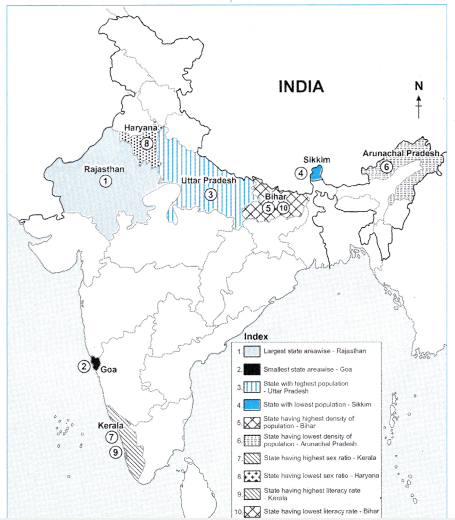
Question 2
Maharashtra Board Solution
On a map of Brazil, show the following.
Solution & Step-by-Step Answer:
Give geographical reasons:
Question 1
Maharashtra Board Solution
In India, population is very unevenly distributed.
Solution & Step-by-Step Answer:
(i) In India, population is very unevenly distributed. (ii) Physiography and climate play an important role in the distribution of population. (iii) Due to fertile land, plain land and availability of water, human settlements have been established in some parts for many centuries. (iv) Due to farming, industries and trade, the. proportion of the population has become concentrated in a few places. (v) For example, the Northern Plains of the country, Delhi, Kolkata, Mumbai, Pune, Bengaluru, Chennai, etc. (vi) On the contrary, in mountainous / hilly regions, dry desert areas, dense forest areas, density is sparse because of inaccessibility, absence of facilities and tough life.
Question 2
Maharashtra Board Solution
The distribution of population is very uneven in Brazil.
Solution & Step-by-Step Answer:
(i) The distribution of population is very uneven in Brazil.. (ii) A majority of the Brazilians are concentrated within 300 kilometers of the eastern coastal areas also called the coastal lowlands because agriculture and industries are well developed here. (iii) In the interior of the Amazon Basin population is very sparse due to. (iv) Unfavourable climate, heavy rainfall, inaccessibility and dense forests which are the barriers to development of human settlements here. (v) The central and western part of Brazil is less moderate.
Question 3
Maharashtra Board Solution
The average life expectancy in India is increasing.
Solution & Step-by-Step Answer:
(i) Earlier the average life expectancy in India was low due to, lack of medical facilities which lead to high incidence of diseases and epidemics like chicken pox, malaria, cholera, etc. (ii) Today with improvement in access to medical facilities and improvement in technology, diseases and epidemics are controlled. (iii) Also today people in India have an improved standard of living, they eat nutritious food and there is awareness of good health. All this has led to increase in average life expectancy in India.
Question 4
Maharashtra Board Solution
In north-eastern India, sparse distribution of population is found.
Solution & Step-by-Step Answer:
(i) North East India comprises of dense forests and uneven topography. (ii) There exist unfavourable climatic conditions in this part. (iii) There is less development of transport, communication and industries here. So, in north-eastern India, sparse distribution of population is found.
Question 5
Maharashtra Board Solution
In India, number of men outnumber women. Is this condition found in all the states of India?
Solution & Step-by-Step Answer:
In India, men outnumber women, on an average. But in Kerala women outnumber men. Sex Ratio of Kerala is 1084 females per 1000 males (2011 Census).
Question 6
Maharashtra Board Solution
Explain the reasons of low sex ratio in India.
Solution & Step-by-Step Answer:
Some of the reasons for lower sex ratio in any region are:
Question 7
Maharashtra Board Solution
Explain – The growth rate of population in India is decreasing but population is increasing.
Solution & Step-by-Step Answer:
(i) Growth rate of population is calculated on the basis of difference between birth rate and death rate. (ii) Earlier the difference between birth rate and death rate was high, so the growth rate was high. (iii) Today the growth rate is decreasing because the difference between birth rate and death rate is not as high as it was earlier. So it is said that in India the growth rate of population is decreasing, but the population is increasing.
Question 8
Maharashtra Board Solution
Explain the uneven distribution of population in India.
Solution & Step-by-Step Answer:
(i) Dense population is found in regions with mild climate and moderate rainfall. E.g. the northern plain as well as the coastal plains of India (ii) Places with heavy rainfall, inaccessibility and dense forests have low population. E.g. north eastern states in India. (iii) The snow covered regions due to extremely cold climatic conditions have less population. E.g. the northernmost part of Jammu & Kashmir. (iv) In certain regions, due to less rainfall and extreme climatic conditions population is sparse. E.g. westernmost part of India in the Thar desert, Rajasthan. (v) Moderate population is found in the plateau regions of Narmada valley.
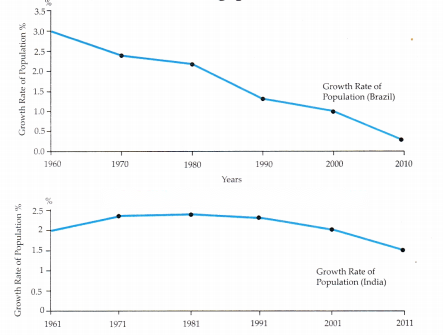
Try this Population growth rate graphs :
Question 2
Maharashtra Board Solution
What is India’s growth rate of population in 2011?
Solution & Step-by-Step Answer:
India’s population growth rate in 2011 is 1.5%.
Question 3
Maharashtra Board Solution
In which two decades has the population growth rate of India remained almost stable?
Solution & Step-by-Step Answer:
The population growth rate of India has remained almost stable during the two decades 1971 to 1981 and 1981 to 1991.
Question 4
Maharashtra Board Solution
From which time period has Brazil seen a sharp decline in the population growth rate?
Solution & Step-by-Step Answer:
From 1980-1990, Brazil has seen a sharp decline in the population growth rate.
Question 5
Maharashtra Board Solution
What is the main point of difference between the two graphs?
Solution & Step-by-Step Answer:
(i) In the first decade between 1961-1971 the growth rate in India showed an upward trend whereas Brazil has a downward trend throughout. (ii) Also the decline in Brazil is more sharp but India’s decline in the growth rate is marginal.
Question 6
Maharashtra Board Solution
What is the interesting feature of Brazil’s growth rate of population?
Solution & Step-by-Step Answer:
The interesting feature of Brazil’s population growth rate is that it is about to touch 0.0 and then will begin its negative growth rate i.e. the population will start decreasing.
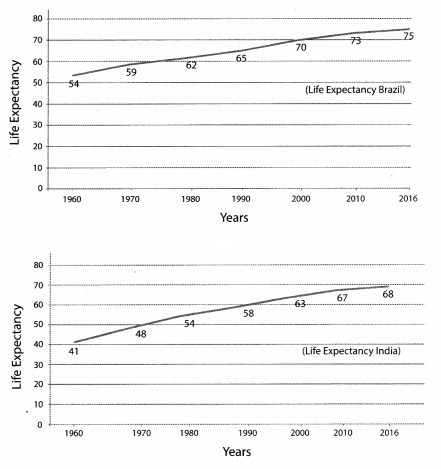
Observe the figure carefully and answer the following questions given below.
Question 2
Maharashtra Board Solution
In which decade was India’s life expectancy the highest?
Solution & Step-by-Step Answer:
Highest life expectancy in India was in the decade of 1960-1970.
Question 3
Maharashtra Board Solution
In which year has the difference in the life expectancy between Brazil and India been the maximum? By how much?
Solution & Step-by-Step Answer:
In the year I960, the difference between the life expectancy of Brazil and India has been the maximum by 13 years. (54 – 51)
Question 4
Maharashtra Board Solution
Has the difference in life expectancy been increasing or decreasing?
Solution & Step-by-Step Answer:
During the past 36 years, i.e. from 1980 onwards, the difference between the life expectancy of Brazil and India has remained constant. It has been 7 to 8 years.
Question 5
Maharashtra Board Solution
What is the similarity between both the graphs?
Solution & Step-by-Step Answer:
Both India and Brazil have experienced an increase in the life expectancy. Both the graphs indicate an upward trend continuously.
Question 6
Maharashtra Board Solution
Is the increase in life expectancy a positive or a negative indicator of an economy? Why?
Solution & Step-by-Step Answer:
The increase in life expectancy is a positive indicator for any economy because longer the people’s average age, longer is their contribution towards the growth of an economy.
Based on the figure, observe carefully and answer the questions given below.
Question 2
Maharashtra Board Solution
What is this general conclusion that you can come to, after observing both the graphs?
Solution & Step-by-Step Answer:
On observing both the graphs, we can conclude that Brazil is and has always been way ahead of India with regard to literacy rate.
Question 3
Maharashtra Board Solution
Which country has higher literacy rate?
Solution & Step-by-Step Answer:
Brazil has a higher literacy rate.
Question 4
Maharashtra Board Solution
What was the literacy rate of Brazil in 2011?
Solution & Step-by-Step Answer:
Brazil had a literacy rate of 91.4% in 2011.
Question 5
Maharashtra Board Solution
What is the difference in the literacy rate of Brazil and India in 2016?
Solution & Step-by-Step Answer:
Literacy rate of Brazil and India had a difference of 20.4% (92.6 – 72.2) in 2016.
Question 6
Maharashtra Board Solution
What is the difference in the literacy rate of India between the years 2001 and 2011?
Solution & Step-by-Step Answer:
The difference in the literacy rate of India is 8.3% (69.3 – 61) between the years 2001 and 2011.
|