Maharashtra State Board Class 10 Geography Solutions Chapter 4 Climate
Class 10 Geography Chapter 4 Climate Textbook Questions and Answers
States/Regions | India | Brazil |
High rainfall | Western Ghats, Eastern Himalayas, Goa | Tocantins, Rio Grande Do Sul, Roraima |
Moderate rainfall | Bihar, Eastern Maharashtra West Bengal | Santa Catarina, Amazonas, Alagoas |
Low rainfall | Western part of Rajasthan, Gujarat, Western Andhra Pradesh | Pernambuco, Paraiba,Rio Grande Do Norte, Alagoas |
2. State whether right or wrong. Rewrite the wrong sentences
Question a.
The fact that Brazil lies on the equator affects its climate in a big way.
Answer:
Right.
Question b.
India and Brazil have the same seasons at the same time.
Answer:
Wrong – India and Brazil have different seasons at the same time.
Question c.
India faces tropical cyclones frequently.
Answer:
Right.
Question d.
Brazil gets a lot of rainfall because of the southwest monsoon winds.
Answer:
Wrong – Brazil gets rainfall from South-East Trade Winds and North-East Trade Winds.
3. Give geographical reasons:
Question a.
The north-eastern part of Brazilian Highlands receives very less rainfall.
Answer:
(i) Brazil gets rainfall from the South-East Trade Winds and the North-East Trade Winds.
(ii) Parts of the Brazilian Highlands extend upto the northern coast.
(iii) The Escarpments act as an obstruction to the winds blowing from the sea and cause orographic type of rainfall in the coastal region.
(iv) Beyond the Highlands, the effect of these winds gets reduced. As a result, the rainfall is minimal.
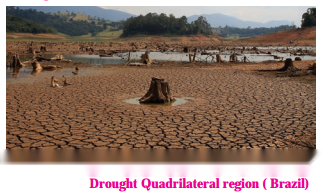
(v) Thus the North Eastern part of Brazilian highlands receives less rainfall. This rain shadow region is also called the ‘Drought Quadrilateral’.
Question b.
Snowfall doesn’t always occur in Brazil.
Answer:
(i) Because of the vast latitudinal extent of Brazil, it experiences a wide range of climatic variations. Near the Equator it is hot, while tropical type of climate is found near the Tropic of Capricorn.
(ii) Considering the temperatures in Brazil, the northern part of Brazil is hot while the temperatures in the southern part are comparatively lower.
(iii) It generally snows in those areas lying in the temperate or polar regions or in the mountainous regions of very high altitude.
(iv) Snowfall does occur but is only confined to higher elevations in the southern states of Rio Grande Do Sul, Parana and Santa Catarina.
(v) Most part of the country lies in the tropical zone which experiences a hot and humid climate.
So snowfall doesn’t always occur in Brazil and is considered a rare phenomenon.
Question c.
Convectional type of rainfall is not prominent in India.
Answer:
(i) Convectional rains are a feature of the equatorial regions and the equator passes through the northern part of Brazil.
(ii) Due to the intense heat here the air expands and rises upwards. As the air goes upwards it cools down, condensation occurs and clouds are formed. This leads to convectional rains every day.
(iii) As such conditions do not exist in India, convection rainfall is not prominent here.
Question d.
Tropical cyclones occur rarely in Brazil.
Answer:
(i) In the coastal regions of Brazil near the Equator, differences in temperatures are negligible.
(ii) The winds move in the vertical direction in this equatorial region.
(iii) Similarly, the convergence zone of the trade winds is weak here. As a result, cyclones are not formed.
(iv) As a result tropical cyclones occur rarely in Brazil.
Question e.
There is not much difference in the range of temperature in Manaus.
Answer:
(i) Manaus is located to the north of Brazil and close to the Equator.
(ii) This region receives perpendicular rays of the sun throughout the year.
(iii) It also receives convectional type of rainfall every day.
(iv) So the climate is hot and humid throughout the year.
(v) As, there is not much difference in the maximum and minimum temperatures there is not much difference in the range of temperature in Manaus.
Question f.
India receives precipitation from the North East Monsoon Winds too.
Answer:
(i) In the winter season, India is influenced by the North East Monsoon Winds.
(ii) These winds bring cool breeze to the country.
(iii) While blowing over Bay of Bengal the North East Monsoon Winds pick up moisture and give rain to the eastern coast of Andhra Pradesh and Tamil Nadu in India.
So, it is said that India receives precipitation from the North East Monsoon Winds too.
4. Answer the following questions:
Question a.
Describe in brief the changes occurring in the climatic conditions of India while going from south to north.
Answer:
(i) India’s Climate is of monsoon type. But there is diversity in climatic conditions of India due to the latitudinal location and altitude of the place.
(ii) As the Tropic of Cancer passes through middle of India, it divides the country into tropical region and sub tropical region.
(iii) The tropical region receives nearly vertical rays of the Sun and the temperature increases as we move towards the south.
(iv) In the sub tropical region of the north, summers are very hot and winters are very cool and dry.
(v) The Himalayas lie in the northern part of India. They protects us from the cold winds that blow from the north, obstructs the South West Monsoon Winds which results in orographic rainfall in its southern slopes.
(vi) In major parts of India precipitation is in the form of rainfall, but in the Himalayas it is in the form of snowfall.
Question b.
Explain the importance of the Himalayas and the Indian Ocean with respect to the climate of India.
Answer:
(i) The Indian Ocean and the Himalayan ranges exert a great influence on the climate of India and the origin of monsoons.
(ii) Because of high temperatures in summers, a low pressure area develops in the Punjab Plains and the Thar Desert of Rajasthan.
(iii) At the same time a high pressure region develops over the Indian Ocean.
(iv) This attracts winds and they start blowing from the Indian Ocean towards the mainland India.
(v) These are moisture-laden winds which bring rainfall to India.
(vi) These winds move towards the Himalayas and due to the natural obstruction of the Himalayas, orographic rain occurs.
(vii) Later these winds retreat from the Himalayas and move from the north-east towards the Indian Ocean and brings rain to some parts of the Peninsula.
(viii) Also the severe cold winds blowing from the north are obstructed by the Himalayas and it saves India from severe winters.
Question c.
Discuss the factors affecting the climate of Brazil.
Answer:
(i) Brazil experiences wide range of climatic variations due to its vast latitudinal extent, proximity to the Equator, presence of the Atlantic Ocean and the Great Escarpment.
(ii) The northern part of Brazil near the Equator is hot, while temperate type of climate is found near the Tropic of Capricorn.
(iii) Brazil gets rainfall from the South-East Trade Winds and the North-East Trade Winds blowing from the Atlantic Ocean.
(iv) Convectional rainfall occurs in places near the equator. Whereas, the Escarpment act as an obstruction to the winds blowing from the sea and cause orographic type of rainfall in the coastal region.
(v) Beyond the Highlands the effects of these winds gets reduced, as a result the rainfall is minimal. This region is a rain-shadow region and is called ‘The Drought Quadrilateral.’
(vi) The Equator passes through the northern part of Brazil so the temperature here is high. Average temperature of Amazon valley is 25°-28°C. Climate is cooler in the highlands. While the temperatures in the southern part are comparatively lower.
(vii) In the coastal regions near the Equator in Brazil, differences in temperatures are negligible. Because of the proximity to the sea, the coast experiences mild and humid climate.
(viii) The winds move in the vertical direction in this region. Similarly, the convergence zone of the trade winds is weak here. So the tropical cyclones are a rare phenomena here.
Question d.
Compare the climates of brazil and India?
Answer:
Climate of India | Climate of Brazil |
(i) India has a monsoon type of climate. | (i) Brazil has a tropical climate to the north and temperate climate to the south. |
(ii) The southern part of India lies in the tropical region so the temperature is high in the south and comparatively low in the north, i.e., the temperature decreases from south to north. | (ii) The northern part of Brazil lies in the tropical region so the temperature is high in the north and comparatively low in the south, i.e., the temperature decreases from north to south. |
(iii) India receives rain from the South West and the North East Monsoon Winds. | (iii) Brazil receives rain from the South East and North East Trade Winds. |
(iv) India receives orographic rainfall. | (iv) Brazil receives convectional and orographic type of rainfall. |
(v) The western part of Rajasthan, Gujarat and eastern side of the Western Ghats receive less rain. | (v) The north eastern part of the Brazilian highlands is a rain shadow region. |
(vi) Tropical cyclones are a frequent phenomena. | (vi) Tropical cyclones are a rare phenomena |
Class 10 Geography Chapter 4 Climate Intext Questions and Answers
Observe the given map below and answer the following questions
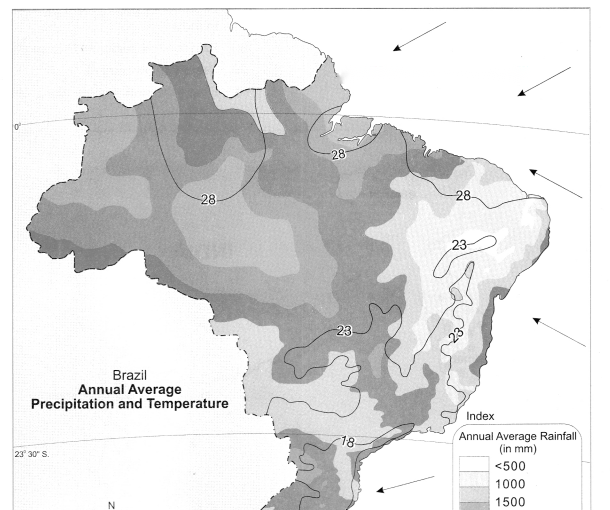

Question 6
Maharashtra Board Solution
Which type of rainfall will occur because of these winds?
Solution & Step-by-Step Answer:
block bg-white dark:bg-slate-900/80 border-l-4 border-emerald-500 rounded-r-xl p-5 my-3 shadow-xs border border-slate-200/60 dark:border-slate-800">
Solution & Step-by-Step Answer:
Orographic rainfall will occur because of these winds.
Question 7
Maharashtra Board Solution
Correlate these winds and rainfall.
Solution & Step-by-Step Answer:
The escarpments act as an obstruction to the winds blowing from the sea and cause an orographic type of rainfall in the coastal region. Beyond the Highlands, the effect of these winds gets reduced. As a result, the rainfall is minimal.
Question 8
Maharashtra Board Solution
In which part of Brazil are the average temperatures low?
Solution & Step-by-Step Answer:
The average temperatures are low in the southern part of Brazil.
Question 9
Maharashtra Board Solution
Identify the rain-shadow area in Brazil. Describe its climatic characteristics.
Solution & Step-by-Step Answer:
The north-eastern part of the Brazilian highlands is a rain shadow region. Beyond the highlands, the effect of the South East Trade Winds gets reduced and the rainfall is minimal. Also, the temperature here is quite high. This rain shadow region is referred to as the ’Drought Quadrilateral’.
Question 10
Maharashtra Board Solution
In which region do you find a higher temperature?
Solution & Step-by-Step Answer:
The northern part of Brazil has higher temperature.
Question 11
Maharashtra Board Solution
Considering the latitudinal extent of Brazil, where will you find a temperate climate in Brazil?
Solution & Step-by-Step Answer:
The southern part of Brazil lying below 23 V4°S latitude (Tropic of Capricorn) experiences temperate climate.
Question 12
Maharashtra Board Solution
Describe the winds blowing between 0° to 5° N and S zones.
Solution & Step-by-Step Answer:
The winds blowing between 0° to 5° N and S zones move in the vertical direction leading to convectional type of rain. The North East and South East Trade winds are very weak in this region.
Question 13
Maharashtra Board Solution
Which method has been used to show distribution in this map?
Solution & Step-by-Step Answer:
The Isopleth method has been used to show distribution in this map.
Observe the given map and answer the following questions
Question 1
Maharashtra Board Solution
Which region gets more than 4000mm of rainfall?
Solution & Step-by-Step Answer:
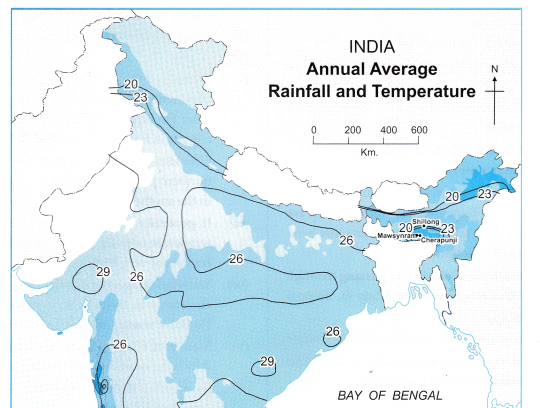
Western Ghats, Western Coasts of India and the northeastern region comprising of Mawsynram, Cherrapunji and parts of Assam and Arunachal Pradesh gets more than 4000 mm of rainfall.
Question 2
Maharashtra Board Solution
Identify the regions with maximum and minimum temperatures?
Solution & Step-by-Step Answer:
Central and North Western parts of Peninsular Plateau and islands have high temperature. Hilly regions of north, northeast and south India have low temperature.
Question 3
Maharashtra Board Solution
In which direction is the temperature increasing?
Solution & Step-by-Step Answer:
The temperature is increasing towards the south.
Question 4
Maharashtra Board Solution
Identify the direction of the winds shown. What are they known as?
Solution & Step-by-Step Answer:
The winds shown are blowing from the south west to north east direction. These winds are called Southwest Monsoon Winds.
Question 5
Maharashtra Board Solution
Which winds are responsible for the rainfall in India ?
Solution & Step-by-Step Answer:
South-West Monsoon Winds are responsible for rainfall in India.
Question 6
Maharashtra Board Solution
Some part of Rajasthan is under desert? What could be the reason for it?
Solution & Step-by-Step Answer:
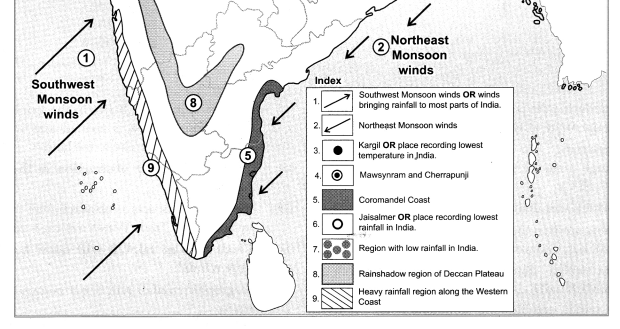
The South West Monsoon Winds blow parallel to the Aravallis. As these moisture laden winds are not obstructed by the Aravallis it rains less here. Hence, Rajasthan is under desert.
Question 7
Maharashtra Board Solution
Draw the main parallel latitude passing through India which affects its climate.
Solution & Step-by-Step Answer:
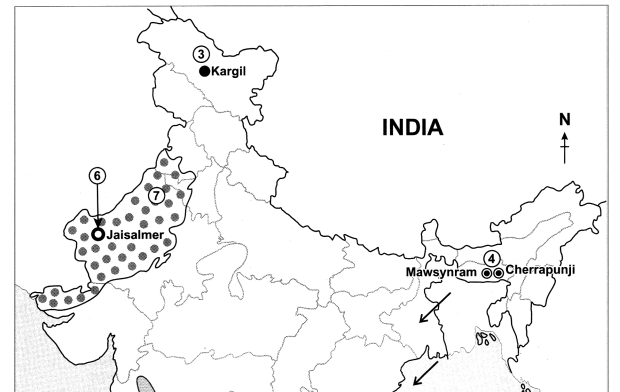
Students are expected to draw the Tropic of Cancer.
Question 8
Maharashtra Board Solution
In which part of Peninsular India is semi-arid climatic conditions found and why?
Solution & Step-by-Step Answer:
(i) The part of peninsular India which has semi-arid climatic conditions are central part of Peninsula Plateau comprising parts of Central Maharashtra, Western Andhra Pradesh, Eastern Karnataka and Western Tamil Nadu. These regions lie on the leeward side of the Western Ghats and Eastern Ghats. It rains less here and a rain shadow region is formed. (ii) Some parts of Gujarat and Rajasthan are also semi-arid as the Aravallis lie parallel and do not obstruct the South-west Monsoon winds.
Give geographical reasons:
Question 1
Maharashtra Board Solution
Shillong gets less than 1000 mm of rainfall annually, whereas Cherrapunji/Mawsynram which is nearby get’s over 11000 mm, of rainfall annually.
Solution & Step-by-Step Answer:
(i) Cherrapunji/Mawsynram lies in the higher altitude on the windward side of the Khasi Hills and receives rainfall from the South West Monsoon Winds. (ii) While Shillong lies in the lower altitude on the leeward side of the Khasi Hills, so it receives less rainfall being in the rain shadow area.
Observe the pictures given below and write brief description about them.
Question 1
Maharashtra Board Solution
Solution & Step-by-Step Answer:
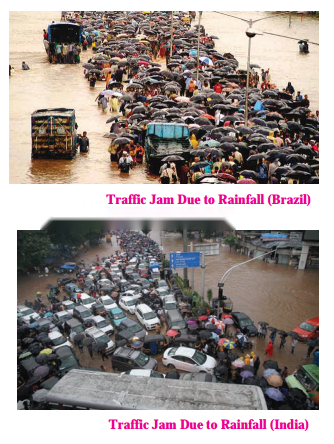
Both the figures shows the traffic congestion during heavy rains. Due to lack of proper drainage and heavy downpour the water gets accumulated disturbing the commuting system.
Question 2
Maharashtra Board Solution
Solution & Step-by-Step Answer:
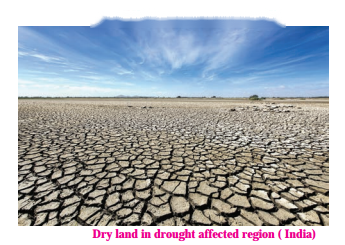
Both the figures show the drought affected regions of India and Brazil respectively. Due to scarce amount of rainfall received in these regions the land has became dry and cannot be cultivated.
Question 3
Maharashtra Board Solution
Solution & Step-by-Step Answer:
figure shows snow fall during winter season in the northern parts of India.
Question 4
Maharashtra Board Solution
Solution & Step-by-Step Answer:
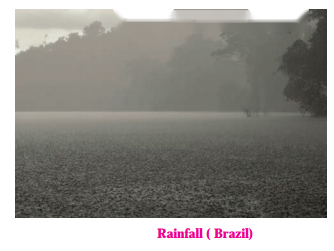
figure shows heavy rainfall in the Brazilian rainforest region.
Question 5
Maharashtra Board Solution
Solution & Step-by-Step Answer:
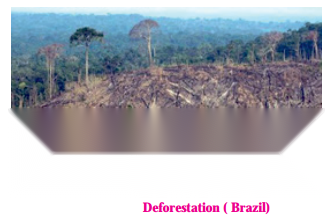
figure shows the trees being cut down to bring land under cultivation. Deforestation is a major issue in Brazil.
Question 6
Maharashtra Board Solution
Solution & Step-by-Step Answer:
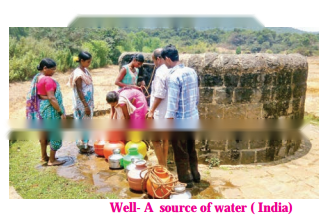
figure shows a well from which water is used for domestic purpose.
Question 7
Maharashtra Board Solution
Solution & Step-by-Step Answer:
figure shows paddy fanning in India. The farmers are planting paddy. The water logged fields are shown.
Study the graphs given below and answer the following questions:
Question 1
Maharashtra Board Solution
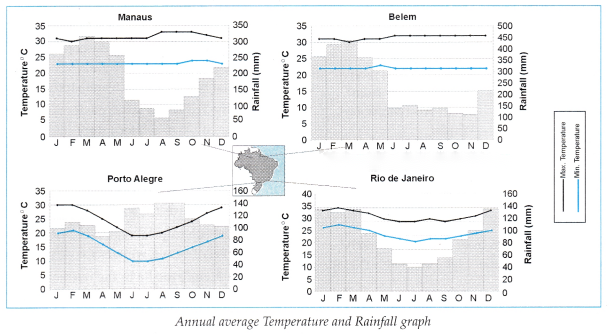
In which month is the highest temperature found in all the four cities?
Solution & Step-by-Step Answer:
The highest temperature is found in the month of January.
Question 2
Maharashtra Board Solution
In which month does it rain the most in the given cities?
Solution & Step-by-Step Answer:
It rains the most in the month of march.
Question 3
Maharashtra Board Solution
When does Brazil have its rainy season?
Solution & Step-by-Step Answer:
Brazil has its rainy season from December to march.
Question 4
Maharashtra Board Solution
Which city has the maximum range of temperature? How much is it?
Solution & Step-by-Step Answer:
Porto Alegre has the maximum range of temperature. It is 20°C (30° C -10° C).
Question 5
Maharashtra Board Solution
What type of climate will be found in Rio de Janeiro?
Solution & Step-by-Step Answer:
Rio de Janeiro has mild & humid climate.
Question 1
Maharashtra Board Solution
What difference do you find in the rainy seasons of Chennai and other cities of India? Why? |



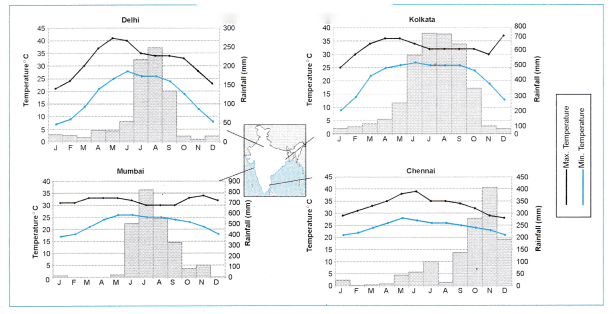
Rainy Season of Chennai | Rainy Seasons of Other Indian Cities |
(i) Chennai mainly receives rain from October to December. | Other cities of India receive rainfall from June to September. |
(ii) Chennai receives rainfall from North East Monsoon Winds. | The other cities receive rainfall mainly from South-West Monsoon Winds. |
Question 2
Maharashtra Board Solution
What similarities do you see in the temperature curves of Delhi and Kolkata?
Solution & Step-by-Step Answer:
block bg-white dark:bg-slate-900/80 border-l-4 border-emerald-500 rounded-r-xl p-5 my-3 shadow-xs border border-slate-200/60 dark:border-slate-800">
Solution & Step-by-Step Answer:
The following similarities can be seen in the temperature curves of Delhi and Kolkata:
Question 3
Maharashtra Board Solution
Calculate the average range of minimum and maximum temperatures of all the four cities.
|
Cities | Average range of minimum and maximum temperatures |
Delhi | 34°C (41°-7°) |
Kolkata | 28°C (37°-9°) |
Mumbai | 17°C (34° -17°) |
Chennai | 18°C (39° – 21°) |
Question 4
Maharashtra Board Solution
In which city is the range minimum? What can you infer about its climate?
Solution & Step-by-Step Answer:
block bg-white dark:bg-slate-900/80 border-l-4 border-emerald-500 rounded-r-xl p-5 my-3 shadow-xs border border-slate-200/60 dark:border-slate-800">
Solution & Step-by-Step Answer:
The range is minimum in Mumbai due to its proximity to the sea.
Question 5
Maharashtra Board Solution
In which city is the range maximum? What can you infer from this about its climate?
Solution & Step-by-Step Answer:
The range is maximum in Delhi. It indicates that Delhi has an extreme climate.
Question 6
Maharashtra Board Solution
Based on the temperature and rainfall of Mumbai, comment upon its climate.
Solution & Step-by-Step Answer:
Mumbai has an equable climate, with less variation in summer and winter temperature.
Question 7
Maharashtra Board Solution
Classify the cites as cities with equable and extreme climates.
Solution & Step-by-Step Answer:
Equable climates – Mumbai, Chennai, Kolkata. Extreme climate – Delhi.
Give it a try
Question 1
Maharashtra Board Solution
Considering the various factors affecting Brazil’s climate, complete the table.
Solution & Step-by-Step Answer:
Question 2
Maharashtra Board Solution
In which part of India are crops grown in a year? How is this related to the rainfall over there?
Solution & Step-by-Step Answer:
(i) Coastal areas of Tamil Nadu in India grow rice three times a year. (ii) This crop is taken during the retreating monsoon season. While blowing over Bay of Bengal, the North East Monsoon winds pick up moisture and give rain to eastern coast of Tamil Nadu.
Use your brain power!
Question 1
Maharashtra Board Solution
Group the months into seasons for a whole year according to the charts given. |
Seasons | India | Brazil |
Summer | March to May | December to March |
Winter | December to February | June to September |
Colours of Both!
Question 1
Maharashtra Board Solution
Considering the location extent and climatic conditions of both the countries, write months according to the seasons.
Solution & Step-by-Step Answer:
Class 10 Geography Chapter 4 Climate Additional Important Questions and Answers Choose the correct option and rewrite the statements:
Question 1
Maharashtra Board Solution
The climate found near the Equatorial region is (a) hot (b) dry (c) humid (d) cold
Solution & Step-by-Step Answer:
(a) hot
Question 2
Maharashtra Board Solution
The climate found near the Tropic of Capricorn is (a) tropical (b) hot (c) temperate (d) tundra
Solution & Step-by-Step Answer:
(c) temperate
Question 3
Maharashtra Board Solution
Brazil gets rainfall from (a) North-West and South-West trade winds (b) Westerly winds (c) South-West and North-East (d) North-East and South-East trade winds
Solution & Step-by-Step Answer:
(d) North-East and South-East trade winds
Question 4
Maharashtra Board Solution
The act as an obstruction to the winds blowing from the sea in Brazil. (a) Himalayas (b) Escarpments (c) Andes (d) Western Ghats
Solution & Step-by-Step Answer:
(b) Escarpments
Question 5
Maharashtra Board Solution
The coastal region of Brazil receives a type of rainfall. (a) orographic (b) cyclonic (c) convectional (d) frontal
Solution & Step-by-Step Answer:
(a) orographic
Question 6
Maharashtra Board Solution
Since the convergence of trade winds are weak near the equator, are not formed. (a) clouds (b) ocean currents (c) cyclones (d) tides
Solution & Step-by-Step Answer:
(c) cyclones
Question 7
Maharashtra Board Solution
The average temperature in the Amazon valley is (a) 15°-20°C (b) 13°-15°C (c) 30°-32°C (d) 25°-28°C
Solution & Step-by-Step Answer:
(d) 25°-28°C
Question 8
Maharashtra Board Solution
The Amazon valley receives around mm of rainfall (a) 2000 (b) 1800 (c) 1500 (d) 1000-1200
Solution & Step-by-Step Answer:
(a) 2000
Question 9
Maharashtra Board Solution
India’s climate is of type. (a) humid (b) monsoon (c) equatorial (d) cold
Solution & Step-by-Step Answer:
(b) monsoon
Question 10
Maharashtra Board Solution
The diversity in the climatic conditions of India is due to the location and altitude of the place. (a) longitudinal (b) latitudinal (c) equatorial (d) tropical
Solution & Step-by-Step Answer:
(b) latitudinal
Question 11
Maharashtra Board Solution
The Ocean and the Himalayan ranges exert a great influence on the climate of India. (a) Atlantic (b) Arctic (c) Pacific (d) Indian
Solution & Step-by-Step Answer:
(d) Indian
Question 12
Maharashtra Board Solution
Orographic type of rainfall occurs in India because of the natural obstruction of (a) Himalayas (b) Escarpments (c) Highlands (d) Satpuda
Solution & Step-by-Step Answer:
(a) Himalayas
Question 13
Maharashtra Board Solution
As the passes through the middle of India, it is considered to be a tropical region. (a) Tropic of Capricorn (b) Equator (c) Tropic of Cancer (d) 60°S latitude
Solution & Step-by-Step Answer:
(c) Tropic of Cancer
Question 14
Maharashtra Board Solution
Most part of Brazil lies in the zone. (а) polar (b) tropical (c) sub-tropical (d) temperate
Solution & Step-by-Step Answer:
(b) tropical
Match the columns:
Question 1
Maharashtra Board Solution
|
Column ‘A’ | Column ‘B’ |
(1) Wettest places in the world | (a) Tamil Nadu |
(2) Driest place in India | (b) Cherrapunji and Mawsynram |
(3) Rainshadow region in Brazil | (c) Jaisalmer, Rajasthan |
(4) Climate of India | (d) Drought Quadrilateral(e) Monsoon type(f) Dry type |
1 – b
2 – c
3 – d
4 – e
Answer in one sentence each.
Question 1
Maharashtra Board Solution
Which natural disasters does India face frequently?
Solution & Step-by-Step Answer:
India frequently faces natural disasters like erratic rainfall, droughts, cyclones, floods, etc.
Question 2
Maharashtra Board Solution
Why does Brazil experience wide climatic variations?
Solution & Step-by-Step Answer:
Brazil has vast latitudinal extent because of which it experiences wide climatic variations.
Question 3
Maharashtra Board Solution
Which winds bring rainfall to Brazil?
Solution & Step-by-Step Answer:
Brazil receives rainfall from the South East and North-East Trade Winds.
Question 4
Maharashtra Board Solution
What acts as an obstruction to the winds blowing from sea in Brazil?
Solution & Step-by-Step Answer:
The Escarpments act as an obstruction to the winds blowing from the sea in Brazil.
Question 5
Maharashtra Board Solution
Which region is called the Drought Quadrilateral’?
Solution & Step-by-Step Answer:
The northern part of Brazil beyond the Highlands is called ‘Drought Quadrilateral’.
Question 6
Maharashtra Board Solution
Where is the difference in temperature negligible in Brazil?
Solution & Step-by-Step Answer:
In Brazil the difference in temperature is negligible in the coastal regions near the equator.
Question 7
Maharashtra Board Solution
In which zone does most of Brazil and India lie?
Solution & Step-by-Step Answer:
Most part of Brazil and India lies in the Tropical zone.
Question 8
Maharashtra Board Solution
Which important latitude passes through the northern part of Brazil?
Solution & Step-by-Step Answer:
The equator passes through the northern part of Brazil.
Question 9
Maharashtra Board Solution
What is the average temperature in Amazon valley?
Solution & Step-by-Step Answer:
The average temperature in Amazon valley is 25°-28°C.
Question 10
Maharashtra Board Solution
Which part of Brazil has cooler climate?
Solution & Step-by-Step Answer:
The climate is cooler in the Highlands.
Question 11
Maharashtra Board Solution
Why do the Brazilian coasts experience mild and humid climate?
Solution & Step-by-Step Answer:
The Brazilian coasts experience mild and humid- climate because of its proximity to sea.
Question 12
Maharashtra Board Solution
Which type of climate is found in India?
Solution & Step-by-Step Answer:
Monsoon type of climate is found in India.
Question 13
Maharashtra Board Solution
Which important latitude passes through the middle of India?
Solution & Step-by-Step Answer:
The Tropic of Cancer passes through the middle of India.
Question 14
Maharashtra Board Solution
What diversifies the climatic conditions of India?
Solution & Step-by-Step Answer:
The diversity in the climatic conditions of India are due to the latitudinal location and altitude of India.
Question 15
Maharashtra Board Solution
What exerts a great influence on the climate of India and the origins of the monsoon?
Solution & Step-by-Step Answer:
The Indian Ocean and the Himalayan ranges exert a great influence on the climate of India and the origin of monsoons.
Question 16
Maharashtra Board Solution
In India, what obstructs the cold winds blowing from the North?
Solution & Step-by-Step Answer:
In India, the Himalayas obstruct the cold winds blowing from the north.
Question 17
Maharashtra Board Solution
What brings more rain in the coastal regions of India?
Solution & Step-by-Step Answer:
The obstruction caused by the Eastern and Western Ghats brings more rain in the coastal regions of India.
Question 18
Maharashtra Board Solution
Find out more about the different ways of classification of the seasons. For example, what is summer?
Solution & Step-by-Step Answer:
The hot weather season is called summer. The season where the rain begins is called the monsoon. The cold weather season is called winter.
Name the following:
Question 1
Maharashtra Board Solution
The two places in India which are considered as the wettest places in the world.
Solution & Step-by-Step Answer:
Cherrapunji and Mawsynram.
Question 2
Maharashtra Board Solution
Years in which Brazil has experienced snowfall.
Solution & Step-by-Step Answer:
1879,1957and 1985.
Question 3
Maharashtra Board Solution
The driest part of India.
Solution & Step-by-Step Answer:
Jaisalmer, Rajasthan.
Question 4
Maharashtra Board Solution
The state in India which receives maximum rainfall during the retreating monsoon season.
Solution & Step-by-Step Answer:
Tamil Nadu.
Question 5
Maharashtra Board Solution
Temperature in Kargil in winter.
Solution & Step-by-Step Answer:
-48°C.
Question 6
Maharashtra Board Solution
Temperature in Ganganagar, Rajasthan in the month of June.
Solution & Step-by-Step Answer:
50°C.
Question 7
Maharashtra Board Solution
The hills responsible for heavy rainfall in Cherrapunji and Mawsynram.
Solution & Step-by-Step Answer:
Garo, Khasi and Jaintia Hills.
Question 8
Maharashtra Board Solution
The winds which provide rainfall to the Tamil Nadu coast.
Solution & Step-by-Step Answer:
North East Monsoon winds. Question 9. The state to receive rain foremost in India. Answer: Kerala.
Question 10
Maharashtra Board Solution
The four seasons of India as per Indian meteorological department.
Solution & Step-by-Step Answer:
The hot weather season (Summer), the season
Are the sentences right ot wrong? Rewrite the wrong ones.
Question 1
Maharashtra Board Solution
Brazil experiences wide climatic variation due to its vast longitudinal extent.
Solution & Step-by-Step Answer:
Wrong – Brazil experiences wide climatic variation due to its vast latitudinal extent.
Question 2
Maharashtra Board Solution
The winds move in the vertical direction in northern Brazil.
Solution & Step-by-Step Answer:
Right.
Question 3
Maharashtra Board Solution
The rainfall reduces on the windward side of the Great Escarpment.
Solution & Step-by-Step Answer:
Wrong – The rainfall increases on the windward side of the Great Escarpment.
Mark the following on the map with the given information and make an index.
Question 1
Maharashtra Board Solution
Outline Map of Brazil. |
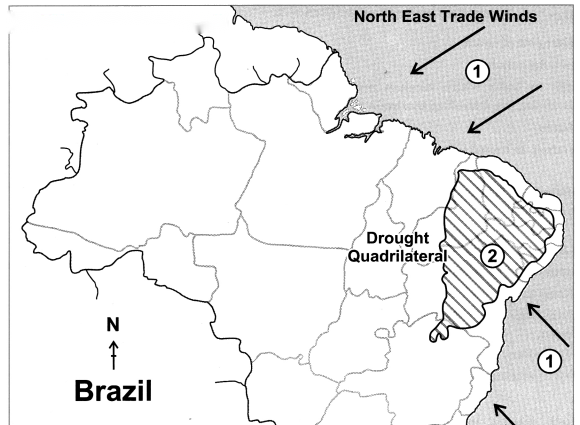
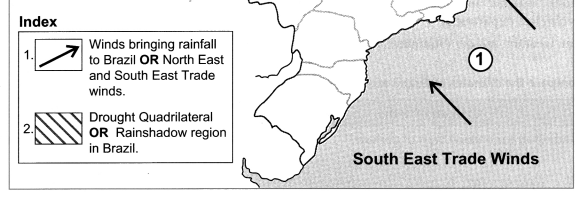
Question 2
Maharashtra Board Solution
Outline Map of India.
Solution & Step-by-Step Answer:
|