Maharashtra State Board Class 10 English Kumarbharati Textbook Solutions Unit 2.6 Science and Spirituality
Maharashtra Board Class 10 English Solutions Unit 2.6 Warming Up Questions and Answers
‘A’ | ‘B’ |
(1) Science | (a) The study of the basic nature of knowledge, reality and existence, especially as an academic subject. |
(2) Religion | (b) The study of nature of God and religious belief. |
(3) Spirituality | (c) The intellectual and practical activities in a systematic study of structure and behaviour of the natural world through experiment and observation. |
(4) Philosophy | (d) The belief in and worship of a superhuman controlling power God. |
(5) Theology | (e) The quality of being more concerned with the human spirit as opposed to material or physical things. |
‘A’ | ‘B’ |
(1) Science | (c) The intellectual and practical activities in a systematic study of structure and behaviour of the natural world through experiment and observation. |
(2) Religion | (d) The belief in and worship of a superhuman controlling power God. |
(3) Spirituality | (e) The quality of being more concerned with the human spirit as opposed to material or physical things. |
(4) Philosophy | (a) The study of the basic nature of knowledge, reality and existence, especially as an academic subject. |
(5) Theology | (b) The study of nature of God and religious belief.
Question 2
Maharashtra Board Solution
Given below are some incomplete Quotes. Complete them choosing from the words SCIENCE /RELIGION /SPIRITUAL and make them meaningful: |
Question 3
Maharashtra Board Solution
What’s the difference between science and technology? Discuss in pairs and tell your
Solution & Step-by-Step Answer:
to the class. Answer: We generally assume that science and technology mean almost the same thing. HowSver, there is a difference. The goal of science is the pursuit of knowledge for its own sake while the goal of technology is to turn the scientific knowledge into industrial and commercial use. Simply put, technology is the practical application of science,
Question 4
Maharashtra Board Solution
Do you think that science and faith are both important in our lives? Why? Discuss in your group and give a small presentation in front of the class.
Solution & Step-by-Step Answer:
Yes, both science and faith are important in our lives. There is no contradiction between the two. Both genuinely seek the truth. Science explores the truth about the material and physical world. Faith introspects on the spiritual aspects including the Self and the Creator. Science helps us understand the physical structure of the universe, while faith deals with human values and morals. Both complement each other. In the words of Einstein, ‘Science without religion is lame; religion without science is blind.’
Question 5
Maharashtra Board Solution
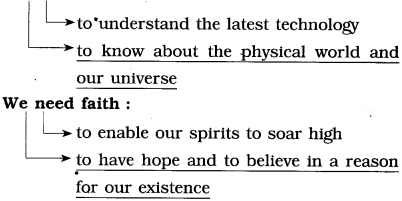
We need science
Solution & Step-by-Step Answer:
Question 6
Maharashtra Board Solution
Refer to a dictionary to find out the meanings of the following words. |

Science and Spirituality Class 10 English Workshop Questions and Answers Maharashtra Board
Question 1
Maharashtra Board Solution
(A) Read ‘Part I’ and match the words in Column ‘A’ with associating words given in Column ‘B’.
(i) …………………………..
Solution & Step-by-Step Answer:
(B) Read ‘Part II’. Go through the given statements and say whether you agree or disagree to each of them. (C) Go through ‘Part III’ and complete the following statements. 2. Choose the correct alternative for the given statements. (B) Dr. Kalam’s friends discussed on ………………………….. (C) According to Dr. Kalam, the need that is felt more than ever is …………………………... (D) Dr. Kalam’s father was a symbol of …………………………... (E) Spirituality takes care of …………………………... (F) How can academic brilliance diminish? (G) What was most astonishing about 102 year old Swamiji? (H) What Dr. Kalam gathered while swimming in silence at the shores of Mahapragyaji?
Question 3
Maharashtra Board Solution
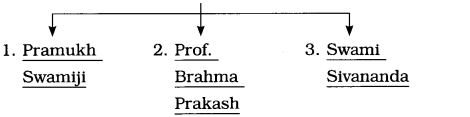
Among the three parts, there are people who touched and influenced the life of Dr. A. P. J. Kalam in one or the other ways. Complete the web chart by writing the names of such people.
Solution & Step-by-Step Answer:
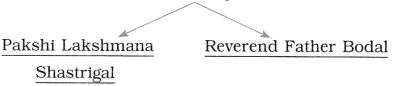
Kalam In one way or the other were:
Question 4
Maharashtra Board Solution
Write the significance of the following years, as given in the text. 1960 …………………………… 1970 …………………………… 1980 …………………………… 2009 …………………………… 2012 ……………………………
Solution & Step-by-Step Answer:
1960 → Is significant as Dr Kalamoined ISRO that year. 1970 → Dr Kalam made his first unsuccessful launch. 1980 → Dr Kalam made his first successful launch. 2009 → The writer graduated from IIMA and met Dr Kalam 2012 → The writer was discussing with Dr Kalam the number of Ph.D’s he (Dr Kalam) had received.
Question 5
Maharashtra Board Solution
Who said to whom and when? (a) “Can we give up God’s abode for such a great scientific mission ?” …………………………………………………………………..
Solution & Step-by-Step Answer:
Reverend Father Pereira said this to „the people in the Church, one Sunday. On the previous day, Dr Sarabhai and Dr Kalam had approached him to request the people to give up the church land for the building of a space research centre.
(b) “And then God will shine through us.” (c) “I wonder what power Mahaswamiji possesses, that keeps him so strong.”
Question 6
Maharashtra Board Solution
Answer the following in your own words, and write in your notebook. (a) What makes Dr Kalam a humble personality?
Solution & Step-by-Step Answer:
Even though Dr Kalam was indisputably a great scientist, he had deep faith and espoused the cause of the betterment of humanity. This shows that he was indeed a humble personality.
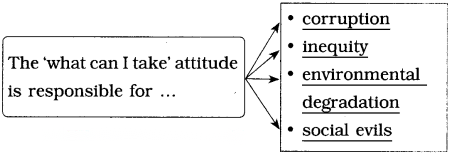
(b) How were different virtues inculcated in Dr Kalam? (c) How did the Reverend relate and compare the work that he and Dr Sarabhai did for people? (d) What was so remarkable about Dr Sri Sri Shivakumar Mahaswamiji? (e) Why is there an urgent need to replace ‘What can I take’ with ‘What can I give?
Question 7
Maharashtra Board Solution
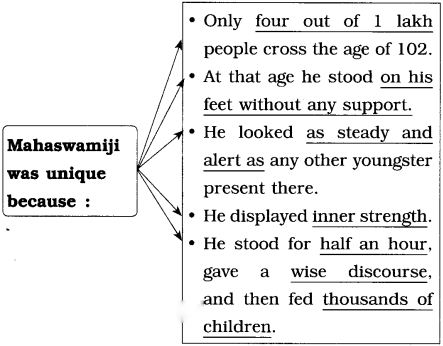
In your notebook, write a short paragraph on each of the following covering up their profession and personality traits with examples. (a) Rev. Peter Bernard Pereira (b) Dr Sri Shivakumar Mahaswamiji (c) Dr A. P. J. Abdul Kalam
Solution & Step-by-Step Answer:
(a) His interactions with the great scientist Professor Vikram Sarabhai and the Reverend Peter Bernard Pereira shaped Dr Kalam’s thoughts on religion. (b) The 102nd birthday celebrations of His Holiness Dr Sri Sri Shivakumara Mahaswamiji. (c) Dr A P Abdul Kalam was the past President of India. By the way, he was a great scientist, orator and a humanitarian.
8. Write in your own simple words what the following expressions convey in the context they occur in the text. (b) Dr Kalam’s own life was nourished by multiple faiths. (c) But there was a major roadblock. (d) Only when the dust is removed, does the mirror shine and the reflection becomes clear. (e) Through his (Kalam’s) words of wisdom, I was getting to learn from countless great minds. (f) He gathered the sands of conscience to be our guide, our best friend. (g) ‘What can I take?’ is the thought which is responsible for all the wrong, seen around us. 9. (A) From the lesson, pick out one word for each of the following. (B) Arrange the following words in the alphabetical order. Answer: (C) Find from the lesson the noun forms of –
Question 10
Maharashtra Board Solution
Match the word connectors with reference to part I, II, III respectively. Make sentences of each of these connectors. |
No | Word | Connector | |
1. | government | (a) | person |
2. | betterment of | (b) | curbs |
3. | pure and ethical | (c) | degradation |
4. | community’s | (d) | launch |
5. | religions | (e) | dialogue |
6. | astonishing | (f) | silence |
7. | technological | (g) | motivation |
8. | frank | (h) | aspect |
9. | social | (i) | life |
10. | faith | (j) | centre |
11. | inquisitive | (k) | officials |
12. | academic | (l) | problems |
13. | environmental | (m) | humanity |
14. | pin-drop | (n) | service |
15. | alternate | (o) | bodies |
16. | remarkable | (p) | evils |
17. | silent | (q) | advancement |
18. | famished | (r) | brilliance |
19. | unsuccessful | (s) | accommodation |
20. | space-research | (t) | discipline |
(1) Some government officials came to our village to inspect the sanitary conditions.
(2) Gandhiji’s efforts were for the betterment of humanity.
(3) The hermit was revered for living a pure and ethical life.
(4) We formed a core team to look into the community’s problems.
(5) We need religious discipline in order to develop a clear conscience.
(6) The most astonishing aspect of this great king’s personality is his humility.
(7) The district required more skilled manpower for technological advancement.
(8) The teacher had a frank dialogue with the youth about his drug problem.
(9) He left his good secureob in order to dedicate himself to social service.
(10) In order to make progress, people should avoid conservative faith curbs.
(11) To be a good detective, ond must basically be an inquisitive person.
(12) All through his school and college days he displayed academic brilliance.
(13) Plastics are major contributors to environmental degradation.
(14) There was pin-drop silence when the sad news was announced.
(15) The owner was provided alternate accommodation until his flat was renovated.
(16) Lai Bahadur Shastri was a remarkable person.
(17) Our inner beliefs should be the silent motivation to do good to others.
(18) The communal kitchen is a great boon to famished bodies.
(19) At the first attempt it was an unsuccessful launch.
(20) ISRO is a space research centre in Bengaluru.
Question 11
Maharashtra Board Solution
Simple sentence : subject + verb + object/complement/adverbial: Analysing a simple sentence is done by separating the subject and the predicate. The predicate is further analysed into – (1) verb + object as in ‘A doctor treats patients’./ ‘He greeted the teacher.’ (2) verb + complement as in ‘They are very tired.’ / ‘I have a cold.’ (3) verb + adverbial as in (He walks slowly. / Raj arrived late. / The thief is hiding there.)
Say whether the predicates in the following sentences have an object/a complement/an adverbial.
Solution & Step-by-Step Answer:
(1) Complement
(2) Object (3) Complement (4) Adverbial (5) Adverbial (6) Object (7) Adverbial
Question 12
Maharashtra Board Solution
(A) Punctuate the following sentences to make them meaningful. (1) dinesh took a bus that stopped at nanded railway station after crossing somvar peth (2) dr a p j abdul kalam was the past president of india by the way he was a great scientist orator and a humanitarian (3) nouns are of different types common proper abstract concrete material (4) what a lot of noise you all make said the teacher cant you keep quiet for a while (5) wow how lovely that cake looks they said we cant wait to eat it Answer” (1) Dinesh took a bus that stopped at Nanded railway station after crossing Somvar Peth. (2) Dr A P J Abdul Kalam was the past President of India. By the way, he was a great scientist, orator and a humanitarian. (3) Nouns are of different types: common, proper, abstract, concrete, material. (4) “What a lot of noise you all make!” said the teacher, “Can’t you keep quiet for a while?” (5) “Wow! How lovely that cake looks!” they said, “We can’t wait to eat it.” |
(B) Copy the first paragraph on page 92 in your notebook, carefully. Encircle all the punctuation marks with a colored pencil/pen.
“Dear children …………………. ‘amen’.
Question 13
Maharashtra Board Solution
Project : Read Dr. A.P.J. Abdul Kalam’s very renowned books ‘Wings of Fire’; and ‘Ignited Minds’, to find the following : (a) Subject of the book (b) Special features of the book (c) Teachings/learnings/moral/message from the book (d) Your own opinion/idea/comment on the book
Solution & Step-by-Step Answer:
block bg-white dark:bg-slate-900/80 border-l-4 border-emerald-500 rounded-r-xl p-5 my-3 shadow-xs border border-slate-200/60 dark:border-slate-800">
Solution & Step-by-Step Answer:
Dr A. P.. Kalam was the son of an imam, a simple fisherman. He was born in Rameswaram on 15 October 1931. He went on to become the 11th President of India from 2002 to 2007. He was widely acclaimed as the ‘People’s President’. He was particularly fond of children and youth and made himself approachable to them at all times.
He was a student of Physics and aerospace engineering. He was a scientist and science administrator mainly at the Defence Research and Development Organisation (DRDO) and Indian Space Research Organisation (ISRO) for nearly four decades. He was intimately involved in India’s civilian space programme and military missile development efforts. He is famous as the Missile Man of India for his work on the development of ballistic missile and launch vehicle technology. He also played a pivotal organisational, technical, and political role in India’s Pokhran-II nuclear tests in 1998, the first since the initial nuclear test by India in 1974. He was the recipient of several prestigious awards, including the Bharat Ratna in 1997, India’s highest civilian honour. Amongst his writings, the most famous are ‘Transcendence: My Spiritual Experiences with Pramukh Swamiji’, and ‘India 2020’. While delivering a lecture at the Indian Institute of Management, Shillong, Kalam collapsed and died from an apparent cardiac arrest on 27uly 2015, aged 83. Thousands including national-level dignitaries attended the funeral ceremony held in his hometown of Rameswaram, where he was buried with full state honours.
Question 14
Maharashtra Board Solution
(A) Draft a speech that you would give at your School Assembly convincing junior students that the secret of true happiness lies in Giving and Sharing more than in Receiving and Taking. |
Write it with the appropriate steps in your notebook.
Friends,
It is through experience I.have learned that ‘AS’ you give, so you live’.
There was a time in my life when I only wanted things. I was happy only when I received gifts. My main goal in life was to take as many things from others as I could.
But then one day, on the way to market, I saw a beggar boy running along the road. In his hand he held a loaf of bread. He ran to his mother, who was lying on the sidewalk. He sat next to her and started feeding her. It touched me deeply that this boy who must have been hungry himself, found greateroy in feeding his famished mother.
From that day onwards I started giving things to others. If I had two pens and someone wanted one, I would give it to him or her. I asked my mother to give my old clothes to a poor child from a nearby slum. For my birthday celebrations, instead of having a party, I went along with my mother to the temple and fed a line of beggars.
Giving things to others brings me greatoy and happiness. Receiving something gives temporary satisfaction. But reaching out to others and seeing them smile, sharing things with others and making it worthwhile – these are far more precious than any other personal possessions.
Thank you.
(B) Divide your class in two groups and have a Debate on the topic ‘Science and Spirituality can go hand in hand’.
Answer:
For (view):
Both science and spirituality study aspects of our world. Both require mental discipline. Both require belief in certain axioms and truths. Hence both are valid. Science is the body. Spirituality is the mind. Science explores the creations of God. Spirituality delves into the nature of God. Both are two sides of the same coin. Both complement each other.
It is inevitable therefore that science and spirituality go hand in hand.
Against (counterview):
Science requires factual knowledge. It is a component of millions of physical laws. Spirituality is a free bird that soars on the wings- of personal belief. It does not require proof. Only faith. How then can they be considered to be on the same plane? One is concrete; the other abstract. In order to draw upon spirituality, one may conjure up any image in the mind and be satisfied. Science seeks explanation in logical reasoning based upon unlimited past experiences and developed into a truth by considering experiment after experiment.
The two are poles apart and cannot go hand in hand.
Question 15
Maharashtra Board Solution
State whether the statements are True or False:
Solution & Step-by-Step Answer:
(a) It is necessary for science and faith to function true to their roles. (b) Kalam’s status as a great scientist is in dispute. (c) Both fact and faith are required for a better world. (d) There is never any conflict between believers in science and believers in religion. Answer: (a) True (b) False (c) True (d) False
Question 16
Maharashtra Board Solution
Why do science and faith have to go hand in hand?
Solution & Step-by-Step Answer:
Science and faith must go hand in hand for the sake of human good. Science provides focus on human activities while faith gives one a perspective, which is essential for success.
Question 17
Maharashtra Board Solution
From the passage pick out one word for each of the following: (a) keeps something within limits (b) unable to be challenged or doubted
Solution & Step-by-Step Answer:
(a) curbs (b) indisputable
Question 18
Maharashtra Board Solution
Write the noun forms of: (a) create (b) coexist (c) discover (d) conceive (e) accelerate.
Solution & Step-by-Step Answer:
(a) create – creation (b) coexist – coexistence (c) discover – discovery (d) conceive – conception (e) accelerate – acceleration.
Question 19
Maharashtra Board Solution
Faith provides perspective. (Rewrite beginning with ‘Perspective’.)
Solution & Step-by-Step Answer:
Perspective is provided by faith.
Question 21
Maharashtra Board Solution
Fill in the blanks with suitable prepositions: (The answers are given directly and underlined.)
Solution & Step-by-Step Answer:
Conflict often arises between people who believe in science and people who believe in religion,
Question 22
Maharashtra Board Solution
Which, according to you, is more important for our planet to survive – science or religion? Give your reasons in brief.
Solution & Step-by-Step Answer:
According to me, both are important – science \ as well as religion. Science provides us with facts that tell us about our planet. Religion educates us about the proper attitude towards all things created on earth. We need both for our planet to survive. Both go hand in hand.
Question 23
Maharashtra Board Solution
Complete the following map:
Solution & Step-by-Step Answer:
Question 24
Maharashtra Board Solution
Complete the following based on the passage: (The answers are given directly and underlined.)
Solution & Step-by-Step Answer:
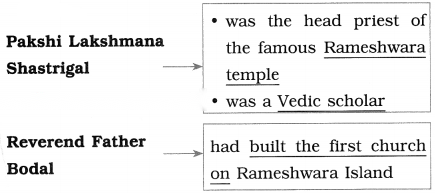
People who touched and influenced Dr A. P.. Kalam in one way or the other were:
Question 25
Maharashtra Board Solution
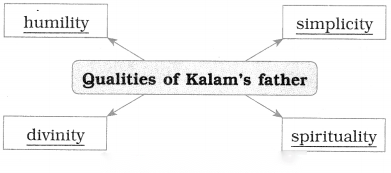
Complete the following.
Solution & Step-by-Step Answer:
Question 26
Maharashtra Board Solution
Give evidence from the passage to show that Dr Kalam’s father combined the virtues of ‘simplicity’ and ‘divinity’.
Solution & Step-by-Step Answer:
Dr Kalam’s father was a boatman. This was the basis for his simplicity. He was also an imam in a mosque and believed strongly in leading a spiritual life. This was the basis of his divinity.
Question 27
Maharashtra Board Solution
Write from the passage four words that are connected with or related to religions.
Solution & Step-by-Step Answer:
imam, mosque, Hindu, Christian (priest, temple, Vedic, reverend father, church, divinity, spiritual, spirituality)
Question 28
Maharashtra Board Solution
Match the words in column ‘A’ with their meanings in column ‘B’: |
‘A’ | ‘B’ |
(i) remembered | (a) frank |
(ii) honest | (b) misery |
(iii) clothes | (c) recalled |
(iv) sorrow | (d) attire |
‘A’ | ‘B’ |
(i) remembered | (c) recalled; |
(ii) honest | (a) frank; |
(iii) clothes | (d) attire; |
(iv) sorrow | (e) misery.
Question 29
Maharashtra Board Solution
Write the noun forms of: (a) solve (b) frank (c) believe.
Solution & Step-by-Step Answer:
(a) Solve – solution (b) frank – frankness (c) believe – belief.
Question 30
Maharashtra Board Solution
(1) Write whether the predicates in the following sentences have an object/a complement/an adverbial: (a) His father was a boatman. (b) Father Bodal had built the first church.
Solution & Step-by-Step Answer:
(a) complement (b) object
Question 31
Maharashtra Board Solution
Pick out the auxiliaries and state the mood: (a) All three of them used to sit and discuss the community’s problems. (b) Simplicity and divinity could go together.
Solution & Step-by-Step Answer:
(a) used to – past habit (b) could – possibility.
Question 32
Maharashtra Board Solution
Even though his father was a boatman, Dr Kalam went on to become the President of India. (Rewrite using ‘yet’.)
Solution & Step-by-Step Answer:
Dr Kalam’s father was a boatman, yet” he went on to become the President of India.
Question 33
Maharashtra Board Solution
Complete the following based on the passage:
Solution & Step-by-Step Answer:
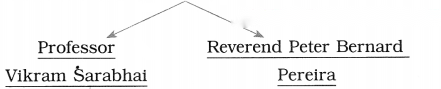
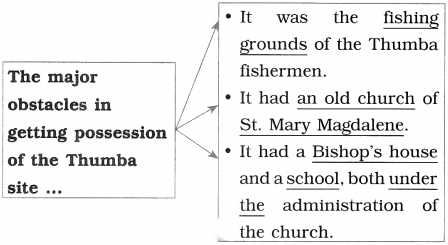
People who touched and influenced Dr A. P.. Kalam in one way or the other were:
Question 34
Maharashtra Board Solution
What is the significance of the year 1960 as given in the passage?
Solution & Step-by-Step Answer:
1960 is significant as Dr Kalamoined ISRO that year.
Question 35
Maharashtra Board Solution
Complete the following.
Solution & Step-by-Step Answer:
Question 36
Maharashtra Board Solution
Write from the passage words that sound the same as: (a) grate (b) dew (c) wood (d) hear (e) two (f) sew.
Solution & Step-by-Step Answer:
(a) grate – great (b) dew – due (c) wood – would (d) hear – here (e) two – to (f) sew – so.
Question 37
Maharashtra Board Solution
Pick out from the following words that, do not begin with the prefix ‘re-’ religion, reverend, religious, research, relocate, region
Solution & Step-by-Step Answer:
religion, reverend, religious, region
Question 38
Maharashtra Board Solution
Match the phrases with one word from the passage: |
‘A’ | ‘B’ |
(i) which is new and inexperienced | (a) proximity |
(ii) a place provided for a particular purpose. | (b) fledgling purpose |
(iii) something that causes delay or obstruction | (c) site |
(iv) nearness in space | (d) roadblock |
‘A’ | ‘B’ |
(i) which is new and inexperienced | (b) fledgling purpose |
(ii) a place provided for a particular purpose. | (c) site |
(iii) something that causes delay or obstruction | (d) roadblock |
(iv) nearness in space | (a) proximity
Question 39
Maharashtra Board Solution
Professor Sarabhai and his team had selected a site in Thumba, Kerala. (Pick out the subject of the sentence.)
Solution & Step-by-Step Answer:
Professor Sarabhai and his team
Question 40
Maharashtra Board Solution
It was here that he learnt about the true meaning of religious service.
Solution & Step-by-Step Answer:
Where did he learn about the true meaning of religious service?
Question 41
Maharashtra Board Solution
It would be impossible to relocate so many people. (Rewrite using ‘not’.)
Solution & Step-by-Step Answer:
It would not be possible to relocate so many people.
Question 42
Maharashtra Board Solution
What do you learn from this passage?
Solution & Step-by-Step Answer:
From this passage, I learn that people belonging to different religions can come together and reach a common understanding to resolve major and sensitive issues. Religious harmony is the theme of this passage.
Question 43
Maharashtra Board Solution
Complete the following: (a) Reverend Father Pereira helped to solve the problem of acquiring the site. (b) Father Pereira described the Church in three ways: (i) his abode (ii) his children’s abode (iii) God’s abode.
Solution & Step-by-Step Answer:
(a) Reverend Father Pereira (b) (i) abode (ii) his children’s (iii) God’s.
Question 44
Maharashtra Board Solution
Go through the given statements and say whether you Agree or Disagree with each of them:
Solution & Step-by-Step Answer:
(a) Science and spirituality seek the prosperity of human life. – (b) Reverend Pereira absolutely refused to consider Dr Kalam’s request. – (c) Alternate accommodation was offered only to the fishermen. – Disagree (d) Everyone present in the church agreed to Reverend Pereira’s plea – Answer: (a) Agree (b) Disagree (c) Disagree (d) Agree
Question 45
Maharashtra Board Solution
Who said to whom and when? ‘Can we give up God’s abode for such a great scientific mission?’
Solution & Step-by-Step Answer:
Reverend Father Pereira said this to „the people in the Church, one Sunday. On the previous day, Dr Sarabhai and Dr Kalam had approached him to request the people to give up the church land for the building of a space research centre.
Question 46
Maharashtra Board Solution
Complete the following with the reference to the passage: (1) We benefit from the devices that science has developed to light up our homes. (2) We can talk to a large gathering and be heard using a microphone. (3) Medical science allows doctors to diagnose and treat patients. (4) Science and technology enhance the overall comfort and quality of human life.
Solution & Step-by-Step Answer:
(1) to light up our homes. (2) using a microphone. (3) diagnose and treat patients. (4) comfort and quality of human life.
Question 47
Maharashtra Board Solution
Write one word for: (a) one who follows a teacher or a leader (b) eager to know everything (c) a place of residence (d) echoed loudly
Solution & Step-by-Step Answer:
(a) discIple (b) inquisitive (c) abode (d) reverberated
Question 48
Maharashtra Board Solution
Write from the passage two words that have almost the same meaning as ‘prosperity’:
Solution & Step-by-Step Answer:
comfort, well-being
Question 49
Maharashtra Board Solution
Write from the passage two words that indicate noise.
Solution & Step-by-Step Answer:
reverberated, deafening.
Question 50
Maharashtra Board Solution
How is it possible? (Rewrite as an assertive sentence.)
Solution & Step-by-Step Answer:
It is not possible.
Question 51
Maharashtra Board Solution
I am able to talk to you using this mic. (Rewrite using ‘can’.)
Solution & Step-by-Step Answer:
I can talk to you using this mic.
Question 52
Maharashtra Board Solution
The whole church reverberated with the deafening noise of a collective ‘amen’. (Pick out the prepositions.)
Solution & Step-by-Step Answer:
with, of
Question 53
Maharashtra Board Solution
Add question tags: (a) Vikram and I are doing the sameob. (b) I am able to talk to you using this mic.
Solution & Step-by-Step Answer:
(a) Vikram and I are doing the sameob, aren’t we? (b) I am able to talk to you using this mie, aren’t I’
Question 54
Maharashtra Board Solution
How did the people respond to the appeal made by Reverend Pereira? Would you give the ( same response?
Solution & Step-by-Step Answer:
The people got up and the whole church reverberated with the deafening noise of a collective ‘amen’. Yes, if I had been part of the gathering, I too would haveoined in with a loud positive response, Considering the importance of the space research centre, I would have been willing to suffer the agony i of relocation.
Question 55
Maharashtra Board Solution
Complete the following: (a) We can lead a pure life by serving humanity. (b) The philosophy of Dr Kalam had an impact on the narrator.
Solution & Step-by-Step Answer:
(a) serving humanity. (b) Dr Kalam
Question 56
Maharashtra Board Solution
Who had directly influenced Dr Kalam’s beliefs? (a) Professor Satish Dhawan (b) Srijan (c) God (d) countless great minds
Solution & Step-by-Step Answer:
(a) Professor Satish Dhawan
Question 57
Maharashtra Board Solution
Who said the following to whom and when? “And then God will shine through us.”
Solution & Step-by-Step Answer:
Professor Satish Dhawan to Dr Kalam when ‘ they were talking about academic brilliance.
Question 58
Maharashtra Board Solution
Match the words in column ‘A’ with their opposites in column ‘B’: ‘ |
‘A’ | ‘B’ |
(i) asked | (a) increased |
(ii) obscure | (b) impure |
(iii) diminished | (c) clear |
(iv) pure | (d) responded |
‘A’ | ‘B’ |
(i) asked | (d) responded |
(ii) obscure | (c) clear |
(iii) diminished | (a) increased |
(iv) pure | (b) impure
Question 59
Maharashtra Board Solution
Choose from the following words/phrases that more or less indicate the meaning of the word ‘wisdom’: humanity, brilliance, ethical lives, academically accomplished, great minds
Solution & Step-by-Step Answer:
brilliance, academically accomplished, great minds
Question 60
Maharashtra Board Solution
Write the noun forms of: (a) responded (b) accomplished (c) different (d) clear t (e) pure
Solution & Step-by-Step Answer:
(a) responded – response (b) accomplished – accomplishment (c) different – difference (d) clear – clarity (e) pure – purity.
Question 61
Maharashtra Board Solution
Academic brilliance is no different from the brilliance of a mirror. (Rewrite without ‘no’.)
Solution & Step-by-Step Answer:
Academic brilliance is similar to the brilliance of a mirror.
Question 62
Maharashtra Board Solution
God will shine through us. (Add a question tag.)
Solution & Step-by-Step Answer:
God will shine through us, won’t He?
Question 63
Maharashtra Board Solution
He had advised me to use my degree and gold medal to transform society. (Pick out the infinitives.)
Solution & Step-by-Step Answer:
to use, to transform
Question 64
Maharashtra Board Solution
Name the following based on the passage. The person who touched and influenced the life of Dr APJ Abdul Kalam. –
Solution & Step-by-Step Answer:
Dr Sri Sri Shivakumara Mahaswamiji.
Question 65
Maharashtra Board Solution
Find evidence from the passage that indicates that Swamiji: (a) was dedicated (b) has inner strength (c) contributed to the good of the society (d) was younger than the young generation
Solution & Step-by-Step Answer:
(a) Who has dedicated his life to the service of humanity. (b) Swamiji stood on his feet without any support! (c) his greatest contribution is the establishment of a free residential education. Swamiji feeds thousands of children. (d) He looked as steady and alert as any other youngster present there.
Question 66
Maharashtra Board Solution
Complete the following.
Solution & Step-by-Step Answer:
Question 67
Maharashtra Board Solution
Write a short paragraph on Dr Sri Shivakumara Mahaswamiji covering his profession and mentioning his personality traits with examples.
Solution & Step-by-Step Answer:
Dr Sri Sri Shivakumara Mahaswamiji was a remarkable person. He had dedicated his life to the service of humanity and had established a free residential education system for more than nine thousand children. At the age of 102 he could stand without support, give a wise discourse for half an hour and then go on to feed thousands of children. He looked as steady and alert as any other youngster present there and displayed tremendous amount of inner strength.
Question 68
Maharashtra Board Solution
Write the opposites of the following words using prefixes (un-, in-, etc.): (a) invited (b) remarkable (c) humanity (d) wise.
Solution & Step-by-Step Answer:
(a) invited – uninvited (b) remarkable – unremarkable (c) humanity – inhumanity (d) wise – unwise.
Question 69
Maharashtra Board Solution
Guess the meanings of: (i) genetics (ii) googled?
Solution & Step-by-Step Answer:
(i) genetics – heredity and the variation of inherited characteristics. (ii) googled – found out information about the subject on the Google website
Question 70
Maharashtra Board Solution
Find out the noun forms of the following from the passage: (a) celebrated …… (b) contribute ….. (c) educate … (d) strong ….
Solution & Step-by-Step Answer:
(a) celebrated – celebration (b) contribute – contribution (c) educate – education (d) strong – strength
Question 71
Maharashtra Board Solution
This display of inner strength touched Dr Kalam deeply. (Rewrite beginning ‘Dr Kalam
Solution & Step-by-Step Answer:
Dr Kalam was deeply touched by this display of inner strength.
Question 72
Maharashtra Board Solution
How many of these four would be able to stand tall for half an hour? (Rewrite as an assertive sentence.)
Solution & Step-by-Step Answer:
Not many of these four would be able to stand tall for half an hour.
Question 73
Maharashtra Board Solution
I had googled the subject beforehand. (Identify the tense of the sentence.)
Solution & Step-by-Step Answer:
Past perfect tense
Question 74
Maharashtra Board Solution
We were discussing this unusual birthday party. (Add a question tag.)
Solution & Step-by-Step Answer:
We were discussing this unusual birthday party, weren’t we?
Question 75
Maharashtra Board Solution
What measures will you take to keep yourself physically and mentally fit?
Solution & Step-by-Step Answer:
To keep myself physically fit, I will take good care of my diet and eat only healthy foods. I will exercise regularly. To keep myself mentally fit, I will try to have a positive attitude towards life, be cheerful and happy and help others.
Question 76
Maharashtra Board Solution
Fill in the blanks: (a) Dr Kalam observed great …………………… in Swami Sivananda. (b) Dr Kalam’s father believed in the value of ………………….. (c) Mahaswamiji gives education to famished ……………………, food to famished …………………... (d) The essence of a happy life and a peaceful society lies in one sentence – ……………………..
Solution & Step-by-Step Answer:
(a) tranquillity (b) giving back (c) minds, bodies (d) ‘What can i give’
Question 77
Maharashtra Board Solution
Complete the following based on the passage:
Solution & Step-by-Step Answer:
The people who touched and influenced Dr APJ Kalam in one way or the other were:
Question 78
Maharashtra Board Solution
Complete the following table: |
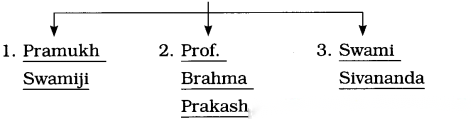
Name of person | Values |
(a) Pramukh Swamiji | goodness of action |
(b) Professor Brahma Prakash | need for living a pure and ethical life |
(c) Father Pereira and Dr Sarabhai | selflessness in service |
(d) Swami Sivananda | tranquillity |
(e) Dr Kalam’s father | simplicity, the value of giving back |
(f) Mahaswamiji | munificence, spirit of giving. |
(a) Goodness of action
(b) Pure and ethical life
(c) Selflessness in service
(d) Tranquillity
(e) Simplicity, giving back
(f) Munificence
Question 79
Maharashtra Board Solution
Rearrange the letters to form sensible words: (a) y e s f i l l e t = (b) s c e n e c o i n c =
Solution & Step-by-Step Answer:
(a) y e s f i l l e t = lifestyle (b) s c e n e c o i n c = conscience
Question 80
Maharashtra Board Solution
From the lesson write one word for:
Solution & Step-by-Step Answer:
(a) giving away much to the needy munificence (b) the basic idea of something essence
Question 81
Maharashtra Board Solution
Complete the following choosing from the words/phrases given below: [moral sense of right and wrong, purity, characteristic spirit of a culture, principle or belief, simplicity, peace, generosity, spirituality] (a) A tenet is a principle or belief. (b) Conscience is a moral sense of right and wrong. (c) Ethos is the characteristic spirit of a culture. (d) Tranquillity is peace.
Solution & Step-by-Step Answer:
(a) Principle or belief. (b) Moral sense of right and wrong. (c) Characteristic spirit of a culture. (d) Peace.
Question 82
Maharashtra Board Solution
Write the noun forms of: (a) pure (b) settle (c) final.
Solution & Step-by-Step Answer:
(a) pure – purity (b) settle – settlement (c) final – finality.
Question 83
Maharashtra Board Solution
Activities based on Contextual Grammar: (1) In giving so much, he becomes strong. (Rewrite using ‘because’.)
Solution & Step-by-Step Answer:
He becomes strong because he gives so much.
Question 84
Maharashtra Board Solution
His munificence fuels his strength. (Rewrite beginning with ‘His strength …’.)
Solution & Step-by-Step Answer:
His strength is fuelled by his munificence.
Question 86
Maharashtra Board Solution
What was the secret of Mahaswamiji’s fitness even at the age of 102 years?
Solution & Step-by-Step Answer:
Mahaswamiji was a remarkable man. He lived with the belief of giving selflessly to famished minds and bodies. By giving, he himself became stronger. His spirit of generosity increased his strength and kept him standing tall and active in life.
Question 87
Maharashtra Board Solution
Fill in the blanks: (1) Dr Kalam’s message made an impact on the writer because of its gravity and the challenge it posed became his silent motivation. (2) The truth of humanity lies in the answer to the question ‘What can I give?’
Solution & Step-by-Step Answer:
(1) gravity, challenge (2) truth, humanity
Question 88
Maharashtra Board Solution
What makes society corrupt and unfair?
Solution & Step-by-Step Answer:
Society becomes corrupt and unfair when humans think they can take indiscriminately from the environment and destroy it or when they think only of what they can take from other humans.
Question 89
Maharashtra Board Solution
Complete the following with word from the passage:
Solution & Step-by-Step Answer:
Question 90
Maharashtra Board Solution
Pick out the adverbs: circumspectiy, indiscriminately, inequity, gravity.
Solution & Step-by-Step Answer:
circumspectly, indiscriminately
Question 91
Maharashtra Board Solution
Write what the underlined auxiliaries indicate: (a) What can I give? (b) We have to replace this attitude …
Solution & Step-by-Step Answer:
(a) can – ability, possibility (b) have to – obligation, compulsion.
Question 92
Maharashtra Board Solution
The gravity of the message struck me. (Rewrite in the passive voice.)
Solution & Step-by-Step Answer:
I was struck by the gravity of the message.
Question 93
Maharashtra Board Solution
What answers do you get when you ask yourself the question ‘What can I give’?
Solution & Step-by-Step Answer:
When I ask myself the question ‘What can I give’, I get the answer that I can ‘give’ my talents, my proper moral attitudes, my efforts in the service of others, financial help according to my means …!
Question 94
Maharashtra Board Solution
Punctuate the following sentences to make them meaningful: (Note: 1 sentence will be asked in the activity sheet.) (1) Spot the errors and rewrite the sentence correctly: We discussing the number of Ph.D’s Dr Kalam received. (2) Arrange the following words in alphabetical order: inventions, indisputable, interactions, inequity, institutions, inquisitive, indiscriminately. (3) Identify the type of sentence: Within a year he wants to build scientific facilities near the sea coast. (4) Rearrange the letters to form two sensible words: (1) i c e g e n t s (2) f u n m i n c e i c e (5) Make a meaningful sentence using the phrase: to come full circle. (6) Pick out an infinitive and use it in your own sentence: I am able to talk to you using this mic. (7) Write two smaller words hidden in the given word: perspective (8) Complete the following word chain with words from the lesson: church, _ _ _ _ _e,
Solution & Step-by-Step Answer:
(1) We weref discussing the number of Ph.D’s Dr Kalam had received. (2) indiscriminately, indisputable, inequity, inquisitive, institutions, interactions, inventions (3) Assertive Sentence (4) (1) genetics (2) munificence (6) It is firstanuary, the year has come full circle. (6) Infinitive: to talk Sentence: The headmaster wants to talk to you about the annual function.! (7) perspective: price, respect (spice, spite) (8) church, house, equator, religious, scientist, team, mic, culture
Question 95
Maharashtra Board Solution
(1) Write a word that sounds the same as ‘there’ and make a sentence. (2) Prepare a word register of eight words for the word ‘house’. (3) Rewrite beginning with the underlined part. His team had selected a site in Thumba.
Solution & Step-by-Step Answer:
(1) Homophone: there – their! Sentence: They wanted admission for their child, (2) House: apartment, residence, abode, dwelling, home, habitation, domicile, lodging, settlement (3) A site in Thumba had been selected (by his team).
Question 96
Maharashtra Board Solution
(1) Underline the modal auxiliary and state its function: They must have come full circle. (2) Use the word ‘benefit’ as a noun as well as a verb in sentences.
Solution & Step-by-Step Answer:
! (1) They must have come full circle. Function: past certainty. (2) (a) Science confers many benefits on mankind, (noun) (b) The bonus will benefit our family in many ways, (verb)
|