Maharashtra State Board Class 10 English Kumarbharati Textbook Solutions Unit 2.2 Three Questions
Maharashtra Board Class 10 English Solutions Unit 2.2 Warming Up Questions and Answers
A | B | |
(1) Principle | (a) | a generally accepted, evident, truth |
(2) Quotation | (b) | short striking messages for the public |
(3) Moral | (c) | a short witty remark stating the truth |
(4) Idioms | (d) | a popular, well-known truth |
(5) Slogans | (e) | established expressions which do not convey exactly the same as individual words |
(6) One-liners | (f) | words cited from a speech/text of a famous person |
(7) Maxims | (g) | a lesson derived from a story or experience |
(8) Proverb | (h) | a rule to govern one’s behavior |
A | B | |
(1) Principle | (h) | a rule to govern one’s behavior |
(2) Quotation | (f) | words cited from a speech/text of a famous person |
(3) Moral | (g) | a lesson derived from a story or experience |
(4) Idioms | (e) | established expressions which do not convey exactly the same as individual words |
(5) Slogans | (b) | short striking messages for the public |
(6) One-liners | (c) | a short witty remark stating the truth |
(7) Maxims | (d) | a popular, well-known truth |
(8) Proverb | (a) | a generally accepted, evident, truth
Question 2
Maharashtra Board Solution
Read the polite requests/suggestions and complete the gaps in the responses. Make sure they are polite and not repeated. → Could you lend me your dictionary? Accept (1) ……………….. Refuse (2) ………………..
Solution & Step-by-Step Answer:
Accept (1) Yes, here it is. Refuse (2) I’m sorry, I can’t. I am using it now.
→ Can you please pass the salad? → May I know the exact time? → Shall we plan a class-picnic? → Do you need help? → Is it alright if I use your laptop?
Question 3
Maharashtra Board Solution
Let’s see if you remember a nursery rhyme you must have sung, as a kid : Fill in the missing words: ……………….. ‘The ……………….. time to be happy is The to be happy is here. And the way to be ……………….., is to ……………….. someone happy And have a little ……………….. right here!’ (happy, make, heaven, now, place) (You can listen to this song on the internet.)
Solution & Step-by-Step Answer:
(happy, make, heaven, now, place) The time to be happy is now. The place to be happy is here. And the way to be happy is to make someone happy. And have a little heaven right here!
Three Questions Class 10 English Workshop Questions and Answers Maharashtra Board
Question 1
Maharashtra Board Solution
Read the story and answer whether the following statements are true or false. (a) The people convinced the King to make a proclamation. …………………………….. (b) The hermit spoke usually to everyone. …………………………….. (c) The King received all answers from the hermit. …………………………….. (d) The person the King saved and helped was his enemy. …………………………….. (e) To do good to people is the purpose of our life. ……………………………..
Solution & Step-by-Step Answer:
(a) True (b) False (c) False (d) True (e) True
Question 2
Maharashtra Board Solution
Match the titles with the contents of the proper paragraph. |
1 | Once a certain king... important to do. | a | King gains a friend. |
2 | Many learned people... time for everything. | b | The wounded stranger |
3 | Equally varied... gave the reward to none. | c | King helps the hermit. |
4 | When the King arrived,... my first attention. | d | The stranger begs for pardon. |
5 | The hermit listened... continued to dig. | e | The hermit points out answers. |
6 | The King turned around... gave it to him. | f | Stranger’s vicious intention |
7 | Meanwhile the sun... said the King. | g | Questions remain unanswered. |
8 | “You do not know … all my life. | h | The king received various answers. |
9 | The King was very glad... the day before. | i | King’s announcement. |
10 | “Do you not see?”... sent into this life!” | j | The King meets the hermit. |
(1) Once a certain king … important to do. | i | The king’s announcement. |
(2) Many learned people … time for everything. | h | The king received various answers. |
(3) Equally varied … gave the reward to none. | g | The questions remained unanswered. |
(4) When the king arrived, … rriy first attention. | j | The king meets the hermit |
(5) The hermit listened … continued to dig. | c | The king helps the hermit. |
(6) The king turned round … gave it to him. | b | The wounded stranger. |
(7) Meanwhile the sun … said the king. | d | The stranger begs for pardon. |
(8) ‘You do not know … all my life.’ | f | The stranger’s vicious intentions. |
(9) The king was very glad … the day before. | a | The king gains a friend. |
(10) ‘Do you not see?’ … sent into his life. | e | The hermit points out answers.
Question 3
Maharashtra Board Solution
The character traits of the king and hermit are mixed up. Sort them out in the right box. |
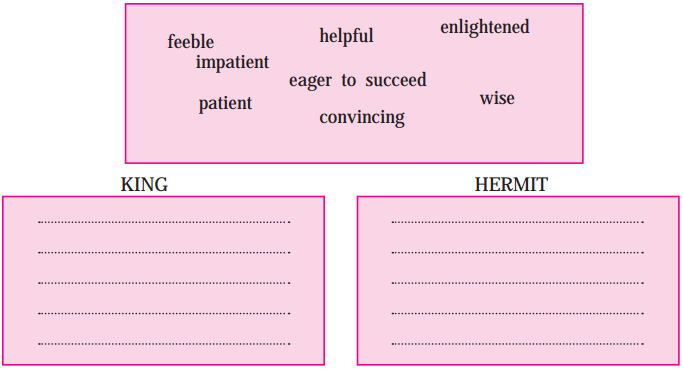
KiNG
impatient. eager to succeed, helpful
HERMIT
feeble, enlightened, patient, convincing, wise
Question 4
Maharashtra Board Solution
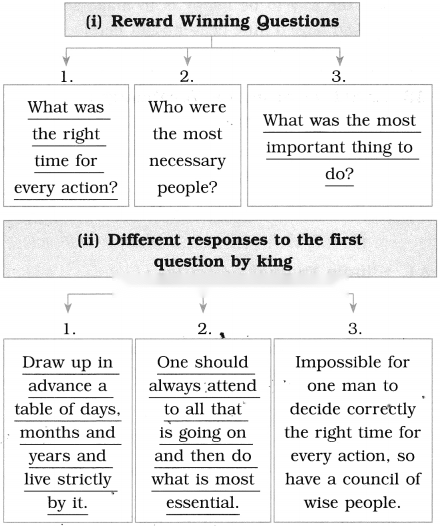
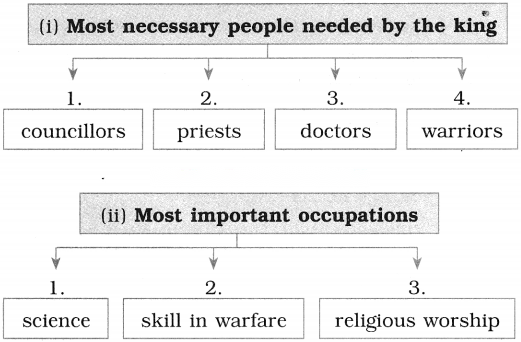
Complete the Tree diagrams associated with the happenings in the story.
Solution & Step-by-Step Answer:
Question 5
Maharashtra Board Solution
Write down in your notebook two points for each of the following. How do you know... (a) the learned advisers who came to the court confused the king. (b) the king was humble. (c) the king’s enemy was repentant. (d) the hermit was truly wise.
Solution & Step-by-Step Answer:
We come to know that the king was humble by the fact that he did not mind doing ordinary work such as digging. He did not use his authority as king to force the hermit to answer his questions. Instead he requested the hermit politely and was ready to go away if the hermit refused to answer his questions.
Question 6
Maharashtra Board Solution
Choose the correct answer and fill in the blanks. (a) “Varied” (Paragraph-3) means …………………… (i) different (ii) unnecessary (iii) unequal (iv) unimportant.
Solution & Step-by-Step Answer:
(a) different
(b) Many learned people came to the court and gave …………………… (c) The synonym of ‘convinced’ is …………………… (d) The King wanted to know the …………………… time to begin everything. (e) ‘‘I pray you to answer my question.’’ Here ‘pray’ means …………………… (f) Choose an adverb that collocates with “breathed ……………………
Question 7
Maharashtra Board Solution
Answer the following questions. (a) The learned people were sometimes divided in their opinions, different persons giving quite different answers; at other times, none of them gave an
Solution & Step-by-Step Answer:
They all suggested ways to look for an answer. Point out one example of each. Answer: To know the right time for every action: Draw up in advance a table of days, months and years and live strictly according to it. The people the king most needed: Councillors The most important occupation: Science.
(b) Though the hermit did not say anything to the king for some time, he did not ignore the king or treat him rudely in any way. Do you agree? What evidence of his politeness can you point out? What shows that he listened and responded to the king’s words? (c) The hermit ‘spoke only to common people’; so the king ‘put on simple clothes’. Do you think the king hoped to be mistaken for a common man, or was he just showing that he was a humble person? What shows that the hermit knew him to be the king? (d) Did the king behave as an ordinary person, rather than as a ruler, at the hermit’s hut? What shows it? Did he also act as a good, kind person? When did he do so? (e) Do you think the hermit knew, beforehand, not only about the king’s arrival but about the ambush by his enemy? Think a little about this and say what you really feel.
Question 8
Maharashtra Board Solution
Consider this list of the different things that happened and rearrange them in the order of time, that is, what happened first, what happened next and so on. Read the related paragraph again if you are uncertain. |

(a) The bearded man resolved to kill the king.
(b) The king went alone to see the hermit.
(c) The king executed the bearded man’s brother.
(d) The king spent the night at the hermit’s hut.
(e) The bearded man laid an ambush to kill the king.
(f) The king’s bodyguards recognised and wounded the bearded man.
(g) The bearded man came out of the ambush.
(b) The king executed the bearded man’s brother.
(a) The bearded man resolved to kill the king.
(c) The bearded man laid an ambush to kill the king.
(e) The bearded man came out of the ambush.
(d) The king’s bodyguards recognised and wounded the bearded man.
(f) The king spent the night at the hermit’s hut.
(g) The king went alone to see the hermit.
Question 9
Maharashtra Board Solution
Read the story in your own language, summarize the following aspects of the story in 4 to 5 lines each in your own language. Write it in your notebook. (a) King’s problem: ……………………
Solution & Step-by-Step Answer:
The King’s problem was that he wanted someone from his kingdom to give him the answers to three questions. (1) What was the right time to begin everything? (2) Who are the right people to listen to? (3) What was the most important thing to do?
(b) Attempts made to find a solution: ……………………
Question 10
Maharashtra Board Solution
(A) The following compound words from the story are spelt in a jumbled order. Rearrange the letters to make them meaningful. (1) a r e e t u k d n = …………………… (2) y o n n a e = …………………… (3) s t a p s i e m = …………………… (4) h e e d a r f o n b = …………………… (5) n e v h i g r e t y = …………………… (6) h e i l n e w a m = …………………… (7) d a d e b e r = ……………………
Solution & Step-by-Step Answer:
(1) a r e e t u k d n = undertake (2) y o n n a e = anyone (3) s t a p s i e m = pastimes (4) h e e d a r f o n b = beforehand (5) n e v h i g r e t y = everything (6) h e i l n e w a m = meanwhile (7) d a d e b e r = bearded
(B) From the story, find the collocations of the following.
Question 11
Maharashtra Board Solution
Say whether the Verbs underlined in the sentences are finite (limited by the number or person of the subject) or non-finite (not governed by the subject, number or person). (1) He decides to go to a hermit. (2) I have come to you, wise hermit. (3) He gave the reward to none. (4) The hermit was digging the ground. (5) I pray you to answer my questions. (6) ‘‘ Forgive me.’’ (7) The sun began to sink.
Solution & Step-by-Step Answer:
(1) decides – finite; to go – non-finite. (2) have come – finite; to ask, to answer-non- finite. (3) gave – finite; This sentence has no non-finite verb. (4) was – finite; digging – non-finite. (5) pray – finite: to answer – non-finite (6) forgive – finIte (7) began – finite; to sink – non-finite.
Question 12
Maharashtra Board Solution
Narrate an experience of your own that has helped you to realise that ‘Patience is bitter, but its fruit is sweet.’ Write it in your notebook, in about 20 lines.
Solution & Step-by-Step Answer:
Patience is bitter, but its fruit is sweet!
It was Rousseau who said, ‘Patience is bitter, but its fruit is sweet.’ I realized the truth of this statement when I was in Std. X. It was an important year for me. My school was far from my home. So were my classes. I had to spend a lot of time walking in order to reach either school or classes. This meant a lot of waste of precious time that I could use very well for study. I was an only child and my father had passed away four years ago. My mother would tell me, ‘Have patience. Things will work out.’ But I really could not understand her. The rainy months passed by with me trudging anxiously to school or to the classes. If I was lucky, someone would give me a lift, dy studies were suffering. I was lagging behind in keeping up with homework and revision. Then one day the postman delivered a letter. Mother read it in excitement. ‘You know what? There’s a good news. Your uncle from the US is coming to visit us. He is your dad’s brother. The last time he saw you was when you were j a baby.’ ‘Oh,’ I said, wondering how that could be good for us. On the contrary, I would have to take my uncle visiting and that would take up more of the time I required for earnest study. The day arrived. My uncle came over. A jolly fellow, full of stories and fun and small delightful gifts. In the afternoon I took his leave saying I had to go to school and then classes. ‘How are you going?’ he asked.
Question 13
Maharashtra Board Solution
After reading this story, develop a dialogue with 2 of your classmates about the characters in the story. Besides the tactful introduction to the conversation and write 8 to 10 sets of dialogues.
Solution & Step-by-Step Answer:
My self: Hey, did you like the story, ‘Three Questions’?
Student 1: Yes, I was particularly impressed with the king. He was very humble. He was eager to know more about life. My self: Yes, he did not claim that he knew everything just because he was king. Student 2: I liked the hermit. He was quite a cool character. My self: He was very wise. He knew beforehand that the king would come to him. He also knew the solution to the king’s problem, even before the incidents occurred. Student 1: Yes. And the surprising thing is that the king indirectly got the answers to his questions from a long-forgotten enemy. My self: The story is very cleverly written, woven around these three characters. One seeks answers to questions. One knows the answers to the questions. One is the medium through which the answers are given. Student 2: If the king’s bodyguards had not attacked the man, he would not have come to the hermit’s hut and met the king. My self: If the man had not been wounded and the king had not bandaged his wounds and saved his life, the man would not have forgiven him for a cruel wrongdoing in the past. Student 1: Yes, Leo Tolstoy wanted to give us the message of forgiveness and doing good even to our enemies. Through the three characters in the story and their interactions, the writer brought out his message very well. My sfelf : Indeed, a well-written story, and one from which we learn such a lot!
Question 14
Maharashtra Board Solution
From the library or Internet, read the story ‘How much land does a man need?’ by Leo Tolstoy and write a review of the same, covering the following points. Background of the story Characters Plot/Theme Climax Message/Moral
Solution & Step-by-Step Answer:
The climax of the story is that the person whom the king had wronged by executing his brother years ago, finally forgave him. This is because the king had saved his life.
(a) rose got up from a sitting or kneeling position a flower By saving the life of the wounded man, who was in fact the king’s enemy, the king passes on to us the message that the most important thing in life is to do good to others, because it is for that purpose alone we were sent into this life.
Question 15
Maharashtra Board Solution
What final suggestion did the last group of learned men offer regarding the best time?
Solution & Step-by-Step Answer:
The last group of learned men said that it was impossible for one man to decide correctly the right time for every action and that the king should, instead, have a council of wise people, who would help him to fix the proper time for everything.
Question 16
Maharashtra Board Solution
Choose the correct question tag from the alternatives and write the complete
Solution & Step-by-Step Answer:
He would give a great reward,… (a) would he? (b) won’t he? (c) wouldn’t he? (d) will he? Answer: He would give a great reward, wouldn’t he?
Question 17
Maharashtra Board Solution
Pick out the finite and non-finite verbs from the sentences: (1) He always knew the right time to begin everything. (2) He was right in thinking this way.
Solution & Step-by-Step Answer:
(1) knew – finite; to begin – non-finite (2) was – finite; thinking – non-finite.
Question 18
Maharashtra Board Solution
They all gave different answers. (Rewrite using the opposite of ‘different’.)
Solution & Step-by-Step Answer:
None of them gave similar answers.
Question 19
Maharashtra Board Solution
He was convinced that he was right. (Pick out the clauses and name them.)
Solution & Step-by-Step Answer:
He was convinced – Main clause. that he was right – Subordinate Noun clause.
Question 20
Maharashtra Board Solution
What is the right time, according to you?
Solution & Step-by-Step Answer:
According to me, the right time is the present. Yesterday cannot be undone. Tomorrow cannot be predicted. Therefore, the only right time is today, i.e. the present.
Question 21
Maharashtra Board Solution
The learned advisers who came to the court confused the king. How do you know?
Solution & Step-by-Step Answer:
By giving the king’ different answers, the learned advisers who came to the court confused the king. None of the answers given by the advisers was complete or comprehensive. From their answers it is quite clear to me that each one of them dwelt on part of the truth and not the whole truth.
Question 22
Maharashtra Board Solution
Read the following passage and do the activities: (1) Arrange these incidents in proper sequence: (a) The king asked the hermit the three questions. (b) The king saw that the hermit was digging the ground. *(c) The king went alone to see the hermit. (d) The hermit greeted the king.
Solution & Step-by-Step Answer:
(c) The king went alone to see the hermit. (b) The king saw that the hermit was digging the ground. (d) The hermit greeted the king. (a) The king asked the liermit the three questions.
Question 23
Maharashtra Board Solution
State whether the following statements are True or False: (The answers are given directly and underlined.)
Solution & Step-by-Step Answer:
(a) The hermit was well known. True (b) The hermit spoke usually to everyone. False (c) The hermit dug the ground easily False (d) The hermit was strong. False
Question 24
Maharashtra Board Solution
Why did the king go to the hermit in disguise?
Solution & Step-by-Step Answer:
The hermit spoke only to common people. The king knew this. So he wanted to present himself as a common man and elicit answers for his questions. That is why he went to the hermit in disguise.
Question 25
Maharashtra Board Solution
Write from the passage synonyms for: (a) famous (b) weak.
Solution & Step-by-Step Answer:
(a) renowned (b) frail.
Question 26
Maharashtra Board Solution
The following compound words from the passage are spelt in jumbled order. Rearrange the letters to make them meaningful.
Solution & Step-by-Step Answer:
(i) d ubgyroad = bodyguard (ii) frawera = warfare
Question 27
Maharashtra Board Solution
The king was convinced by none of these answers. (Rewrite beginning with ‘None of these answers …’.)
Solution & Step-by-Step Answer:
None of these answers convinced the king.
Question 28
Maharashtra Board Solution
State whether the following statements are True or False:
Solution & Step-by-Step Answer:
(a) The king got irritated with the hermit. False (b) The hermit answered all the questions of the king. False (c) It was evening when the king met the hermit. True (d) The hermit was full of energy. False
Question 29
Maharashtra Board Solution
Who said to whom? (a) Let me take the spade and work a while for you. (b) Now rest a while and let me work a bit.
Solution & Step-by-Step Answer:
(a) The king said this to the hermit. (b) The hermit said this to the king.
Question 30
Maharashtra Board Solution
How did the hermit respond to the king’s questions?
Solution & Step-by-Step Answer:
The hermit listened to the king but said nothing. He just spat on his hand and continued digging. Later, when the king felt sorry for him, the hermit handed the king the spade to take over. When the king asked his question again, instead of giving an answer, the hermit rose and stretched out his hand for the spade.
Question 31
Maharashtra Board Solution
In what state was the bearded man when he arrived?
Solution & Step-by-Step Answer:
The bearded man was wounded. He fainted. He had a large wound in his stomach. The bleeding j would not stop and the wound had to be bandaged and re-bandaged. The bandage was soaked with blood. The bearded man was indeed in a very serious condition when he arrived.
Question 32
Maharashtra Board Solution
Choose adverbs/adjectives that collocate with these words: (1) moaning: (a) profusely (b) heavily (c) feebly (d) sadly.
Solution & Step-by-Step Answer:
(i) moaning feebly
(ii) blood:
Question 33
Maharashtra Board Solution
Complete the following table with meanings from the brackets: (Meanings: go down below the surface of a liquid, to cease work in order to relax or sleep, a piece of furniture for resting, a garden plot, got up from a sitting or kneeling position, drop downwards, the remaining part, a flower) (The answers are given directly in the table.)
Solution & Step-by-Step Answer:
Words Meaning in the text Other meaning (a) rose got up from a sitting or kneeling position a flower (b) sink drop downwards go down below the surface of a liquid (c) bed a garden plot a piece of furniture for resting (d) rest to cease work in order to relax or sleep the remaining part
Question 34
Maharashtra Board Solution
Pick out the finite and non-finite verbs from the sentences: (a) The king continued to dig.
Solution & Step-by-Step Answer:
(a) continued – finite; to dig – non-finite.
Question 35
Maharashtra Board Solution
‘Here comes someone running,’ said the hermit. (Rewrite in indirect speech.)
Solution & Step-by-Step Answer:
The hermit said that there came someone running.
Question 36
Maharashtra Board Solution
He fainted and fell to the ground. (Rewrite using a present participle in place of the underlined word.)
Solution & Step-by-Step Answer:
Fainting, he fell to the ground.
Question 37
Maharashtra Board Solution
The blood would not stop flowing. (Rewrite without ‘not’.)
Solution & Step-by-Step Answer:
The blood flowed continuously.
Question 38
Maharashtra Board Solution
Say whether the following statements are True or False: (The answers are given directly and underlined.)
Solution & Step-by-Step Answer:
(a) The person the king saved and helped was his enemy. True (b) The hermit helped the king. True (c) When he awoke, the king immediately realized where he was. False (d) The king had gone out for a walk. False
Question 39
Maharashtra Board Solution
Why had the wounded man asked for the king’s pardon?
Solution & Step-by-Step Answer:
The wounded man had resolved to kill the king. In try ng to do so. he was wounded and the king saved his life. Hence the wounded man asked for the king’s pardon.
Question 40
Maharashtra Board Solution
Write two points for the following: The king’s enemy was repentant. How do you know?
Solution & Step-by-Step Answer:
The king’s enemy tells him that since the king had saved his life, if he (the king) wished it, he would serve him all his life. This shows that he was repentant.
Question 41
Maharashtra Board Solution
Match the words with their opposites:
Solution & Step-by-Step Answer:
Answer: (a) familiar X strange (b) forget X remember. (c) firm X weak (d) everything x nothing.
Question 42
Maharashtra Board Solution
Forgive me,’ said the beard€d man. (Rewrite In indirect speech.)
Solution & Step-by-Step Answer:
The bearded man asked him (the king) to forgive him.
Question 43
Maharashtra Board Solution
What qualities of the king do you notice in this passage?
Solution & Step-by-Step Answer:
Even though he was king, he did not hesitate to carry the wounded man into the hut. He was humble enough to sleep in a hut next to a wounded man. All this shows, that the king was not proud of his royal position. He was, at heart, kind, considerate and humane.
Question 44
Maharashtra Board Solution
State whether the following statements are True or False: (The answers are given directly and underlined.)
Solution & Step-by-Step Answer:
(1) The hermit pitied the king’s weakness. False (2) The king received all answers from the hermit. True (3) The present is the only time when we have power. True (4) To do good to people is the purpose of our life. True
Question 45
Maharashtra Board Solution
How did the hermit finally point out the answers to the king’s questions?
Solution & Step-by-Step Answer:
The hermit finally pointed out the answers to the king’s questions by referring to incidents that the king actually experienced when he visited the hermit. With the help of each incident, the- hermit explained to the king what the most important time was,’ who the most important person was and what the most important action was.
Question 46
Maharashtra Board Solution
Summarize the following aspect in 4 to 5 lines each in your own words: (a) The
Solution & Step-by-Step Answer:
Answer: The king finally got the answers to his questions. The most important time was when the king was digging the beds and when he was attending to the wounded man. Otherwise he would not have met the man and the man would have died. The most important action was bandaging the man’s wounds. If the man had died, he would not have made peace with the king. The most important man was the hermit, who made it possible for the king to find the answers to his questions.
Question 47
Maharashtra Board Solution
Match the following: ‘A’ ‘B’ (1) one who heals – (a) sower (2) one who lives alone in a forest – (b) physician (3) one who plants seeds – (c) enemy (4) one who is actively opposed to you – (d) hermit
Solution & Step-by-Step Answer:
(1) one who heals – physician (2) one who lives alone in a forest – hermit (3) one who plants seeds – sower (4) one who is actively opposed to you – enemy
Question 48
Maharashtra Board Solution
He was the most important man. (Rewrite as a question.)
Solution & Step-by-Step Answer:
Wasn’t he the most important man?
Question 49
Maharashtra Board Solution
There is only one time that is important. (Rewrite using ‘no’.)
Solution & Step-by-Step Answer:
There is no other time that is important.
Question 50
Maharashtra Board Solution
For that purpose alone were you sent into this world. (Rewrite beginning with the subject ‘you’.)
Solution & Step-by-Step Answer:
You were sent into this world for that purpose alone.
Question 51
Maharashtra Board Solution
What qualities of the king stand out as he forgave his enemy?
Solution & Step-by-Step Answer:
As the king forgave his enemy, we see him as a very humane person, as a person who believes in peace and forgiveness and one who shows mercy to even those who would wish to harm him.
Question 52
Maharashtra Board Solution
(1) Pick out the infinitives in the given sentence and make your own sentence: He would give a reward to anyone who would teach him how he might know the most important thing to do. (2) Write two compound words from the lesson. (3) Punctuate the sentence: ive nothing to forgive you for said the king (4) Make a meaningful sentence using the phrase: to feel sorry for (someone) (5) Find out two hidden words in the given word: approaching (6) Spot the error and rewrite the correct sentence: The king convinced none of these answers. (7) Write the present participle forms of the given verbs: let, beg (run) (8) Write these words in alphabetical order: beforehand, bearded, breathed, bodyguard.
Solution & Step-by-Step Answer:
(1) Infinitive: to do Sentence: We were asked to do a simple activity before the session began. (2) undertake, warfare (3) T ve nothing to forgive you for,” said the king. (4) Feeling sorry for the poor man, I gave him some food to eat. (5) approach, aching (6) The king was convinced by none of these answers. (7) letting, begging (running) (8) bearded, beforehand, bodyguard, breathed.
Question 53
Maharashtra Board Solution
(1) Rewrite using indirect narration: “O wise one! Could you give me the answer to my three questions?” the king said to the hermit. (2) Complete the following word chain with words from the lesson: we..... →..... →..... →..... (3) Rewrite beginning with the underlined part: The hermit again gave no
Solution & Step-by-Step Answer:
(4) Make sentences of your own to show the difference of meaning between the words: ‘pray’ and ‘prey’. Answer: (1) Addressing the hermit as the ‘wise one’, the king asked him if he could give him the answer to his three questions. (2) weak → king → ground → different. (3) Again no answer was given by the hermit. (4) (a) Every night the little boy would kneel by his bedside and pray.
(b) The vulture is a bird of prey. |